Méndez Isabel, Díaz-Muñoz Mauricio
Departamento de Neurobiología Celular y Molecular, Instituto de Neurobiología, Universidad Nacional Autónoma de México, Querétaro, Mexico.
Front Endocrinol (Lausanne). 2018 Mar 15;9:93. doi: 10.3389/fendo.2018.00093. eCollection 2018.
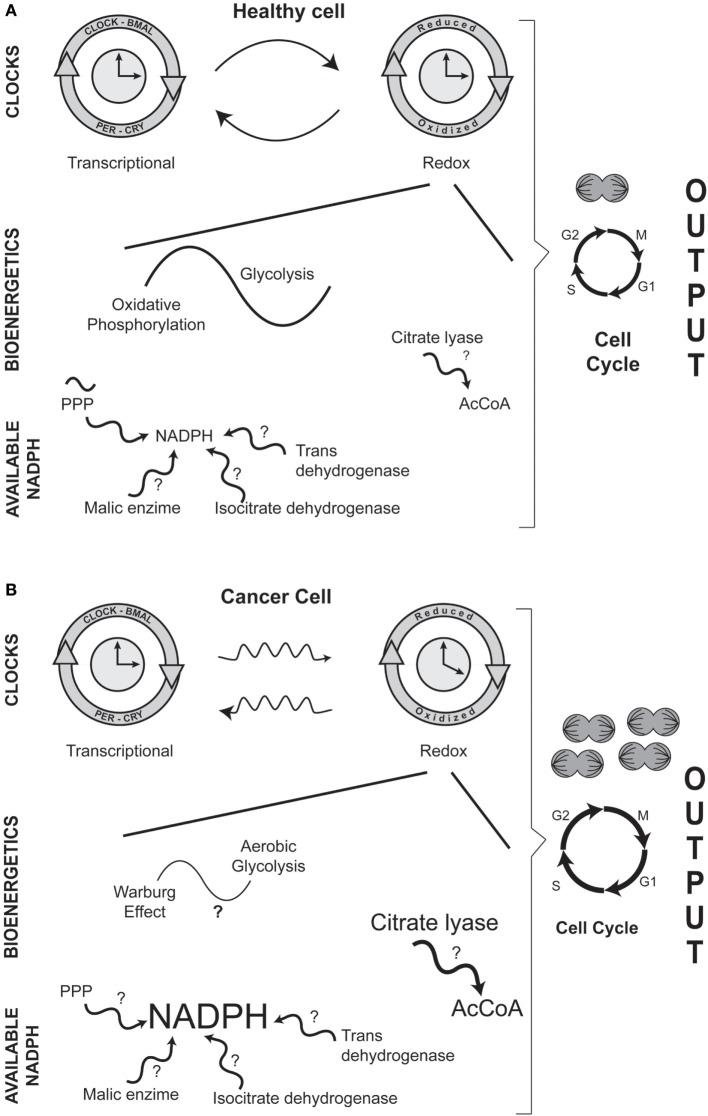
Physiological activity in healthy conditions requires a coordinated interaction between the molecular circadian clock and the network of biochemical pathways. An important metabolic parameter in the interface between these two entities is the redox state. Among the redox coenzymes that regulate the fluxes of enzymatic reactions is the NADP/NADPH pair. Indeed, the main biosynthetic pathways need NADPH to serve as an electron donor for cellular anabolic transformations. The existence of a metabolic circadian clock is well established, and it was first identified in mammalian red blood cells. The metabolic circadian clock is independent of transcriptional activity and is sustained by the enzymatic complex peroxiredoxin/thioredoxin/NADPH. This complex shows 24-h redox fluctuations metabolizing HO in various tissues and species (fungi, insects, and mammals). Although this NADPH-sensitive metabolic clock is autonomous in erythrocytes that lack a nucleus, it functions in concert with the transcriptional circadian clock in other cell types to accomplish the task of timing cellular physiology. During carcinogenesis, circadian alterations influence cell cycle onset and promote tumoral growth. These alterations also deregulate cellular energetics through a process known as aerobic glycolysis, or the Warburg effect. The Warburg effect is a typical response of cancer cells in which the metabolism turns into glycolysis even in the presence of functional mitochondria. This alteration has been interpreted as a cellular strategy to increase biomass during cancer, and one of its main factors is the availability of NADPH. This minireview explores the potential role of NADPH as a circadian and cancer-promoting metabolite.
在健康状态下,生理活动需要分子生物钟与生化途径网络之间进行协调互动。这两个实体之间相互作用的一个重要代谢参数是氧化还原状态。在调节酶促反应通量的氧化还原辅酶中,NADP/NADPH对是其中之一。事实上,主要的生物合成途径需要NADPH作为细胞合成代谢转化的电子供体。代谢生物钟的存在已得到充分证实,它最初是在哺乳动物红细胞中被发现的。代谢生物钟独立于转录活性,并由过氧化物酶/硫氧还蛋白/NADPH酶复合物维持。这种复合物在各种组织和物种(真菌、昆虫和哺乳动物)中表现出24小时的氧化还原波动,代谢过氧化氢。尽管这种对NADPH敏感的代谢生物钟在无细胞核的红细胞中是自主的,但它在其他细胞类型中与转录生物钟协同发挥作用,以完成调节细胞生理活动时间的任务。在致癌过程中,生物钟改变会影响细胞周期起始并促进肿瘤生长。这些改变还通过一种称为有氧糖酵解或瓦伯格效应的过程使细胞能量代谢失调。瓦伯格效应是癌细胞的一种典型反应,即即使在存在功能正常的线粒体的情况下,代谢也会转变为糖酵解。这种改变被解释为癌症期间增加生物量的一种细胞策略,其主要因素之一是NADPH的可用性。本综述探讨了NADPH作为一种生物钟调节和促进癌症的代谢物的潜在作用。