Caba Mario, González-Mariscal Gabriela, Meza Enrique
Centro de Investigaciones Biomédicas, Universidad Veracruzana, Xalapa, Mexico.
Centro de Investigación en Reproducción Animal, CINVESTAV-Universidad Autónoma de Tlaxcala, Tlaxcala, Mexico.
Front Endocrinol (Lausanne). 2018 Mar 15;9:106. doi: 10.3389/fendo.2018.00106. eCollection 2018.
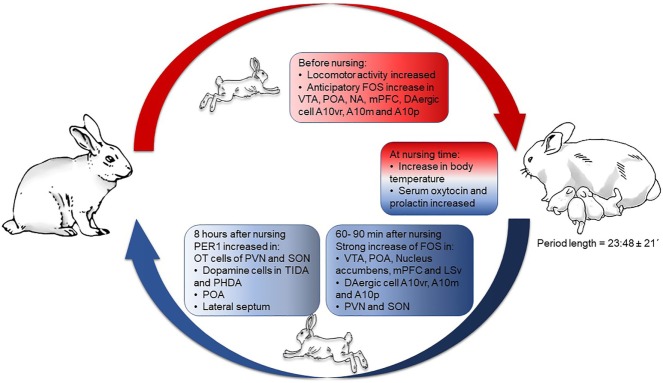
Clock gene oscillations are necessary for a successful pregnancy and parturition, but little is known about their function during lactation, a period demanding from the mother multiple physiological and behavioral adaptations to fulfill the requirements of the offspring. First, we will focus on circadian rhythms and clock genes in reproductive tissues mainly in rodents. Disruption of circadian rhythms or proper rhythmic oscillations of clock genes provoke reproductive problems, as found in clock gene knockout mice. Then, we will focus mainly on the rabbit doe as this mammal nurses the young just once a day with circadian periodicity. This daily event synchronizes the behavior and the activity of specific brain regions critical for reproductive neuroendocrinology and maternal behavior, like the preoptic area. This region shows strong rhythms of the PER1 protein (product of the Per1 clock gene) associated with circadian nursing. Additionally, neuroendocrine cells related to milk production and ejections are also synchronized to daily nursing. A threshold of suckling is necessary to entrain once a day nursing; this process is independent of milk output as even virgin does (behaving maternally following anosmia) can display circadian nursing behavior. A timing motivational mechanism may regulate such behavior as mesolimbic dopaminergic cells are entrained by daily nursing. Finally, we will explore about the clinical importance of circadian rhythms. Indeed, women in chronic shift-work schedules show problems in their menstrual cycles and pregnancies and also have a high risk of preterm delivery, making this an important field of translational research.
生物钟基因振荡对于成功怀孕和分娩是必要的,但对于它们在哺乳期的功能却知之甚少,哺乳期要求母亲进行多种生理和行为适应以满足后代的需求。首先,我们将主要关注啮齿动物生殖组织中的昼夜节律和生物钟基因。昼夜节律或生物钟基因的正常节律振荡被破坏会引发生殖问题,这在生物钟基因敲除小鼠中已得到证实。然后,我们将主要聚焦于母兔,因为这种哺乳动物每天仅在昼夜节律周期时哺育一次幼崽。这一日常活动使对生殖神经内分泌学和母性行为至关重要的特定脑区的行为和活动同步,比如视前区。该区域显示出与昼夜节律性哺育相关的PER1蛋白(Per1生物钟基因的产物)的强烈节律。此外,与乳汁分泌和排出相关的神经内分泌细胞也与每日哺育同步。每日一次哺育需要一定的哺乳阈值;这个过程与乳汁分泌量无关,因为即使是未生育的母兔(在嗅觉缺失后表现出母性行为)也能表现出昼夜节律性哺育行为。一种定时动机机制可能调节这种行为,因为中脑边缘多巴胺能细胞会被每日哺育所调节。最后,我们将探讨昼夜节律的临床重要性。确实,长期从事轮班工作的女性在月经周期和怀孕方面存在问题,并且早产风险也很高,这使得这成为转化研究的一个重要领域。