Moravac Catherine Claire
Department of Medical Imaging, Faculty of Medicine, University of Toronto, Toronto, ON, Canada.
Front Public Health. 2018 Feb 28;6:30. doi: 10.3389/fpubh.2018.00030. eCollection 2018.
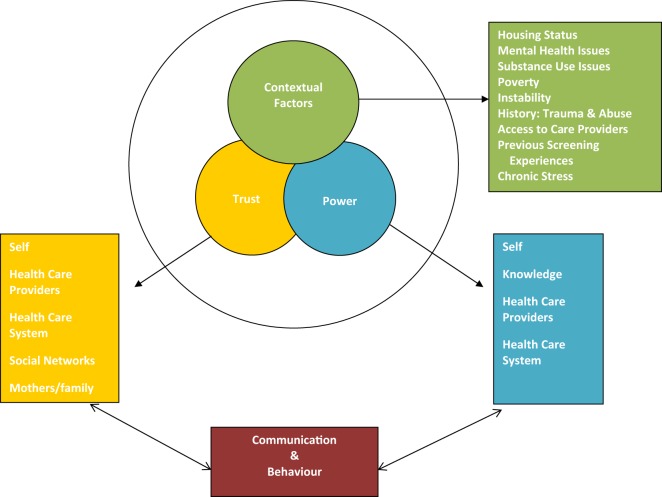
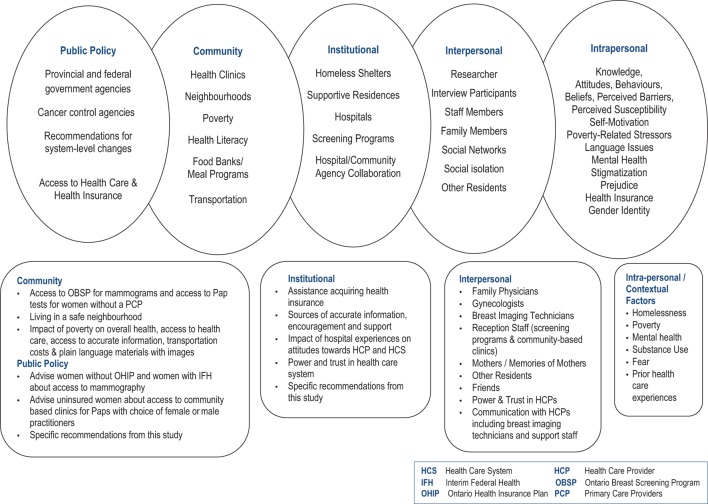
This study conducted in Toronto, Canada, explored the perceptions of women living in homeless shelters and women with severe mental health challenges about the factors influencing their decision-making processes regarding breast and cervical cancer screening. Twenty-six in-depth qualitative interviews were conducted. The objectives of this research were (i) to provide new insights about women's decision-making processes, (ii) to describe the barriers to and facilitators for breast and cervical cancer screening, and (iii) to offer recommendations for future outreach, education, and screening initiatives developed specifically for under/never-screened marginalized women living in urban centers. This exploratory study utilized thematic analysis to broaden our understanding about women's decision-making processes. A constructed ontology was used in an attempt to understand and describe participants' constructed realities. The epistemological framework was subjective and reflected co-created knowledge. The approach was hegemonic, values-based, and context-specific. The aim of the analysis was to focus on meanings and actions with a broader view to identify the interplay between participants' narratives and social structures, medical praxis, and policy implications. Results from 26 qualitative interviews conducted in 2013-2014 provided insights on both positive and negative prior cancer screening experiences, the role of power and trust in women's decision-making, and areas for improvement in health care provider/patient interactions. Outcomes of this investigation contribute to the future development of appropriately designed intervention programs for marginalized women, as well as for sensitivity training for health care providers. Tailored and effective health promotion strategies leading to life-long cancer screening behaviors among marginalized women may improve clinical outcomes, decrease treatment costs, and save lives.
这项在加拿大多伦多开展的研究,探讨了居住在收容所的女性以及有严重心理健康问题的女性,对于影响她们在乳腺癌和宫颈癌筛查决策过程的因素的看法。研究进行了26次深度定性访谈。本研究的目的包括:(i)提供有关女性决策过程的新见解;(ii)描述乳腺癌和宫颈癌筛查的障碍与促进因素;(iii)为未来专门针对城市中心未接受筛查或从未接受筛查的边缘化女性开展的外展、教育及筛查举措提供建议。这项探索性研究采用主题分析法来拓宽我们对女性决策过程的理解。运用建构本体论来试图理解和描述参与者构建的现实。认识论框架是主观的,反映了共同创造的知识。该方法具有霸权性、基于价值观且因地制宜。分析的目的是从更广泛的视角关注意义和行动,以识别参与者的叙述与社会结构、医疗实践及政策影响之间的相互作用。2013年至2014年进行的26次定性访谈结果,揭示了之前癌症筛查的正反两方面经历、权力和信任在女性决策中的作用,以及医疗服务提供者与患者互动方面有待改进的领域。这项调查的结果有助于为边缘化女性设计合适的干预项目,以及为医疗服务提供者开展敏感性培训。制定量身定制且有效的健康促进策略,促使边缘化女性养成终身癌症筛查行为,可能会改善临床结果、降低治疗成本并挽救生命。