University of California, Davis, Department of Communication, One Shields Avenue, Davis, CA 95616, USA.
University of California San Francisco, Center for Vulnerable Populations, Division of General Internal Medicine, San Francisco, CA 94143, USA.
Prev Med. 2019 Sep;126:105751. doi: 10.1016/j.ypmed.2019.105751. Epub 2019 Jun 19.
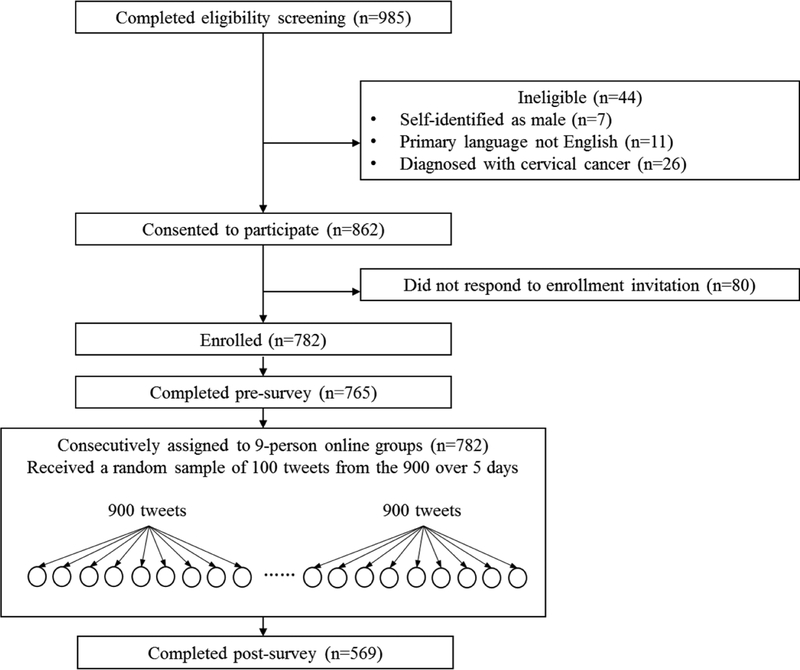
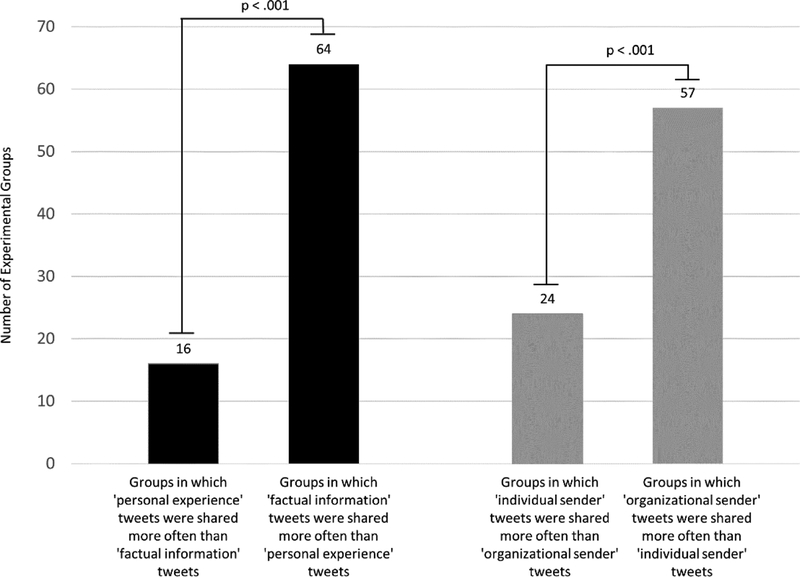
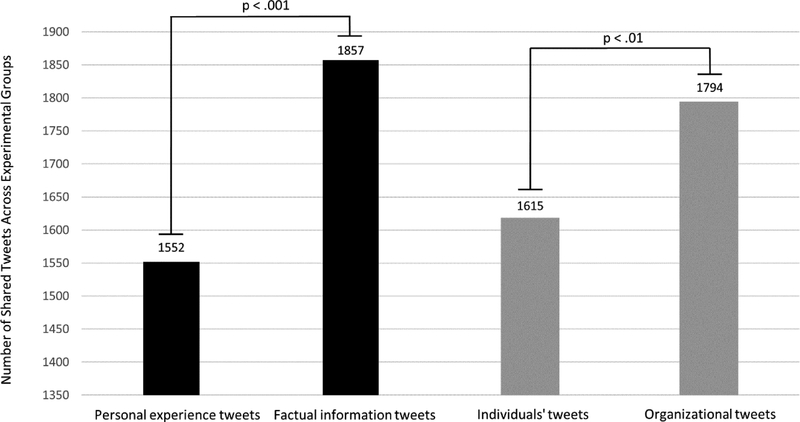
Social media has become a valuable tool for disseminating cancer prevention information. However, the design of messages for achieving wide dissemination remains poorly understood. We conducted a multi-method study to identify the effects of sender type (individuals or organizations) and content type (personal experiences or factual information) on promoting the spread of cervical cancer prevention messages over social media. First, we used observational Twitter data to examine correlations between sender type and content type with retweet activity. Then, to confirm the causal impact of message properties, we constructed 900 experimental tweets according to a 2 (sender type) by 2 (content type) factorial design and tested their probabilities of being shared in an online platform. A total of 782 female participants were randomly assigned to 87 independent 9-person online groups and each received a unique message feed of 100 tweets drawn from the 4 experimental cells over 5 days. We conducted both tweet-level and group-level analyses to examine the causal effects of tweet properties on influencing sharing behaviors. Personal experience tweets and organizational senders were associated with more retweets. However, the experimental study revealed that informational tweets were shared significantly more (19%, 95% CI: 11 to 27) than personal experience tweets; and organizational senders were shared significantly more (10%, 95% CI: 3 to 18) than individual senders. While rare personal experience messages can achieve large success, they are generally unsuccessful; however, there is a reproducible causal effect of messages that use organizational senders and factual information for achieving greater peer-to-peer dissemination.
社交媒体已成为传播癌症预防信息的宝贵工具。然而,对于实现广泛传播的信息设计仍了解甚少。我们进行了一项多方法研究,以确定发送者类型(个人或组织)和内容类型(个人经历或事实信息)对促进社交媒体上宫颈癌预防信息传播的影响。首先,我们使用观察性 Twitter 数据来检验发送者类型和内容类型与转发活动之间的相关性。然后,为了确认消息属性的因果影响,我们根据 2(发送者类型)×2(内容类型)的因子设计构建了 900 条实验推文,并在一个在线平台上测试了它们被分享的概率。共有 782 名女性参与者被随机分配到 87 个独立的 9 人在线小组,每个小组在 5 天内收到来自 4 个实验单元的 100 条独特推文的独特消息Feed。我们进行了推文级和小组级分析,以检验推文属性对影响分享行为的因果效应。个人经历推文和组织发送者与更多的转发相关。然而,实验研究表明,信息性推文的分享比例明显更高(19%,95%置信区间:11 到 27),而个人经历推文则明显较低;组织发送者的分享比例也明显更高(10%,95%置信区间:3 到 18),而个人发送者则较低。虽然罕见的个人经历消息可能会取得巨大成功,但它们通常并不成功;然而,使用组织发送者和事实信息来实现更大的点对点传播的消息确实存在可复制的因果效应。