Cui Xiaomeng, Li Zhangming, Zhao Yilei, Song Anqi, Shi Yunbo, Hai Xin, Zhu Wenliang
The higher educational key laboratory for Measuring & Control Technology and Instrumentations of Heilongjiang Province, Harbin, China.
School of Measurement-Control Tech & Communications Engineering, Harbin University of Science and Technology, Harbin, China.
PeerJ. 2018 Mar 26;6:e4551. doi: 10.7717/peerj.4551. eCollection 2018.
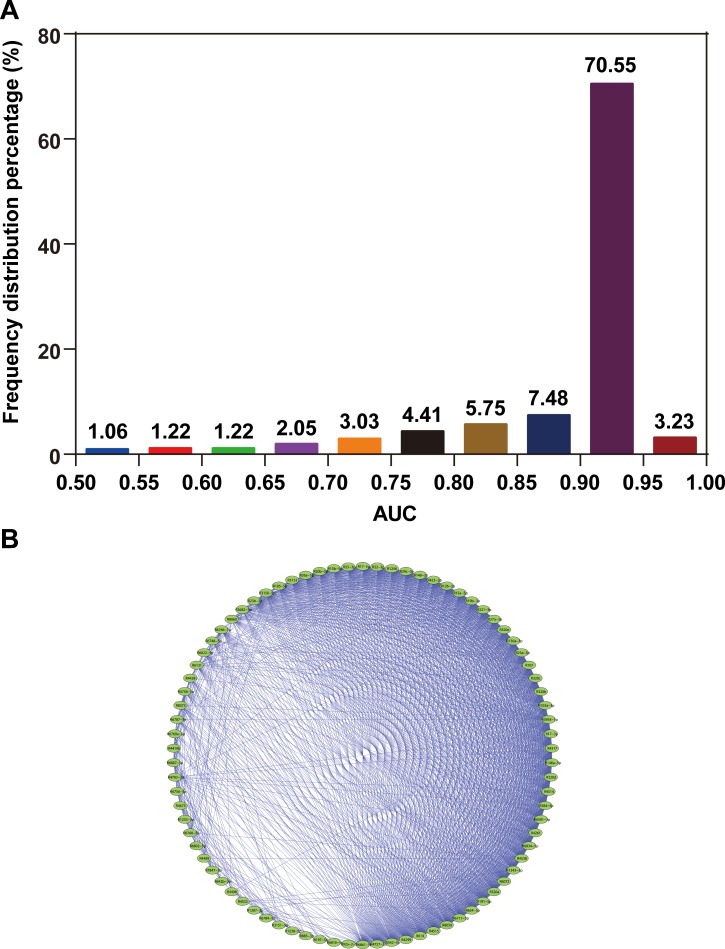
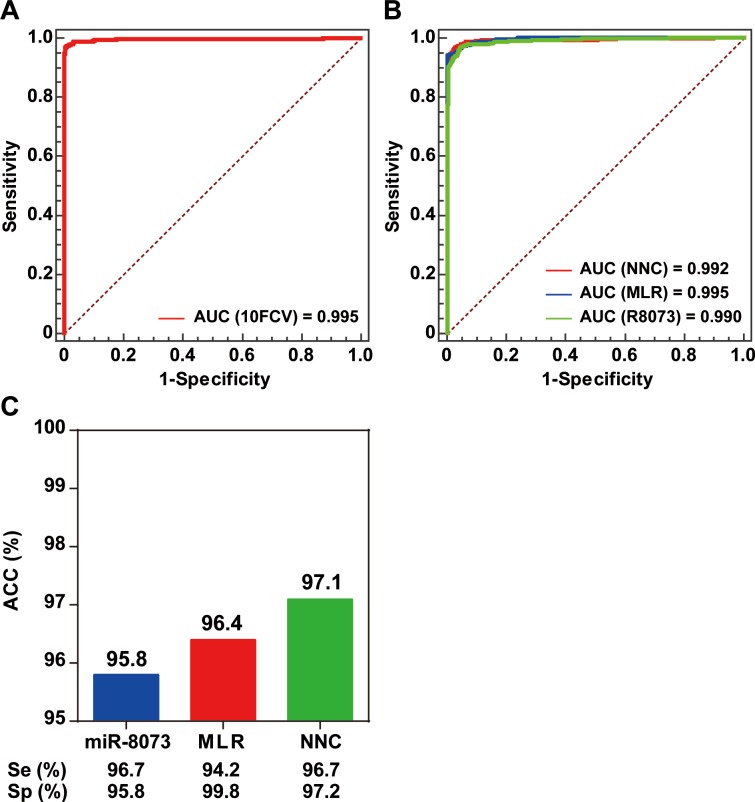
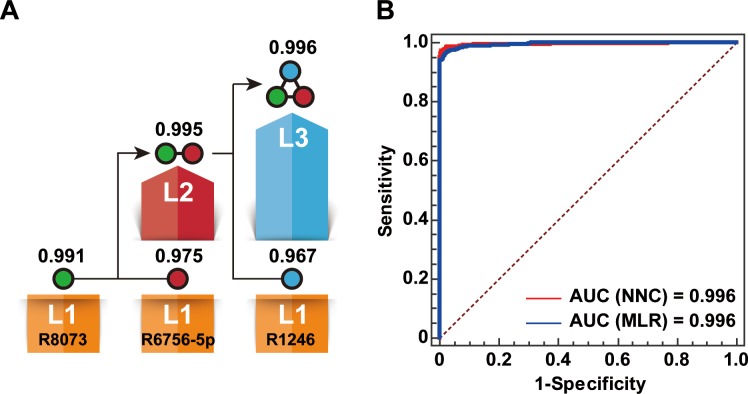
Prolonged life expectancy in humans has been accompanied by an increase in the prevalence of cancers. Breast cancer (BC) is the leading cause of cancer-related deaths. It accounts for one-fourth of all diagnosed cancers and affects one in eight females worldwide. Given the high BC prevalence, there is a practical need for demographic screening of the disease. In the present study, we re-analyzed a large microRNA (miRNA) expression dataset (GSE73002), with the goal of optimizing miRNA biomarker selection using neural network cascade (NNC) modeling. Our results identified numerous candidate miRNA biomarkers that are technically suitable for BC detection. We combined three miRNAs (miR-1246, miR-6756-5p, and miR-8073) into a single panel to generate an NNC model, which successfully detected BC with 97.1% accuracy in an independent validation cohort comprising 429 BC patients and 895 healthy controls. In contrast, at least seven miRNAs were merged in a multiple linear regression model to obtain equivalent diagnostic performance (96.4% accuracy in the independent validation set). Our findings suggested that suitable modeling can effectively reduce the number of miRNAs required in a biomarker panel without compromising prediction accuracy, thereby increasing the technical possibility of early detection of BC.
人类预期寿命的延长伴随着癌症患病率的增加。乳腺癌(BC)是癌症相关死亡的主要原因。它占所有确诊癌症的四分之一,全球每八名女性中就有一人受其影响。鉴于乳腺癌的高患病率,实际需要对该疾病进行人群筛查。在本研究中,我们重新分析了一个大型微小RNA(miRNA)表达数据集(GSE73002),目的是使用神经网络级联(NNC)建模优化miRNA生物标志物的选择。我们的结果确定了许多在技术上适合乳腺癌检测的候选miRNA生物标志物。我们将三种miRNA(miR-1246、miR-6756-5p和miR-8073)组合成一个单一的检测组以生成一个NNC模型,该模型在一个由429名乳腺癌患者和895名健康对照组成的独立验证队列中以97.1%的准确率成功检测出乳腺癌。相比之下,在多元线性回归模型中合并了至少七种miRNA以获得同等的诊断性能(独立验证集中的准确率为96.4%)。我们的研究结果表明,合适的建模可以有效减少生物标志物检测组中所需的miRNA数量,而不会影响预测准确性,从而增加乳腺癌早期检测的技术可能性。