Department of Biozentrum, University of Basel, Basel, Switzerland.
Department of Chemistry, Johns Hopkins University, Baltimore, MD, USA.
Nat Chem Biol. 2018 May;14(5):474-479. doi: 10.1038/s41589-018-0026-3. Epub 2018 Apr 2.
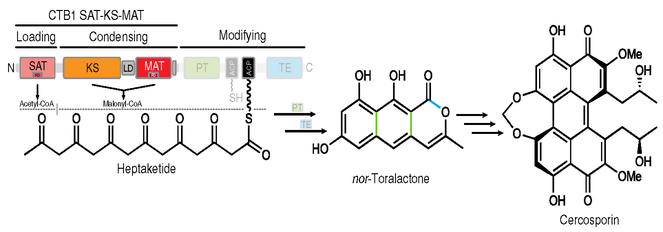
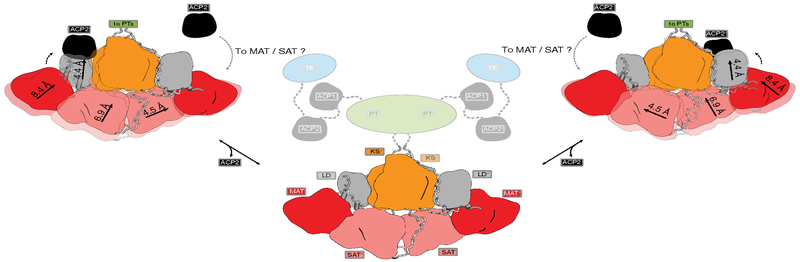
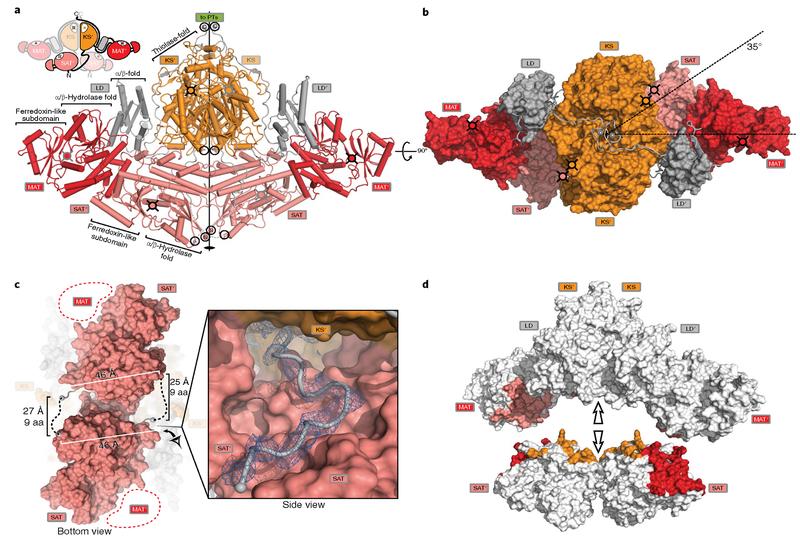
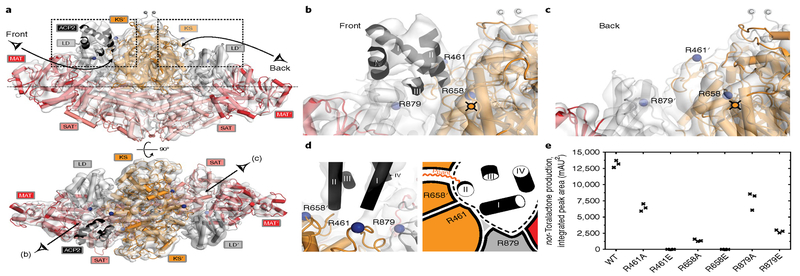
Polyketide synthases (PKSs) are microbial multienzymes for the biosynthesis of biologically potent secondary metabolites. Polyketide production is initiated by the loading of a starter unit onto an integral acyl carrier protein (ACP) and its subsequent transfer to the ketosynthase (KS). Initial substrate loading is achieved either by multidomain loading modules or by the integration of designated loading domains, such as starter unit acyltransferases (SAT), whose structural integration into PKS remains unresolved. A crystal structure of the loading/condensing region of the nonreducing PKS CTB1 demonstrates the ordered insertion of a pseudodimeric SAT into the condensing region, which is aided by the SAT-KS linker. Cryo-electron microscopy of the post-loading state trapped by mechanism-based crosslinking of ACP to KS reveals asymmetry across the CTB1 loading/-condensing region, in accord with preferential 1:2 binding stoichiometry. These results are critical for re-engineering the loading step in polyketide biosynthesis and support functional relevance of asymmetric conformations of PKSs.
聚酮合酶(PKSs)是微生物多酶复合物,用于生物合成具有生物活性的次级代谢产物。聚酮的生物合成由起始单元加载到完整酰基载体蛋白(ACP)上开始,并随后将其转移到酮合酶(KS)上。起始单元的加载可以通过多结构域加载模块或通过整合指定的加载结构域来实现,例如起始单元酰基转移酶(SAT),其结构整合到 PKS 中仍未得到解决。非还原型 PKS CTB1 的加载/缩合区域的晶体结构表明,假二聚体 SAT 有序地插入到缩合区域,SAT-KS 连接子辅助了这一过程。通过基于机制的 ACP 与 KS 的交联来捕获加载后的状态的冷冻电子显微镜显示,CTB1 的加载/缩合区域存在不对称性,与优先的 1:2 结合计量一致。这些结果对于重新设计聚酮生物合成中的加载步骤至关重要,并支持 PKSs 不对称构象的功能相关性。