Department of Public Health, Erasmus MC-University Medical Center Rotterdam, Rotterdam, South Holland, the Netherlands.
The Generation R Group, Erasmus MC- University Medical Center Rotterdam, Rotterdam, South Holland, the Netherlands.
PLoS One. 2018 Apr 3;13(4):e0194999. doi: 10.1371/journal.pone.0194999. eCollection 2018.
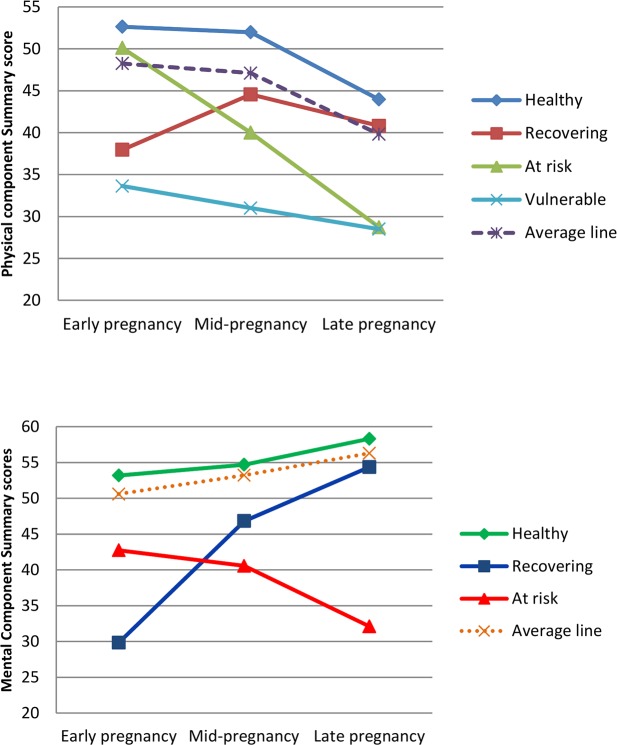
The objective of this study was to identify distinct trajectories and their predictors of health-related quality of life (HRQOL) of women during pregnancy in a prospective mother and child cohort. Analyses were based on 3936 Dutch pregnant women in Rotterdam area, the Netherlands. Information on potential predictors was collected in early pregnancy by questionnaire. Latent Class Mixture Modelling and Multinomial Logistic Regression were applied to assess the trajectory and predictors of HRQOL during pregnancy. HRQOL was measured by SF-12 in early, mid- and late pregnancy; physical and mental component summary (PCS-12/MCS-12) scores were calculated. Four physical HRQOL trajectories were identified: a healthy trajectory ('healthy') in 63.3%, consistently low ('vulnerable') in 10.8%; a small increase ('recovering') in 12.8% and a large decrease ('at risk') in 13.1%. Three mental HRQOL trajectories were identified: a healthy trajectory ('healthy') in 86.1%; a large increase ('recovering') in 7.5%; and a large decrease ('at risk') in 6.4%. Compared with healthy trajectories, the likelihood of following the 'vulnerable' physical HRQOL trajectory rather than a healthy trajectory was increased by daily fatigue(OR: 4.82[2.76, 8.40]), pelvic pain (OR:4.76[2.91, 7.78]) and back pain (OR:5.29[3.21, 8.70]); pregnancy-specific anxiety increased the likelihood of following the 'at risk' mental HRQOL trajectory (OR:7.95[4.84, 13.05]). Healthy physical and mental HRQOL trajectories during pregnancy were most common. Predictors indicative of poor HRQOL trajectories included pregnancy-related symptoms and anxiety.
本研究旨在确定特定轨迹及其预测因素,以了解荷兰鹿特丹地区前瞻性母婴队列中女性在怀孕期间的健康相关生活质量(HRQOL)。分析基于 3936 名荷兰孕妇,在孕早期通过问卷收集潜在预测因素的信息。应用潜在类别混合模型和多项逻辑回归来评估怀孕期间 HRQOL 的轨迹和预测因素。使用 SF-12 在孕早期、中期和晚期测量 HRQOL;计算生理和心理成分综合评分(PCS-12/MCS-12)。确定了四个生理 HRQOL 轨迹:63.3%的健康轨迹(“健康”),10.8%的持续低水平轨迹(“脆弱”);12.8%的小幅度增加轨迹(“恢复”)和 13.1%的大幅度下降轨迹(“有风险”)。确定了三个心理 HRQOL 轨迹:86.1%的健康轨迹(“健康”);7.5%的大幅度增加轨迹(“恢复”)和 6.4%的大幅度下降轨迹(“有风险”)。与健康轨迹相比,每日疲劳(OR:4.82[2.76, 8.40])、骨盆疼痛(OR:4.76[2.91, 7.78])和背部疼痛(OR:5.29[3.21, 8.70])使“脆弱”生理 HRQOL 轨迹而非健康轨迹的可能性增加;妊娠特异性焦虑增加了“有风险”心理 HRQOL 轨迹的可能性(OR:7.95[4.84, 13.05])。怀孕期间健康的生理和心理 HRQOL 轨迹最为常见。预示 HRQOL 轨迹不良的预测因素包括与妊娠相关的症状和焦虑。