Thomas Margaret L, Marcato Paola
Department of Pathology, Dalhousie University, Halifax, NS B3H 4G7, Canada.
Department of Microbiology and Immunology, Dalhousie University, Halifax, NS B3H 4G7, Canada.
Cancers (Basel). 2018 Apr 1;10(4):101. doi: 10.3390/cancers10040101.
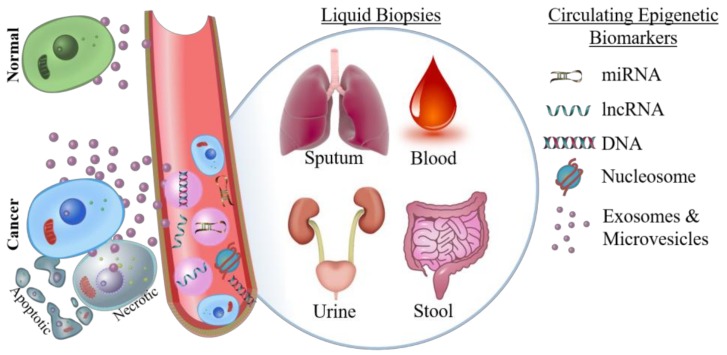
Aberrant epigenetic modifications are an early event in carcinogenesis, with the epigenetic landscape continuing to change during tumor progression and metastasis-these observations suggest that specific epigenetic modifications could be used as diagnostic and prognostic biomarkers for many cancer types. DNA methylation, post-translational histone modifications, and non-coding RNAs are all dysregulated in cancer and are detectable to various degrees in liquid biopsies such as sputum, urine, stool, and blood. Here, we will focus on the application of liquid biopsies, as opposed to tissue biopsies, because of their potential as non-invasive diagnostic tools and possible use in monitoring therapy response and progression to metastatic disease. This includes a discussion of septin-9 () DNA hypermethylation for detecting colorectal cancer, which is by far the most developed epigenetic biomarker assay. Despite their potential as prognostic and diagnostic biomarkers, technical issues such as inconsistent methodology between studies, overall low yield of epigenetic material in samples, and the need for improved histone and non-coding RNA purification methods are limiting the use of epigenetic biomarkers. Once these technical limitations are overcome, epigenetic biomarkers could be used to monitor cancer development, disease progression, therapeutic response, and recurrence across the entire cancer care continuum.
异常的表观遗传修饰是致癌作用中的早期事件,在肿瘤进展和转移过程中表观遗传格局持续变化——这些观察结果表明,特定的表观遗传修饰可作为多种癌症类型的诊断和预后生物标志物。DNA甲基化、组蛋白翻译后修饰和非编码RNA在癌症中均失调,并且在痰液、尿液、粪便和血液等液体活检样本中可不同程度地检测到。在此,我们将重点关注液体活检而非组织活检的应用,因为其作为非侵入性诊断工具的潜力以及在监测治疗反应和向转移性疾病进展方面的可能用途。这包括讨论用于检测结直肠癌的Sept9()DNA高甲基化,这是目前发展最为成熟的表观遗传生物标志物检测方法。尽管表观遗传生物标志物具有作为预后和诊断生物标志物的潜力,但诸如研究间方法不一致、样本中表观遗传物质总体产量低以及需要改进组蛋白和非编码RNA纯化方法等技术问题限制了表观遗传生物标志物的应用。一旦克服这些技术限制,表观遗传生物标志物可用于监测整个癌症治疗过程中的癌症发展、疾病进展、治疗反应和复发情况。