Division of Plant and Soil Sciences, West Virginia University, Morgantown, WV 26506, USA.
Department of Crop Sciences, University of Illinois at Urbana-Champaign, Urbana, IL 61801, USA.
Int J Mol Sci. 2018 Apr 2;19(4):1058. doi: 10.3390/ijms19041058.
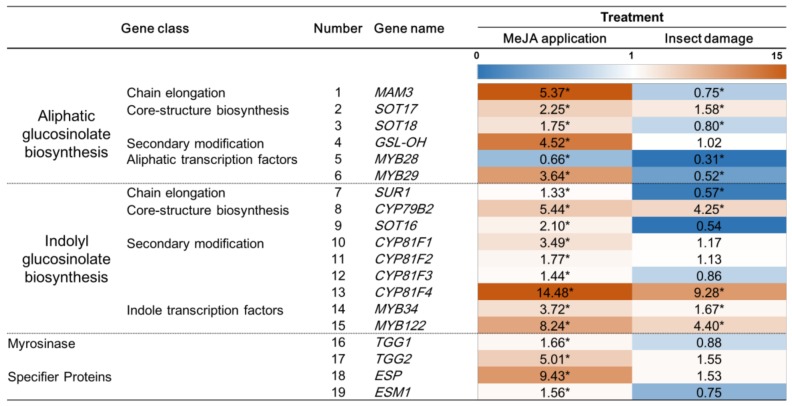
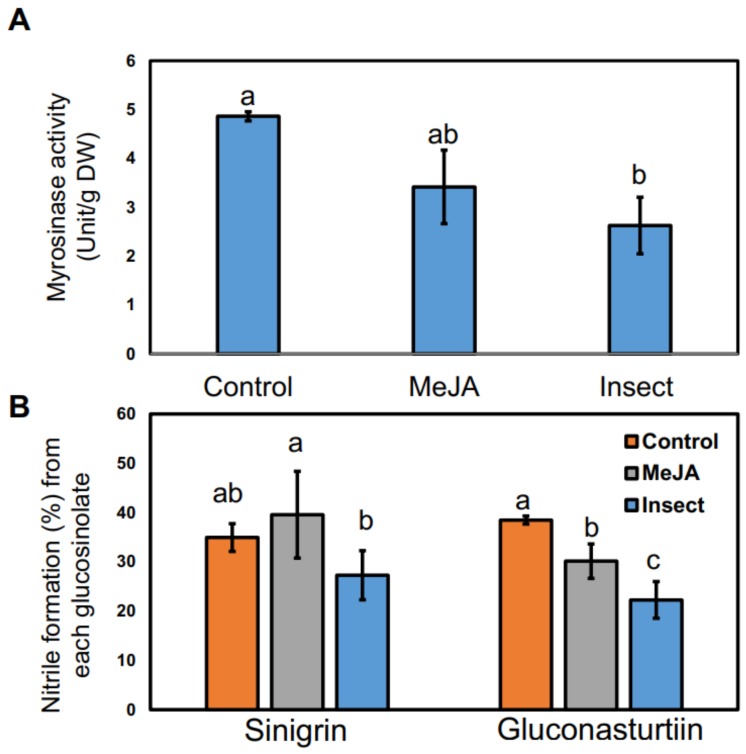
Methyl jasmonate (MeJA), synthesized in the jasmonic acid (JA) pathway, has been found to upregulate glucosinolate (GS) biosynthesis in plant species of the family. Exogenous application of MeJA has shown to increase tissue GS concentrations and the formation of myrosinase-mediated GS hydrolysis products (GSHPs). In vitro and in vivo assays have demonstrated the potential health-promoting effects of certain GSHPs. MeJA is also known to elicit and induce genes associated with defense mechanisms to insect herbivory in species. To investigate the relationship between MeJA-induced GS biosynthesis and insect defense, three treatments were applied to "Red Russian" kale ( var. ) seedlings: (1) a 250 µM MeJA leaf spray treatment; (2) leaf infestation with larvae of the cabbage looper ( (Hübner)); (3) control treatment (neither larval infestation nor MeJA application). Samples of leaf tissue from the three treatments were then assayed for changes in GS and GSHP concentrations, GS gene biosynthesis expression, and myrosinase activity. Major differences were observed between the three treatments in the levels of GS accumulation and GS gene expression. The insect-damaged samples showed significantly lower aliphatic GS accumulation, while both MeJA and infestation treatments induced greater accumulation of indolyl GS. The gene expression levels of , , and were significantly upregulated in samples treated with MeJA and insects compared to the control group, which explained the increased indolyl GS concentration. The results suggest that the metabolic changes promoted by MeJA application and the insect herbivory response share common mechanisms of induction. This work provides potentially useful information for kale pest control and nutritional quality.
茉莉酸甲酯(MeJA)在茉莉酸(JA)途径中合成,已被发现可上调 科植物种的硫代葡萄糖苷(GS)生物合成。外源施用 MeJA 已显示出可增加组织 GS 浓度和形成由糜蛋白酶介导的 GS 水解产物(GSHP)。体外和体内测定证明了某些 GSHP 的潜在促进健康的作用。MeJA 还已知可引发和诱导与 物种对昆虫取食的防御机制相关的基因。为了研究 MeJA 诱导的 GS 生物合成与昆虫防御之间的关系,将三种处理应用于“红色俄罗斯”羽衣甘蓝( var.)幼苗:(1)250 µM MeJA 叶片喷雾处理;(2)用小菜蛾((Hübner))幼虫叶片侵染;(3)对照处理(既无幼虫侵染也无 MeJA 应用)。然后对来自这三种处理的叶片组织样品进行 GS 和 GSHP 浓度、GS 基因生物合成表达和糜蛋白酶活性的变化分析。在 GS 积累和 GS 基因表达方面,三种处理之间观察到明显的差异。受损的昆虫样本显示出明显较低的脂肪族 GS 积累,而 MeJA 和 侵染处理都诱导了更大的吲哚 GS 积累。与对照组相比,用 MeJA 和昆虫处理的样品中 、和 的基因表达水平显著上调,这解释了吲哚 GS 浓度的增加。结果表明,MeJA 应用和昆虫取食响应所促进的代谢变化具有共同的诱导机制。这项工作为羽衣甘蓝害虫防治和营养质量提供了潜在的有用信息。