Gerontology Research Center, Faculty of Sport and Health Sciences, University of Jyväskylä, P.O. Box 35 (VIV), FIN-40014, Jyväskylä, Finland.
Institute for Molecular Medicine Finland (FIMM), University of Helsinki, Helsinki, Finland.
BMC Geriatr. 2018 Apr 4;18(1):83. doi: 10.1186/s12877-018-0775-6.
Biomarkers of biological aging - DNA methylation age (DNAm age) and leukocyte telomere length (LTL)- correlate strongly with chronological age across the life course. It is, however, unclear how these measures of cellular wear and tear are associated with muscle strength and functional capacity, which are known to decline with older age and are associated with mortality. We investigated if DNAm age and LTL were associated with body composition and physical functioning by examining 48 monozygotic twin sisters.
White blood cell DNAm age (predicted years) was calculated from Illumina 450 k BeadChip methylation data using an online calculator. DNAm age acceleration was defined from the residuals derived from a linear regression model of DNAm age on chronological age. LTL was measured by qPCR. Total body percentage of fat and lean mass were estimated using bioimpedance. Physical functioning was measured by grip strength, knee extension strength and by 10 m maximal walking speed test.
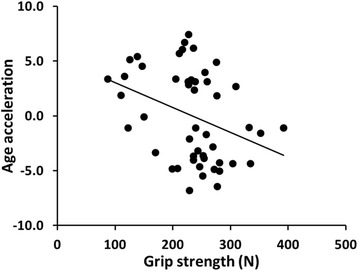
In all participants, DNAm age (58.4 ± 6.6) was lower than chronological age (61.3 ± 5.9 years). Pairwise correlations of monozygotic co-twins were high for DNAm age (0.88, 95% CI 0.79, 0.97), age acceleration (0.68, 95% CI 0.30, 0.85) and LTL (0.77, 95% CI 0.60, 0.94). Increased age acceleration i.e. faster epigenetic aging compared to chronological age was associated with lower grip strength (β = - 5.3 SE 1.9 p = 0.011), but not with other measures of physical functioning or body composition. LTL was not associated with body composition or physical functioning.
To conclude, accelerated DNAm age is associated with lower grip strength, a biomarker known to be associated with physiological aging, and which predicts decline in physical functioning and mortality. Further studies may clarify whether epigenetic aging explains the decline in muscle strength with aging or whether DNAm age just illustrates the progress of aging.
生物衰老的生物标志物——DNA 甲基化年龄(DNAm 年龄)和白细胞端粒长度(LTL)——在整个生命周期中与实际年龄密切相关。然而,这些细胞磨损的测量指标与肌肉力量和功能能力的关系尚不清楚,众所周知,随着年龄的增长,这些指标会下降,与死亡率有关。我们通过检查 48 对同卵双胞胎,研究了 DNAm 年龄和 LTL 是否与身体成分和身体功能有关。
使用在线计算器,根据 Illumina 450k BeadChip 甲基化数据计算白细胞 DNAm 年龄(预测年龄)。通过线性回归模型对 DNAm 年龄与实际年龄进行回归,计算 DNAm 年龄的加速值。通过 qPCR 测量 LTL。使用生物电阻抗法估计体脂肪和瘦体重的百分比。通过握力、膝关节伸展力量和 10m 最大步行速度测试来衡量身体功能。
在所有参与者中,DNAm 年龄(58.4±6.6)低于实际年龄(61.3±5.9 岁)。同卵双胞胎的 DNAm 年龄(0.88,95%置信区间 0.79,0.97)、年龄加速(0.68,95%置信区间 0.30,0.85)和 LTL(0.77,95%置信区间 0.60,0.94)的双胞胎间相关性很高。与实际年龄相比,更快的表观遗传衰老(即更快的年龄加速)与握力降低相关(β=−5.3 SE 1.9 p=0.011),但与其他身体功能或身体成分指标无关。LTL 与身体成分或身体功能无关。
综上所述,加速的 DNAm 年龄与握力降低有关,握力是与生理衰老相关的生物标志物,预示着身体功能下降和死亡率上升。进一步的研究可能会阐明表观遗传衰老是否解释了肌肉力量随年龄的下降,或者 DNAm 年龄是否只是反映了衰老的进程。