Park Eunhee, Kwon Misol
School of Nursing, University at Buffalo, Buffalo, NY, United States.
J Med Internet Res. 2018 Apr 3;20(4):e120. doi: 10.2196/jmir.7731.
The internet is widely used by children and adolescents, who generally have a high level of competency with technology. Thus, the internet has become a great resource for supporting youth self-care and health-related services. However, few studies have explored adolescents' internet use for health-related matters.
The objective of this systematic literature review was to examine the phenomenon of children and adolescents' health-related internet use and to identify gaps in the research.
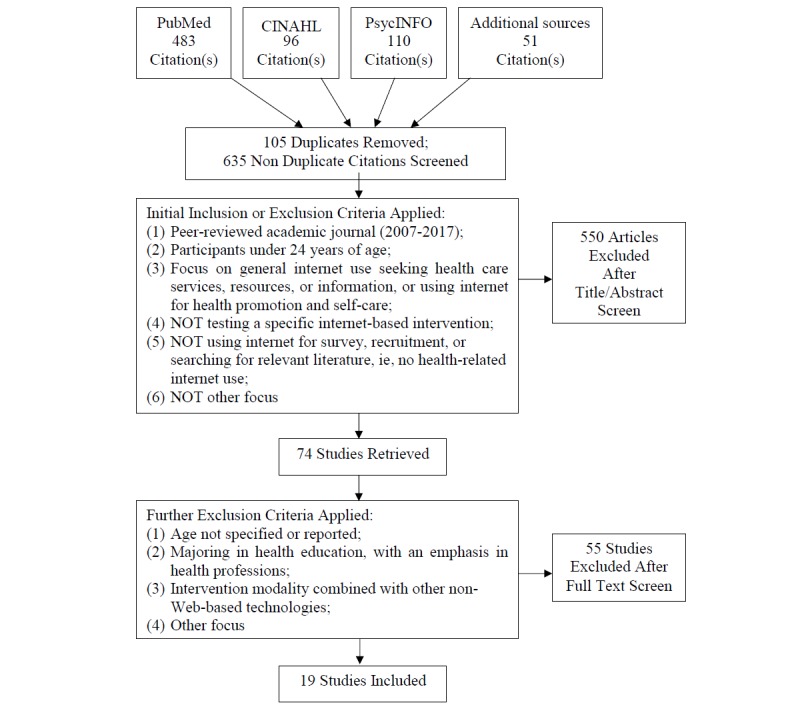
A total of 19 studies were selected from a search of major electronic databases: PubMed, Cumulative Index of Nursing and Allied Health Literature, and PsycINFO using the following search terms: "health-related internet use," "eHealth," "Internet use for health-related purpose," "Web-based resource," "health information seeking," and "online resource," combined with "child," "adolescent," "student," "youth," and "teen." The children's and adolescents' ages were limited to 24 years and younger. The search was conducted from September 2015 to October 2017. The studies identified to contain youth (<24 years) health-related internet use were all published in peer-reviewed journals in the past 10 years; these studies examined general internet use seeking health care services, resources, information, or using the internet for health promotion and self-care. Studies were excluded if they explored the role of the internet as a modality for surveys, recruitment, or searching for relevant literature without specifically aiming to study participants' health-related internet use; focused solely on quality assurance for specific websites; or were designed to test a specific internet-based intervention.
Interesting patterns in adolescents' health-related internet use, such as seeking preventative health care and specific information about medical issues, were identified. Quantitative studies reported rates of the internet use and access among youth, and the purpose and patterns of health-related internet use among youth were identified. A major objective of health-related internet use is to gain information, but there are inconsistencies in adolescents' perceptions of health-related internet use.
This study's findings provide important information on how youth seek information and related support systems for their health care on the internet. The conceptual and methodological limitations of the identified studies, such as the lack of a theoretical background and unrepresentative samples, are discussed, and gaps within the studies are identified for future research. This review also suggests important features for potential Web-based health interventions for children and adolescents.
儿童和青少年广泛使用互联网,他们通常对技术有较高的熟练程度。因此,互联网已成为支持青少年自我保健和健康相关服务的重要资源。然而,很少有研究探讨青少年在健康相关事务上的互联网使用情况。
本系统文献综述的目的是研究儿童和青少年与健康相关的互联网使用现象,并找出研究中的空白。
通过在主要电子数据库(PubMed、护理及相关健康文献累积索引和PsycINFO)中搜索,使用以下搜索词共筛选出19项研究:“与健康相关的互联网使用”、“电子健康”、“用于健康相关目的的互联网使用”、“基于网络的资源”、“健康信息寻求”和“在线资源”,并与“儿童”、“青少年”、“学生”、“青年”和“青少年”相结合。儿童和青少年的年龄限制在24岁及以下。搜索时间为2015年9月至2017年10月。确定包含青少年(<24岁)与健康相关的互联网使用的研究均发表在过去10年的同行评审期刊上;这些研究考察了寻求医疗保健服务、资源、信息的一般互联网使用情况,或利用互联网进行健康促进和自我保健。如果研究探讨的是互联网作为调查、招募或搜索相关文献的一种方式的作用,而没有专门旨在研究参与者与健康相关的互联网使用情况;仅关注特定网站的质量保证;或旨在测试特定的基于互联网的干预措施,则将其排除。
发现了青少年与健康相关的互联网使用中的有趣模式,例如寻求预防性医疗保健和有关医疗问题的特定信息。定量研究报告了青少年的互联网使用和访问率,并确定了青少年与健康相关的互联网使用目的和模式。与健康相关的互联网使用的一个主要目标是获取信息,但青少年对与健康相关的互联网使用的认知存在不一致。
本研究的结果提供了关于青少年如何在互联网上寻求医疗保健信息和相关支持系统的重要信息。讨论了已确定研究的概念和方法局限性,如缺乏理论背景和样本不具代表性,并确定了研究中的空白以供未来研究。本综述还提出了针对儿童和青少年的潜在基于网络的健康干预措施的重要特征。
