Turgay Yıldırım Özge, Yıldırır Aylin, Sade Leyla Elif, Has Hasırcı Senem, Kozan Hatice, Özçalık Emre, Okyay Kaan, Bal Uğur Abbas, Aydınalp Alp, Müderrisoğlu Haldun
Department of Cardiology, Faculty of Medicine, Başkent University; Ankara-Turkey.
Anatol J Cardiol. 2018 Apr;19(4):267-272. doi: 10.14744/AnatolJCardiol.2018.66181.
Resistin, a cysteine-rich peptide, is associated with atherosclerosis and diabetes. Resistin levels increase corresponding to coronary artery disease (CAD) and heart failure severity. Since resistin level tends to elevate with symptomatic heart failure, it is expected to be associated with left ventricular end-diastolic pressure (LVEDP). However, there is no relevant literature on the relationship between resistin levels and LVEDP. We aimed to evaluate the association between resistin levels and LVEDP, severity of CAD, carotid intima-media thickness (CIMT), and echocardiographic diastolic dysfunction parameters.
For this study, 128 euvolemic patients with creatinine clearance >50 mg/dL and without acute coronary syndrome, who had typical chest pain or were stress test positive, were enrolled. Resistin level was measured by Enzyme-linked immunosorbent assays (ELISA) method. Severe CAD is defined as ≥50% stenosis in one of the major coronary arteries. LVEDP was measured during left heart catheterization.
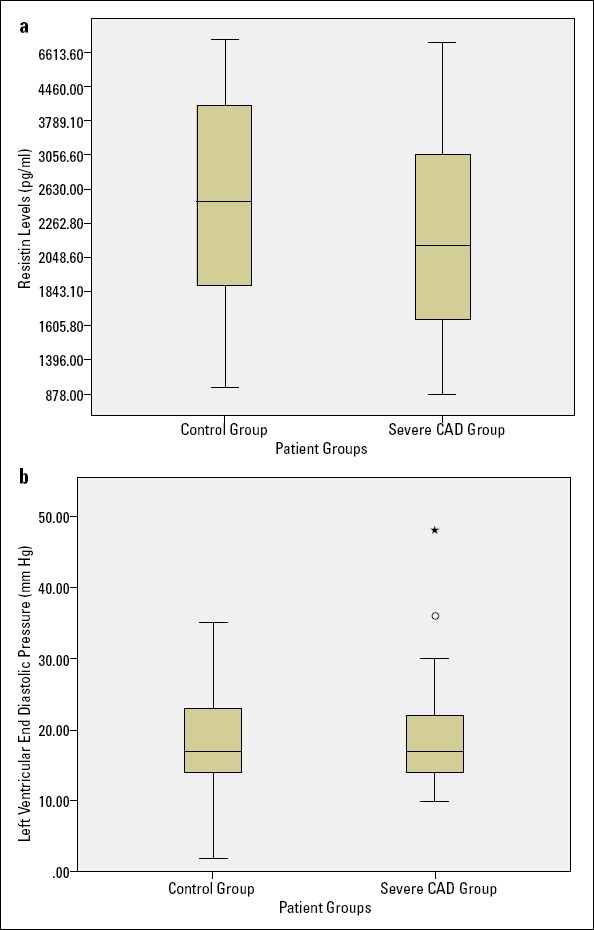
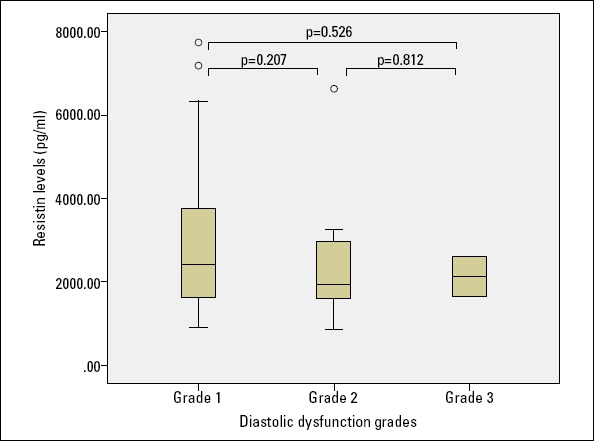
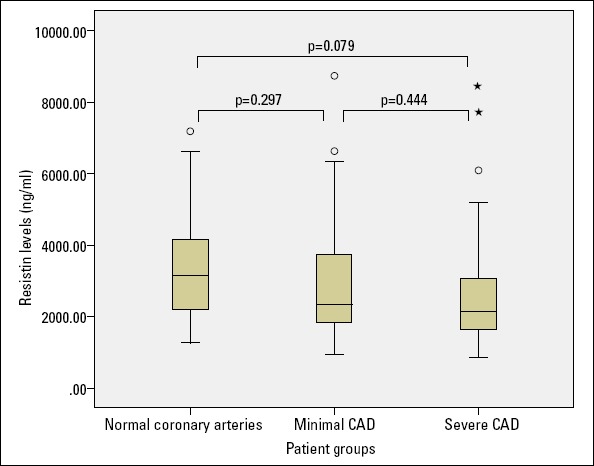
After coronary angiography, 60 patients (46.9%) had severe CAD. The mean LVEDPs were similar for patients with and without severe CAD (p=0.480). The resistin levels did not differ between the groups (p=0.154). The resistin levels did not correlate with LVEDP (r=-0.045, p=0.627), ejection fraction (EF; r=0.110, p=0.228), the Gensini score (r=-0.091, p=0.328), and CIMT (r=0.082, p=0.457). No significant correlation was found between the echocardiographic diastolic dysfunction parameters and resistin levels.
There was no significant correlation between resistin level and LVEDP, CAD severity, echocardiographic diastolic dysfunction parameters, and CIMT. Further studies are warranted to determine the efficacy of resistin in clinical use.
抵抗素是一种富含半胱氨酸的肽,与动脉粥样硬化和糖尿病相关。抵抗素水平随冠状动脉疾病(CAD)和心力衰竭严重程度相应升高。由于抵抗素水平往往随症状性心力衰竭而升高,预计其与左心室舒张末期压力(LVEDP)有关。然而,关于抵抗素水平与LVEDP之间的关系尚无相关文献。我们旨在评估抵抗素水平与LVEDP、CAD严重程度、颈动脉内膜中层厚度(CIMT)以及超声心动图舒张功能障碍参数之间的关联。
本研究纳入了128例肌酐清除率>50 mg/dL、无急性冠状动脉综合征、有典型胸痛或运动试验阳性的血容量正常患者。采用酶联免疫吸附测定(ELISA)法测量抵抗素水平。严重CAD定义为主要冠状动脉之一狭窄≥50%。在左心导管检查期间测量LVEDP。
冠状动脉造影后,60例患者(46.9%)患有严重CAD。有和没有严重CAD的患者的平均LVEDP相似(p = 0.480)。两组之间的抵抗素水平无差异(p = 0.154)。抵抗素水平与LVEDP(r = -0.045,p = 0.627)、射血分数(EF;r = 0.110,p = 0.228)、Gensini评分(r = -0.091,p = 0.328)和CIMT(r = 0.082,p = 0.457)均无相关性。超声心动图舒张功能障碍参数与抵抗素水平之间未发现显著相关性。
抵抗素水平与LVEDP、CAD严重程度、超声心动图舒张功能障碍参数和CIMT之间无显著相关性。有必要进一步研究以确定抵抗素在临床应用中的疗效。