Brunner M, Bujard H
Zentrum für Molekulare Biologie der Universität Heidelberg, FRG.
EMBO J. 1987 Oct;6(10):3139-44. doi: 10.1002/j.1460-2075.1987.tb02624.x.
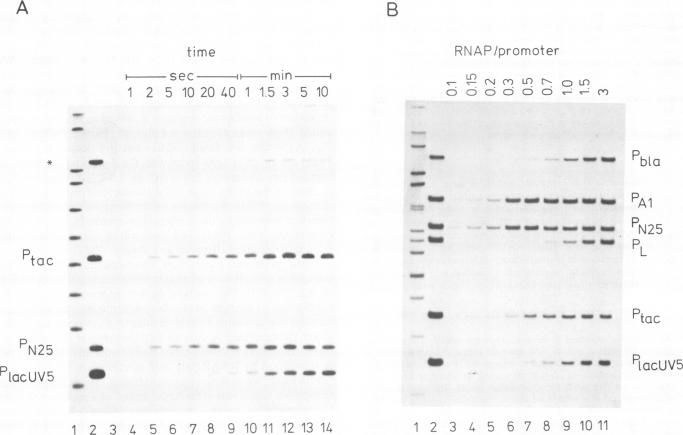
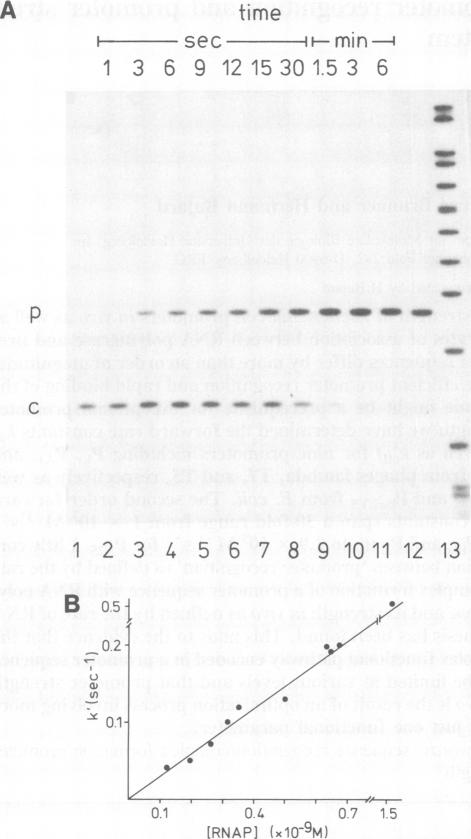
The strength of Escherichia coli promoters in vivo as well as the rates of association between RNA polymerase and promoter sequences differ by more than an order of magnitude. Since efficient promoter recognition and rapid binding of the enzyme might be a prerequisite for exceptional promoter strength we have determined the forward rate constants kon (as well as koff) for nine promoters including PL, PA1, and PN25 from phages lambda, T7, and T5, respectively as well as Pbla and PlacUV5 from E. coli. The second order forward rate constants span a 30-fold range from 1 X 10(7) M-1 s-1 for Pbla and PL up to 2.9 X 10(8) M-1 S-1 for PN25. Little correlation between 'promoter recognition' as defined by the rate of complex formation of a promoter sequence with RNA polymerase and its strength in vivo as defined by the rate of RNA synthesis has been found. This adds to the evidence that the complex functional pathway encoded in a promoter sequence can be limited at various levels and that promoter strength in vivo is the result of an optimization process involving more than just one functional parameter.
大肠杆菌启动子在体内的强度以及RNA聚合酶与启动子序列之间的结合速率相差超过一个数量级。由于高效的启动子识别和酶的快速结合可能是超强启动子强度的先决条件,我们已经测定了9个启动子的正向速率常数kon(以及koff),其中包括分别来自噬菌体λ、T7和T5的PL、PA1和PN25,以及来自大肠杆菌的Pbla和PlacUV5。二级正向速率常数的范围为30倍,从Pbla和PL的1×10⁷ M⁻¹ s⁻¹到PN25的2.9×10⁸ M⁻¹ s⁻¹。由启动子序列与RNA聚合酶形成复合物的速率所定义的“启动子识别”与其在体内由RNA合成速率所定义的强度之间几乎没有相关性。这进一步证明,启动子序列中编码的复杂功能途径可能在多个层面受到限制,并且体内启动子强度是一个涉及不止一个功能参数的优化过程的结果。