Department of Pathobiology, Faculty of Veterinary Medicine, Utrecht University, Utrecht, 3584 CL, The Netherlands.
MRC-University of Glasgow Centre for Virus Research, Glasgow, G61 1QH, UK.
Emerg Microbes Infect. 2018 Apr 4;7(1):56. doi: 10.1038/s41426-018-0058-5.
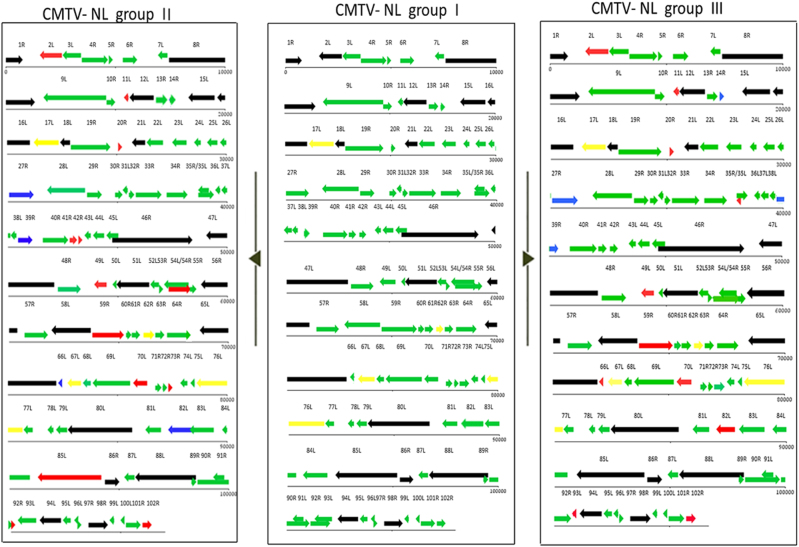
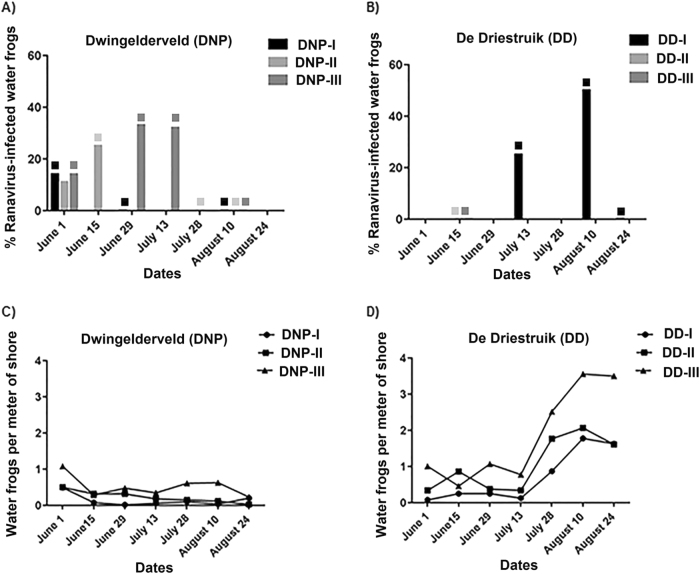
Ranaviruses are pathogenic viruses for poikilothermic vertebrates worldwide. The identification of a common midwife toad virus (CMTV) associated with massive die-offs in water frogs (Pelophylax spp.) in the Netherlands has increased awareness for emerging viruses in amphibians in the country. Complete genome sequencing of 13 ranavirus isolates collected from ten different sites in the period 2011-2016 revealed three CMTV groups present in distinct geographical areas in the Netherlands. Phylogenetic analysis showed that emerging viruses from the northern part of the Netherlands belonged to CMTV-NL group I. Group II and III viruses were derived from the animals located in the center-east and south of the country, and shared a more recent common ancestor to CMTV-amphibian associated ranaviruses reported in China, Italy, Denmark, and Switzerland. Field monitoring revealed differences in water frog host abundance at sites where distinct ranavirus groups occur; with ranavirus-associated deaths, host counts decreasing progressively, and few juveniles found in the north where CMTV-NL group I occurs but not in the south with CMTV-NL group III. Investigation of tandem repeats of coding genes gave no conclusive information about phylo-geographical clustering, while genetic analysis of the genomes revealed truncations in 17 genes across CMTV-NL groups II and III compared to group I. Further studies are needed to elucidate the contribution of these genes as well as environmental variables to explain the observed differences in host abundance.
蛙壶病毒是一种能感染变温脊椎动物的病原体病毒,在全世界范围内都有分布。在荷兰,大量水蛙(Pelophylax 属)死亡与一种常见的蟾蜍病毒(CMTV)有关,这引起了人们对该国两栖动物中新兴病毒的关注。对 2011 年至 2016 年期间从荷兰十个不同地点采集的 13 株蛙壶病毒分离株进行了全基因组测序,结果显示在荷兰不同地理区域存在三种 CMTV 群。系统进化分析表明,来自荷兰北部的新兴病毒属于 CMTV-NL 组 I。组 II 和组 III 病毒来自该国中东部和南部的动物,与在中国、意大利、丹麦和瑞士报道的与蛙壶病毒相关的蛙类 Ranavirus 具有更近的共同祖先。实地监测显示,在不同蛙壶病毒群发生的地点,水蛙宿主的丰度存在差异;与蛙壶病毒相关的死亡病例中,宿主数量逐渐减少,在荷兰北部发现的幼体较少,而在南部则没有发现,荷兰北部存在 CMTV-NL 组 I,但南部没有。对编码基因串联重复的研究没有提供关于系统地理聚类的明确信息,而对基因组的遗传分析显示,与组 I 相比,组 II 和组 III 中的 17 个基因发生了截断。需要进一步的研究来阐明这些基因以及环境变量对解释观察到的宿主丰度差异的贡献。