Department of Primary and Community Care, Radboud Institute for Health Sciences, Radboud university medical center, Nijmegen, The Netherlands.
Department of Pulmonary Diseases, Groningen Research Institute for Asthma and COPD, University Medical Center Groningen, Groningen, The Netherlands.
NPJ Prim Care Respir Med. 2018 Apr 3;28(1):12. doi: 10.1038/s41533-018-0079-5.
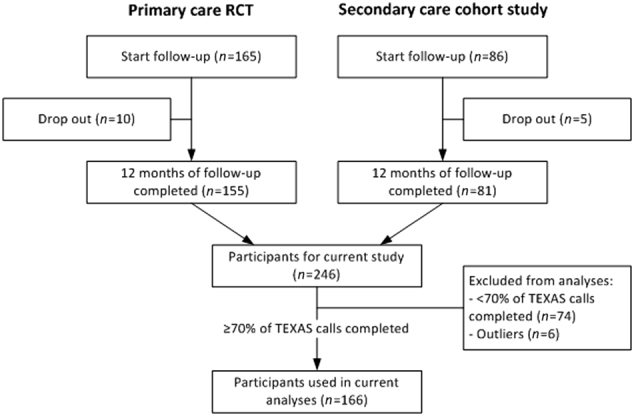
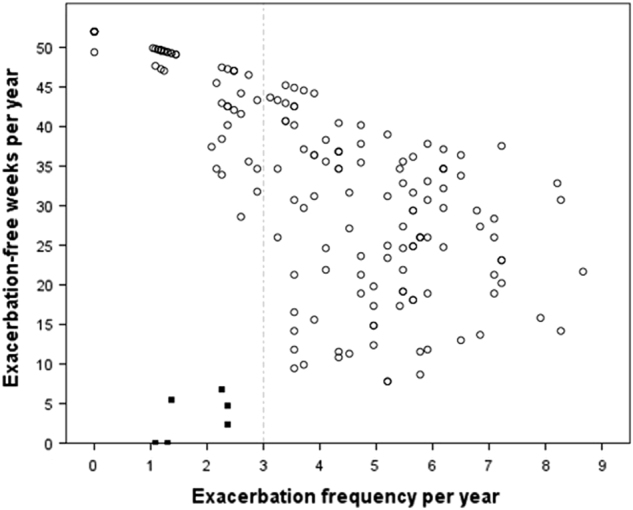
COPD exacerbations are commonly quantified as rate per year. However, the total amount of time a patient suffers from exacerbations may be stronger related to his or her disease burden than just counting exacerbation episodes. In this study, we examined the relationship between exacerbation frequency and exacerbation-free time, and their associations with baseline characteristics and health-related quality of life. A total of 166 COPD patients reported symptom changes during 12 months. Symptom-defined exacerbation episodes were correlated to the number of exacerbation-free weeks per year. Analysis of covariance was used to examine the effects of baseline characteristics on annual exacerbation frequency and exacerbation-free weeks, Spearman's rank correlations to examine associations between the two methods to express exacerbations and the Chronic Respiratory Questionnaire (CRQ). The correlation between exacerbation frequency and exacerbation-free weeks was -0.71 (p < 0.001). However, among frequent exacerbators (i.e., ≥3 exacerbations/year, n = 113) the correlation was weak (r = -0.25; p < 0.01). Smokers had less exacerbation-free weeks than non-smokers (β = -5.709, p < 0.05). More exacerbation-free weeks were related to better CRQ Total (r = 0.22, p < 0.05), Mastery (r = 0.22, p < 0.05), and Fatigue (r = 0.23, p < 0.05) scores, whereas no significant associations were found between exacerbation frequency and CRQ scores. In COPD patients with frequent exacerbations, there is substantial variation in exacerbation-free time. Exacerbation-free time may better reflect the burden of exacerbations in patients with COPD than exacerbation frequency does.
COPD 加重通常以每年的发生率来定量。然而,患者患加重的总时间可能比仅仅计算加重发作次数更与他或她的疾病负担相关。在这项研究中,我们检查了加重发作频率与无加重发作时间之间的关系,以及它们与基线特征和健康相关生活质量之间的关系。共有 166 名 COPD 患者在 12 个月内报告了症状变化。症状定义的加重发作与每年无加重发作的周数相关。协方差分析用于检查基线特征对每年加重发作频率和无加重发作周数的影响,Spearman 秩相关用于检查两种表达加重方法之间的关系以及慢性呼吸问卷(CRQ)。加重发作频率与无加重发作周数之间的相关性为-0.71(p<0.001)。然而,在频繁加重者(即≥3 次/年,n=113)中,相关性较弱(r=-0.25;p<0.01)。吸烟者的无加重发作周数少于非吸烟者(β=-5.709,p<0.05)。更多的无加重发作周数与更好的 CRQ 总评分(r=0.22,p<0.05)、掌握评分(r=0.22,p<0.05)和疲劳评分(r=0.23,p<0.05)相关,而加重发作频率与 CRQ 评分之间没有显著相关性。在频繁加重的 COPD 患者中,无加重发作时间存在很大差异。无加重发作时间可能比加重发作频率更能反映 COPD 患者的加重负担。