Ruiz-Núñez Begoña, Tarasse Rabab, Vogelaar Emar F, Janneke Dijck-Brouwer D A, Muskiet Frits A J
Department of Laboratory Medicine, University Medical Centre Groningen, University of Groningen, Groningen, Netherlands.
Healthy Institute, Madrid, Spain.
Front Endocrinol (Lausanne). 2018 Mar 20;9:97. doi: 10.3389/fendo.2018.00097. eCollection 2018.
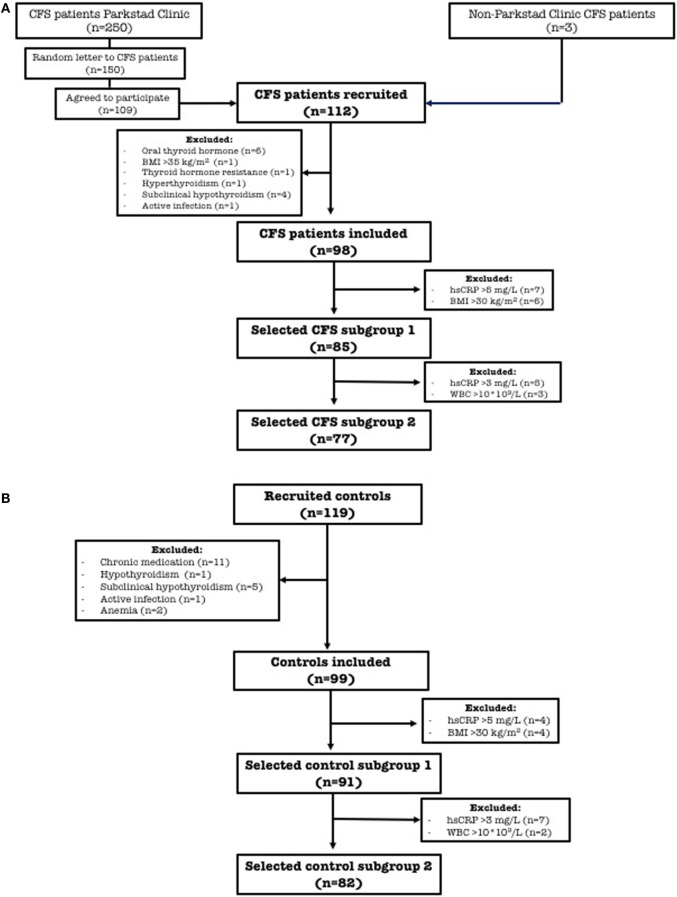
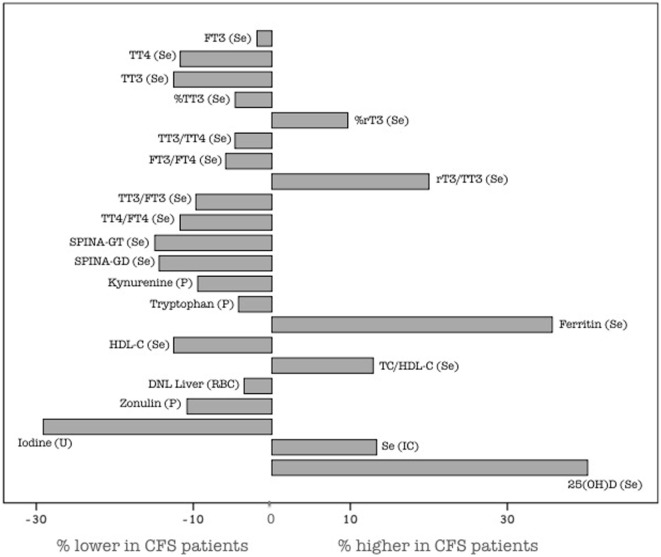
Chronic fatigue syndrome (CFS) is a heterogeneous disease with unknown cause(s). CFS symptoms resemble a hypothyroid state, possibly secondary to chronic (low-grade) (metabolic) inflammation. We studied 98 CFS patients (21-69 years, 21 males) and 99 age- and sex-matched controls (19-65 years, 23 males). We measured parameters of thyroid function, (metabolic) inflammation, gut wall integrity and nutrients influencing thyroid function and/or inflammation. Most remarkably, CFS patients exhibited similar thyrotropin, but lower free triiodothyronine (FT3) (difference of medians 0.1%), total thyroxine (TT4) (11.9%), total triiodothyronine (TT3) (12.5%), %TT3 (4.7%), sum activity of deiodinases (14.4%), secretory capacity of the thyroid gland (14.9%), 24-h urinary iodine (27.6%), and higher % reverse T3 (rT3) (13.3%). FT3 below the reference range, consistent with the "low T3 syndrome," was found in 16/98 CFS patients vs. 7/99 controls (OR 2.56; 95% confidence interval = 1.00-6.54). Most observations persisted in two sensitivity analyses with more stringent cutoff values for body mass index, high-sensitive C-reactive protein (hsCRP), and WBC. We found possible evidence of (chronic) low-grade metabolic inflammation (ferritin and HDL-C). FT3, TT3, TT4, and rT3 correlated positively with hsCRP in CFS patients and all subjects. TT3 and TT4 were positively related to hsCRP in controls. Low circulating T3 and the apparent shift from T3 to rT3 may reflect more severely depressed tissue T3 levels. The present findings might be in line with recent metabolomic studies pointing at a hypometabolic state. They resemble a mild form of "non-thyroidal illness syndrome" and "low T3 syndrome" experienced by a subgroup of hypothyroid patients receiving T4 monotherapy. Our study needs confirmation and extension by others. If confirmed, trials with, e.g., T3 and iodide supplements might be indicated.
慢性疲劳综合征(CFS)是一种病因不明的异质性疾病。CFS的症状类似于甲状腺功能减退状态,可能继发于慢性(低度)(代谢性)炎症。我们研究了98例CFS患者(年龄21 - 69岁,男性21例)和99例年龄及性别匹配的对照者(年龄19 - 65岁,男性23例)。我们测量了甲状腺功能、(代谢性)炎症、肠壁完整性以及影响甲状腺功能和/或炎症的营养素相关参数。最显著的是,CFS患者的促甲状腺激素水平相似,但游离三碘甲状腺原氨酸(FT3)较低(中位数差异0.1%),总甲状腺素(TT4)较低(11.9%),总三碘甲状腺原氨酸(TT3)较低(12.5%),TT3百分比(4.7%),脱碘酶总活性较低(14.4%),甲状腺分泌能力较低(14.9%),24小时尿碘较低(27.6%),而反三碘甲状腺原氨酸(rT3)百分比更高(13.3%)。在98例CFS患者中有16例FT3低于参考范围,符合“低T3综合征”,而99例对照者中有7例(比值比2.56;95%置信区间 = 1.00 - 6.54)。在两项敏感性分析中,对于体重指数、高敏C反应蛋白(hsCRP)和白细胞采用更严格的临界值时,大多数观察结果仍然存在。我们发现了(慢性)低度代谢性炎症(铁蛋白和高密度脂蛋白胆固醇)的可能证据。在CFS患者和所有受试者中,FT3、TT3、TT4和rT3与hsCRP呈正相关。在对照者中,TT3和TT4与hsCRP呈正相关。循环中T3水平低以及明显从T3向rT3的转变可能反映了组织T3水平更严重的降低。目前的研究结果可能与最近指向低代谢状态的代谢组学研究一致。它们类似于接受T4单药治疗的亚组甲状腺功能减退患者所经历的轻度“非甲状腺疾病综合征”和“低T3综合征”。我们的研究需要其他研究的证实和扩展。如果得到证实,可能需要进行例如补充T3和碘化物的试验。