Department of Physiology, Semmelweis University School of Medicine, Budapest, Hungary.
MTA-SE "Lendület" Inflammation Physiology Research Group of the Hungarian Academy of Sciences and Semmelweis University, Budapest, Hungary.
Front Immunol. 2018 Mar 19;9:555. doi: 10.3389/fimmu.2018.00555. eCollection 2018.
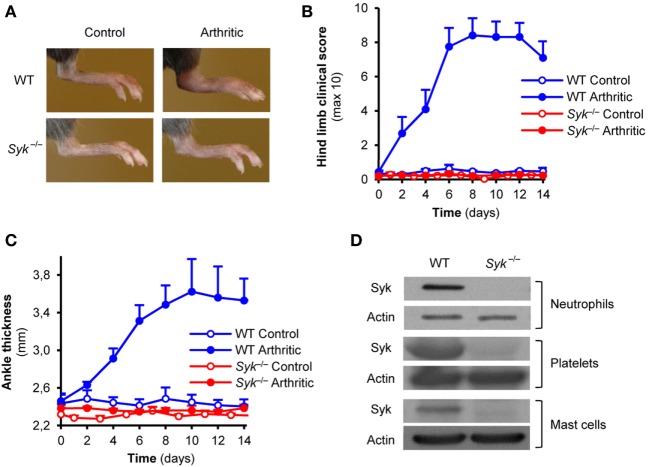
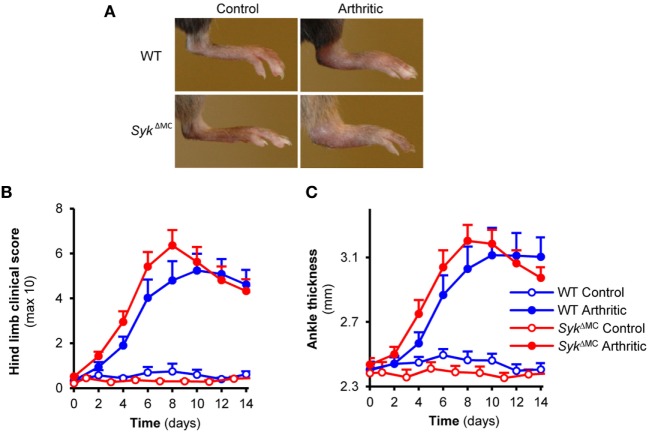
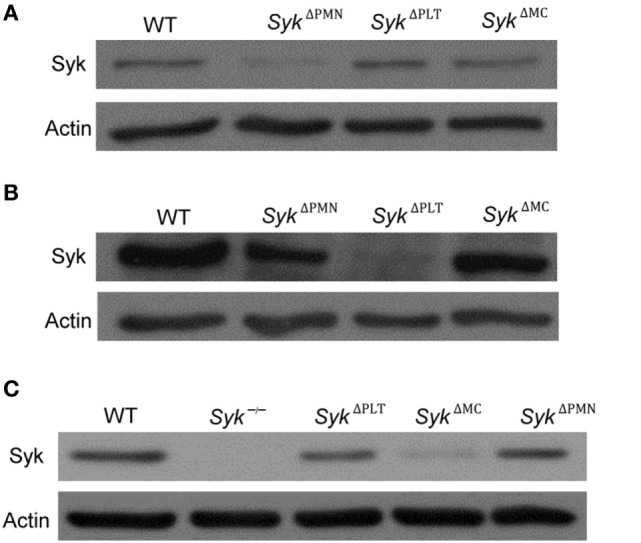
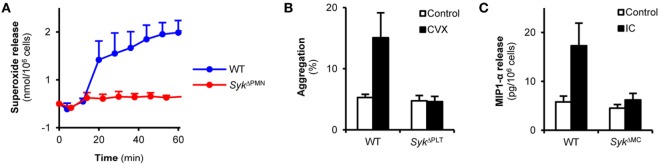
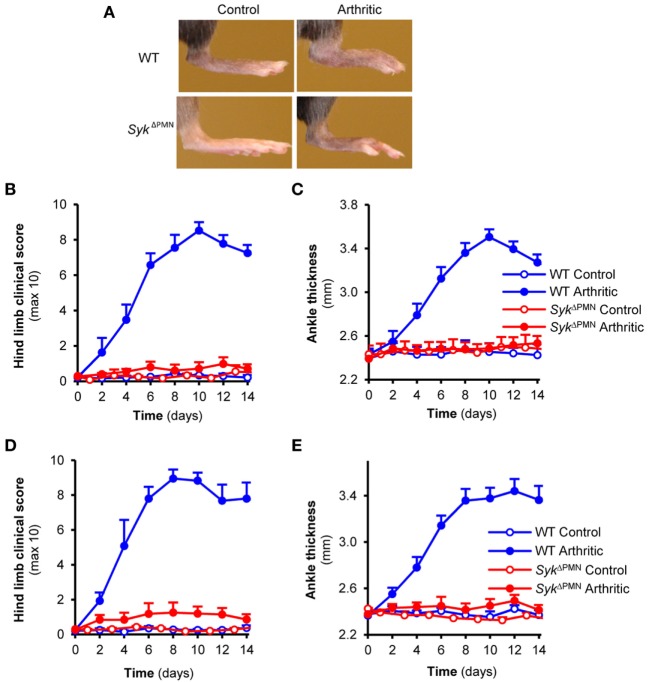
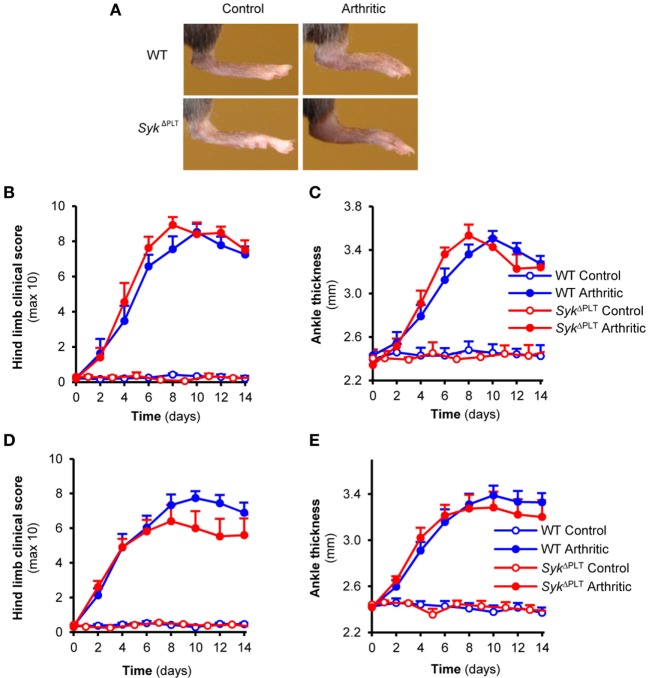
Autoantibody production and autoantibody-mediated inflammation are hallmarks of a number of autoimmune diseases. The K/BxN serum-transfer arthritis is one of the most widely used models of the effector phase of autoantibody-induced pathology. Several hematopoietic lineages including neutrophils, platelets, and mast cells have been proposed to contribute to inflammation and tissue damage in this model. We have previously shown that the Syk tyrosine kinase is critically involved in the development in K/BxN serum-transfer arthritis and bone marrow chimeric experiments indicated that Syk is likely involved in one or more hematopoietic lineages during the disease course. The aim of the present study was to further define the lineage(s) in which Syk expression is required for autoantibody-induced arthritis. To this end, K/BxN serum-transfer arthritis was tested in conditional mutant mice in which Syk was deleted in a lineage-specific manner from neutrophils, platelets, or mast cells. Combination of the MRP8-Cre, PF4-Cre, or Mcpt5-Cre transgene with floxed Syk alleles allowed efficient and selective deletion of Syk from neutrophils, platelets, or mast cells, respectively. This has also been confirmed by defective Syk-dependent functional responses of the respective cell types. studies revealed nearly complete defect of the development of K/BxN serum-transfer arthritis upon neutrophil-specific deletion of Syk. By contrast, Syk deletion from platelets or mast cells did not affect the development of K/BxN serum-transfer arthritis. Our results indicate that autoantibody-induced arthritis requires Syk expression in neutrophils, whereas, contrary to prior assumptions, Syk expression in platelets or mast cells is dispensable for disease development in this model.
自身抗体的产生和自身抗体介导的炎症是许多自身免疫性疾病的特征。K/BxN 血清转移关节炎是自身抗体诱导病理的效应期最广泛使用的模型之一。包括中性粒细胞、血小板和肥大细胞在内的几种造血谱系已被提出有助于该模型中的炎症和组织损伤。我们之前已经表明,Syk 酪氨酸激酶在 K/BxN 血清转移关节炎的发展中起着至关重要的作用,骨髓嵌合实验表明,Syk 在疾病过程中可能涉及一种或多种造血谱系。本研究的目的是进一步确定 Syk 表达在自身抗体诱导关节炎中所需的谱系。为此,在条件性突变小鼠中测试了 K/BxN 血清转移关节炎,其中 Syk 从中性粒细胞、血小板或肥大细胞中以谱系特异性方式缺失。MRP8-Cre、PF4-Cre 或 Mcpt5-Cre 转基因与 floxed Syk 等位基因的组合允许分别从中性粒细胞、血小板或肥大细胞中有效且选择性地缺失 Syk。这也通过各自细胞类型的缺陷 Syk 依赖性功能反应得到了证实。研究表明,在中性粒细胞特异性缺失 Syk 的情况下,K/BxN 血清转移关节炎的发展几乎完全缺陷。相比之下,从血小板或肥大细胞中缺失 Syk 不会影响 K/BxN 血清转移关节炎的发展。我们的结果表明,自身抗体诱导的关节炎需要中性粒细胞中的 Syk 表达,而与先前的假设相反,血小板或肥大细胞中的 Syk 表达对于该模型中疾病的发展是可有可无的。