Molecular Biology and Genetic Engineering Laboratory, School of Biotechnology, Jawaharlal Nehru University, New Delhi, India.
Front Immunol. 2018 Mar 20;9:562. doi: 10.3389/fimmu.2018.00562. eCollection 2018.
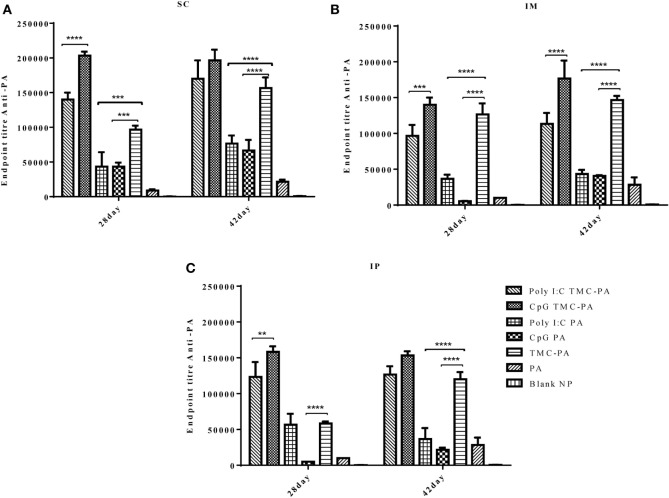
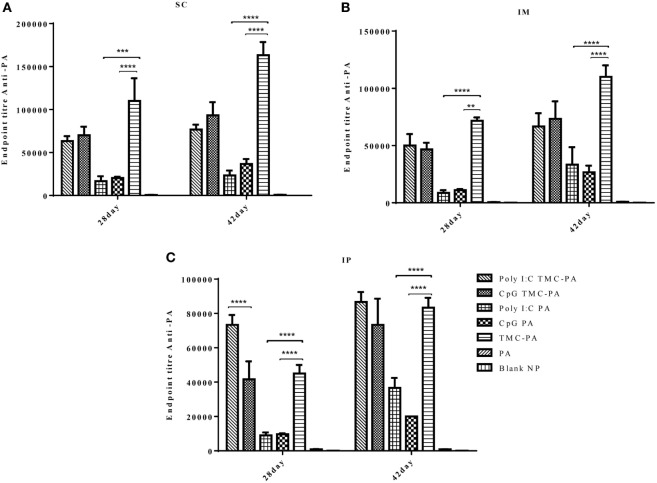
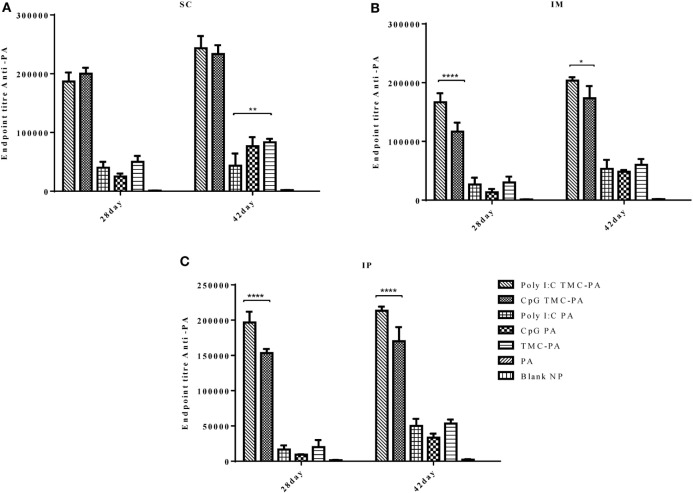
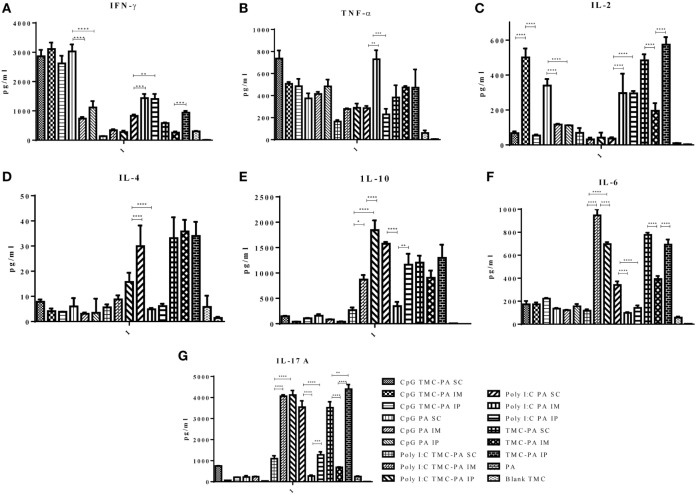
Anthrax is an era old deadly disease against which there are only two currently available licensed vaccines named anthrax vaccine adsorbed and precipitated (AVP). Though they can provide a protective immunity, their multiple side-effects owing to their ill-defined composition and presence of toxic proteins (LF and EF) of , the causative organism of anthrax, in the vaccine formulation makes their widespread use objectionable. Hence, an anthrax vaccine that contains well-defined and controlled components would be highly desirable. In this context, we have evaluated the potential of various vaccine formulations comprising of protective antigen (PA) encapsulated trimethyl-chitosan nanoparticles (TMC-PA) in conjunction with either CpG-C ODN 2395 (CpG) or Poly I:C. Each formulation was administered three different routes, viz., subcutaneous (SC), intramuscular (IM), and intraperitoneal in female BALB/c mice. Irrespective of the route of immunization, CpG or Poly I:C adjuvanted TMC-PA nanoparticles induced a significantly higher humoral response (total serum IgG and its isotypes viz., IgG1, IgG2a, and IgG2b), compared to their CpG or Poly I:C PA counterparts. This clearly demonstrates the synergistic behavior of CpG and Poly I:C with TMC nanoparticles. The adjuvant potential of TMC nanoparticles could be observed in all the three routes as the TMC-PA nanoparticles by themselves induced IgG titers (1-1.5 × 10) significantly higher than both CpG PA and Poly I:C PA groups (2-8 × 10). The effect of formulations on T-helper (T) cell development was assessed by quantifying the Th1-dependant (TNF-α, IFN-γ, and IL-2), Th2-dependant (IL-4, IL-6, and IL-10), and Th17-type (IL-17A) cytokines. Adjuvanation with CpG and Poly I:C, the TMC-PA nanoparticles triggered a Th1 skewed immune response, as suggested by an increase in the levels of total IgG2a along with IFN-γ cytokine production. Interestingly, the TMC-PA group showed a Th2-biased immune response. Upon challenge with the Ames strain, CpG and Poly I:C adjuvanted TMC-PA nanoparticles immunized the SC and IM routes showed the highest protective efficacy of ~83%. Altogether, the results suggest that CpG or Poly I:C adjuvanted, PA-loaded TMC nanoparticles could be used as an effective, non-toxic, second generation subunit-vaccine candidate against anthrax.
炭疽是一种古老的致命疾病,目前只有两种已获得许可的疫苗,分别为炭疽疫苗吸附剂和沉淀疫苗(AVP)。虽然它们可以提供保护性免疫,但由于其成分不明确,且疫苗制剂中存在炭疽的致病生物体的有毒蛋白(LF 和 EF),因此它们存在多种副作用,这使得它们的广泛使用令人反感。因此,含有明确且受控成分的炭疽疫苗将是非常理想的。在这种情况下,我们评估了包含保护性抗原(PA)包裹的三甲基壳聚糖纳米颗粒(TMC-PA)的各种疫苗制剂的潜力,这些制剂与 CpG-C ODN 2395(CpG)或聚肌苷酸:胞苷酸(Poly I:C)联合使用。每种制剂通过三种不同途径,即皮下(SC)、肌肉内(IM)和腹腔内途径,在雌性 BALB/c 小鼠中进行给药。无论免疫途径如何,CpG 或 Poly I:C 佐剂的 TMC-PA 纳米颗粒诱导的体液反应(总血清 IgG 及其同种型,即 IgG1、IgG2a 和 IgG2b)均明显高于其 CpG 或 Poly I:C PA 对应物。这清楚地表明了 CpG 和 Poly I:C 与 TMC 纳米颗粒的协同作用。TMC 纳米颗粒的佐剂潜力可以在所有三种途径中观察到,因为 TMC-PA 纳米颗粒本身诱导的 IgG 滴度(1-1.5×10)明显高于 CpG PA 和 Poly I:C PA 组(2-8×10)。通过定量 Th1 依赖性(TNF-α、IFN-γ 和 IL-2)、Th2 依赖性(IL-4、IL-6 和 IL-10)和 Th17 型(IL-17A)细胞因子,评估了制剂对辅助性 T 细胞(T)发育的影响。CpG 和 Poly I:C 佐剂化后,TMC-PA 纳米颗粒引发了 Th1 偏向的免疫反应,这表现为总 IgG2a 水平升高以及 IFN-γ 细胞因子的产生。有趣的是,TMC-PA 组显示出 Th2 偏向的免疫反应。在用 Ames 株进行攻毒后,CpG 和 Poly I:C 佐剂化的 TMC-PA 纳米颗粒通过 SC 和 IM 途径免疫的动物表现出高达 83%的最高保护效力。总的来说,结果表明,CpG 或 Poly I:C 佐剂化、PA 负载的 TMC 纳米颗粒可用作针对炭疽的有效、无毒的第二代亚单位疫苗候选物。