Department of Oncology, University of Oxford, Old Road Campus Research Building, Roosevelt Drive, Oxford OX3 7DQ, United Kingdom. Author to whom any correspondence should be addressed.
Phys Med Biol. 2018 May 4;63(9):095013. doi: 10.1088/1361-6560/aabb62.
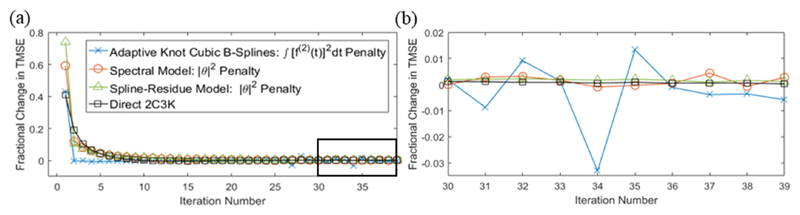
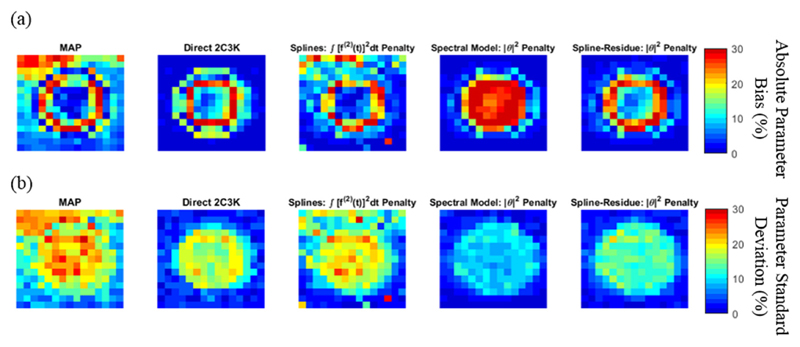
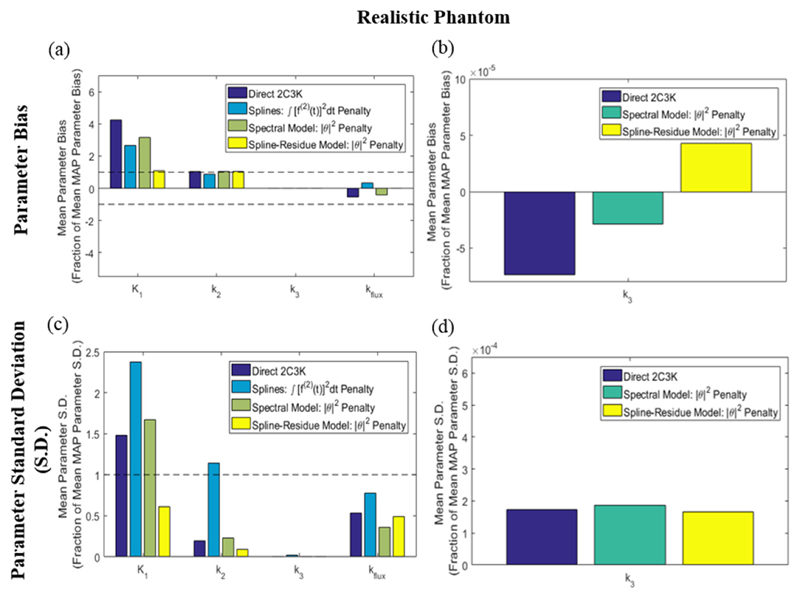
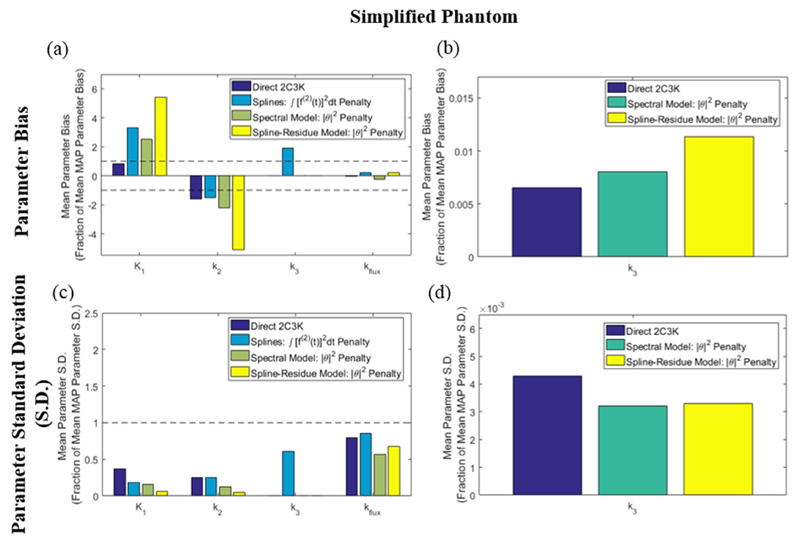
4D reconstruction of dynamic positron emission tomography (dPET) data can improve the signal-to-noise ratio in reconstructed image sequences by fitting smooth temporal functions to the voxel time-activity-curves (TACs) during the reconstruction, though the optimal choice of function remains an open question. We propose a spline-residue model, which describes TACs as weighted sums of convolutions of the arterial input function with cubic B-spline basis functions. Convolution with the input function constrains the spline-residue model at early time-points, potentially enhancing noise suppression in early time-frames, while still allowing a wide range of TAC descriptions over the entire imaged time-course, thus limiting bias. Spline-residue based 4D-reconstruction is compared to that of a conventional (non-4D) maximum a posteriori (MAP) algorithm, and to 4D-reconstructions based on adaptive-knot cubic B-splines, the spectral model and an irreversible two-tissue compartment ('2C3K') model. 4D reconstructions were carried out using a nested-MAP algorithm including spatial and temporal roughness penalties. The algorithms were tested using Monte-Carlo simulated scanner data, generated for a digital thoracic phantom with uptake kinetics based on a dynamic [F]-Fluromisonidazole scan of a non-small cell lung cancer patient. For every algorithm, parametric maps were calculated by fitting each voxel TAC within a sub-region of the reconstructed images with the 2C3K model. Compared to conventional MAP reconstruction, spline-residue-based 4D reconstruction achieved >50% improvements for five of the eight combinations of the four kinetics parameters for which parametric maps were created with the bias and noise measures used to analyse them, and produced better results for 5/8 combinations than any of the other reconstruction algorithms studied, while spectral model-based 4D reconstruction produced the best results for 2/8. 2C3K model-based 4D reconstruction generated the most biased parametric maps. Inclusion of a temporal roughness penalty function improved the performance of 4D reconstruction based on the cubic B-spline, spectral and spline-residue models.
4D 重建动态正电子发射断层扫描 (dPET) 数据可以通过在重建过程中对体素时间-活性曲线 (TAC) 拟合平滑的时间函数来提高重建图像序列的信噪比,尽管函数的最佳选择仍然是一个悬而未决的问题。我们提出了一种样条残差模型,该模型将 TAC 描述为动脉输入函数与三次 B 样条基函数卷积的加权和。与输入函数的卷积约束了样条残差模型在早期时间点,有可能增强早期时间帧中的噪声抑制,同时仍然允许在整个成像时间过程中对 TAC 进行广泛的描述,从而限制了偏差。基于样条残差的 4D 重建与传统(非 4D)最大后验概率 (MAP) 算法以及基于自适应结三次 B 样条、谱模型和不可逆双组织隔室 ('2C3K') 模型的 4D 重建进行了比较。4D 重建使用包括空间和时间粗糙度惩罚的嵌套 MAP 算法进行。使用基于非小细胞肺癌患者动态 [F]-Fluromisonidazole 扫描的摄取动力学的数字胸部体模生成的蒙特卡罗模拟扫描数据对算法进行了测试。对于每种算法,通过使用 2C3K 模型拟合重建图像子区域内的每个体素 TAC,计算了参数图。与传统的 MAP 重建相比,对于使用分析它们的偏差和噪声度量标准创建参数图的四个动力学参数中的五个组合中的五个组合,基于样条残差的 4D 重建实现了超过 50%的改进,并且对于五个组合中的五个组合,优于研究的任何其他重建算法,而基于谱模型的 4D 重建产生了 2/8 的最佳结果。基于 2C3K 模型的 4D 重建生成的参数图最具偏差。包含时间粗糙度惩罚函数可以提高基于三次 B 样条、谱和样条残差模型的 4D 重建的性能。