Zacharioudakis Ioannis M, Zervou Fainareti N, Mylonakis Eleftherios
Infectious Diseases Division, Warren Alpert Medical School of Brown University, Rhode Island Hospital 593 Eddy Street, Providence, RI 02903, USA.
Department of Medicine, Warren Alpert Medical School of Brown University, Providence, RI 02912, USA.
J Fungi (Basel). 2018 Apr 4;4(2):45. doi: 10.3390/jof4020045.
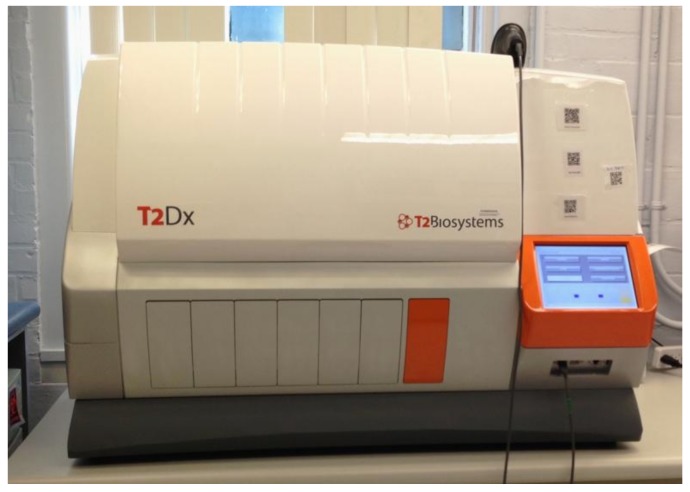
Invasive candidiasis is a common healthcare-associated infection with a high mortality rate that can exceed 60% in cases of septic shock. Blood culture performance is far from ideal, due to the long time to positivity and suppression by antifungal agents. The T2 Magnetic Resonance (T2MR) assay is an FDA-approved qualitative molecular diagnostic method that can detect and speciate the 5 most common spp.; namely, , , , , and , in approximately 5 h. In a multicenter clinical trial that included both a prospective and a contrived arm to represent the full range of clinically relevant concentrations of spp., T2MR demonstrated a sensitivity and specificity of 91.1% and 98.1%, respectively. The utility of T2MR in candidemia depends on the prevalence of disease in each clinical setting. In intensive care units and other high-prevalence settings, the incorporation of T2MR in diagnostic algorithms is very appealing. T2MR is expected to allow timely initiation of antifungal therapy and help with anti-fungal stewardship. In low-prevalence settings, the positive predictive value of T2MR might not be enough to justify initiation of antifungal treatment in itself. The performance of T2MR has not been studied in cases of deep-seated candidiasis. Despite some promising evidence in published clinical trials, further studies are needed to determine the performance of T2MR in invasive candidiasis without candidemia. Overall, experience with T2MR in everyday clinical practice is evolving but, in the right setting, this technology is expected to provide "actionable information" for the management of patients evaluated for candidemia.
侵袭性念珠菌病是一种常见的医疗相关感染,死亡率很高,在感染性休克病例中可超过60%。血培养的表现远不理想,因为阳性时间长且会受到抗真菌药物的抑制。T2磁共振(T2MR)检测是一种经美国食品药品监督管理局(FDA)批准的定性分子诊断方法,可在约5小时内检测出5种最常见的念珠菌属菌种并进行鉴定,即白色念珠菌、热带念珠菌、近平滑念珠菌、光滑念珠菌和克柔念珠菌。在一项多中心临床试验中,该试验包括一个前瞻性组和一个人为设定组,以代表念珠菌属菌种的所有临床相关浓度范围,T2MR检测的敏感性和特异性分别为91.1%和98.1%。T2MR在念珠菌血症中的效用取决于每种临床环境中疾病的患病率。在重症监护病房和其他高患病率环境中,将T2MR纳入诊断算法非常有吸引力。T2MR有望使抗真菌治疗及时开始,并有助于抗真菌药物管理。在低患病率环境中,T2MR的阳性预测值可能不足以证明仅据此就开始抗真菌治疗是合理的。T2MR在深部念珠菌病病例中的表现尚未得到研究。尽管已发表临床试验中有一些有前景的证据,但仍需要进一步研究以确定T2MR在无念珠菌血症的侵袭性念珠菌病中的表现。总体而言,T2MR在日常临床实践中的经验正在不断发展,但在合适的环境中,这项技术有望为评估念珠菌血症的患者管理提供“可采取行动的信息”。