Department of Medicine, Boston University Medical Center, Boston, MA, United States of America.
Department of Medicine, NorthShore University HealthSystem, Evanston, IL, United States of America.
PLoS One. 2018 Apr 4;13(4):e0193544. doi: 10.1371/journal.pone.0193544. eCollection 2018.
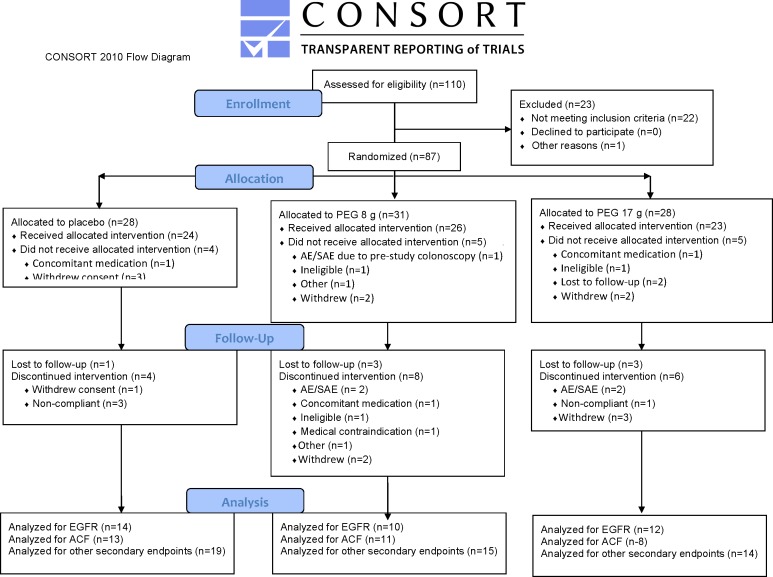
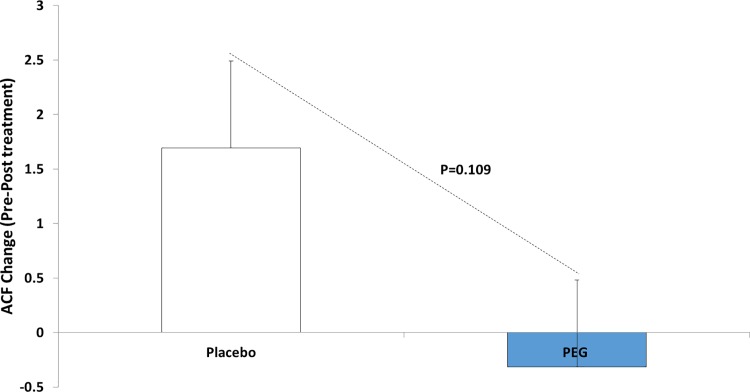
Chemoprevention represents an attractive modality against colorectal cancer (CRC) although widespread clinical implementation of promising agents (e.g. aspirin/NSAIDS) have been stymied by both suboptimal efficacy and concerns over toxicity. This highlights the need for better agents. Several groups, including our own, have reported that the over-the-counter laxative polyethylene glycol (PEG) has remarkable efficacy in rodent models of colon carcinogenesis. In this study, we undertook the first randomized human trial to address the role of PEG in prevention of human colonic neoplasia. This was a double-blind, placebo-controlled, three-arm trial where eligible subjects were randomized to 8g PEG-3350 (n = 27) or 17g PEG-3350 (n = 24), or placebo (n = 24; maltodextrin) orally for a duration of six months. Our initial primary endpoint was rectal aberrant crypt foci (ACF) but this was changed during protocol period to rectal mucosal epidermal growth factor receptor (EGFR). Of the 87 patients randomized, 48 completed study primary endpoints and rectal EGFR unchanged PEG treatment. Rectal ACF had a trend suggesting potentially reduction with PEG treatment (pre-post change 1.7 in placebo versus -0.3 in PEG 8+ 17g doses, p = 0.108). Other endpoints (proliferation, apoptosis, expression of SNAIL and E-cadherin), previously noted to be modulated in rodent models, appeared unchanged with PEG treatment in this clinical trial. We conclude that PEG was generally well tolerated with the trial failing to meet primary efficacy endpoints. However, rectal ACFs demonstrated a trend (albeit statistically insignificant) for suppression with PEG. Moreover, all molecular assays including EGFR were unaltered with PEG underscoring issues with lack of translatability of biomarkers from preclinical to clinical trials. This data may provide the impetus for future clinical trials on PEG using more robust biomarkers of chemoprevention.
ClinicalTrials.gov NCT00828984.
化学预防是一种有吸引力的结直肠癌(CRC)防治手段,尽管有希望的药物(如阿司匹林/非甾体抗炎药)的广泛临床应用受到疗效不佳和毒性担忧的阻碍。这凸显了寻找更好药物的必要性。包括我们在内的多个研究小组报告称,非处方缓泻剂聚乙二醇(PEG)在结直肠癌变的啮齿动物模型中具有显著疗效。在这项研究中,我们进行了第一项随机人体试验,以研究 PEG 在预防人类结直肠肿瘤中的作用。这是一项双盲、安慰剂对照、三臂试验,合格的受试者被随机分为 8g PEG-3350(n=27)或 17g PEG-3350(n=24)或安慰剂(n=24;麦芽糊精),口服,持续 6 个月。我们最初的主要终点是直肠异常隐窝病灶(ACF),但在试验期间改为直肠黏膜表皮生长因子受体(EGFR)。在随机的 87 名患者中,48 名完成了研究的主要终点和直肠 EGFR 不变的 PEG 治疗。直肠 ACF 有一个趋势表明,PEG 治疗可能会减少(安慰剂组前后变化 1.7,8g+17g PEG 剂量组为-0.3,p=0.108)。其他终点(增殖、凋亡、SNAIL 和 E-钙粘蛋白的表达),以前在啮齿动物模型中被发现有调节作用,在这项临床试验中,PEG 治疗似乎没有改变。我们的结论是,PEG 通常耐受性良好,试验未能达到主要疗效终点。然而,直肠 ACF 显示出 PEG 抑制的趋势(尽管统计学上不显著)。此外,所有分子检测,包括 EGFR,PEG 治疗后均未改变,突出了从临床前到临床试验转化生物标志物缺乏可转化性的问题。这些数据可能为未来使用更强大的化学预防生物标志物进行 PEG 临床试验提供动力。
ClinicalTrials.gov NCT00828984。