Betka Sophie, Gould Van Praag Cassandra, Paloyelis Yannis, Bond Rod, Pfeifer Gaby, Sequeira Henrique, Duka Theodora, Critchley Hugo
Clinical Imaging Science Centre, Brighton and Sussex Medical School, Brighton BN1 9RY, UK.
Psychology Department, University of Sussex, Brighton BN1 9RR, UK.
Soc Cogn Affect Neurosci. 2018 Apr 1;13(4):440-448. doi: 10.1093/scan/nsy027.
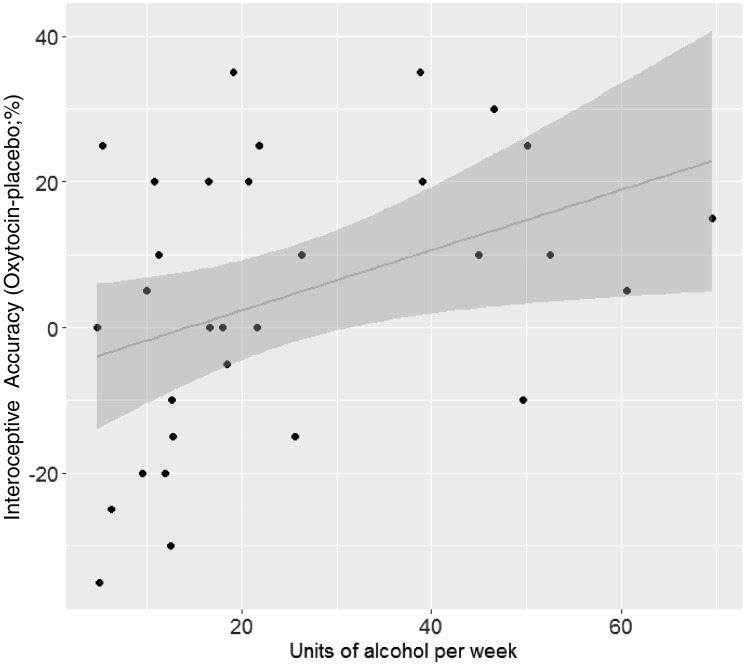
Interoception, i.e. the perception and appraisal of internal bodily signals, is related to the phenomenon of craving, and is reportedly disrupted in alcohol use disorders. The hormone oxytocin influences afferent transmission of bodily signals and, through its potential modulation of craving, is proposed as a possible treatment for alcohol use disorders. However, oxytocin's impact on interoception in alcohol users remains unknown. Healthy alcohol users (n = 32) attended two laboratory sessions to perform tests of interoceptive ability (heartbeat tracking: attending to internal signals and, heartbeat discrimination: integrating internal and external signals) after intranasal administration of oxytocin or placebo. Effects of interoceptive accuracy, oxytocin administration and alcohol intake, were tested using mixed-effects models. On the tracking task, oxytocin reduced interoceptive accuracy, but did not interact with alcohol consumption. On the discrimination task, we found an interaction between oxytocin administration and alcohol intake: Oxytocin, compared with placebo, increased interoceptive accuracy in heavy drinkers, but not in light social drinkers. Our study does not suggest a pure interoceptive impairment in alcohol users but instead potentially highlights reduced flexibility of internal and external attentional resource allocation. Importantly, this impairment seems to be mitigated by oxytocin. This attentional hypothesis needs to be explicitly tested in future research.
内感受,即对体内信号的感知和评估,与渴望现象相关,据报道在酒精使用障碍中会受到干扰。催产素会影响身体信号的传入传递,并且由于其对渴望的潜在调节作用,被提议作为治疗酒精使用障碍的一种可能方法。然而,催产素对酒精使用者内感受的影响仍然未知。健康的酒精使用者(n = 32)参加了两次实验室实验,在经鼻给予催产素或安慰剂后,进行内感受能力测试(心跳追踪:关注内部信号,以及心跳辨别:整合内部和外部信号)。使用混合效应模型测试内感受准确性、催产素给药和酒精摄入量的影响。在追踪任务中,催产素降低了内感受准确性,但与酒精消费没有相互作用。在辨别任务中,我们发现催产素给药和酒精摄入量之间存在相互作用:与安慰剂相比,催产素提高了重度饮酒者的内感受准确性,但对轻度社交饮酒者没有影响。我们的研究并不表明酒精使用者存在单纯的内感受障碍,而是潜在地突出了内部和外部注意力资源分配灵活性的降低。重要的是,这种障碍似乎可以通过催产素得到缓解。这一注意力假设需要在未来的研究中进行明确测试。