Yuk Moonsu, Yeo Woonhyung, Lee Kangeui, Ko Jungin, Park Taejin
Department of Emergency Medicine, National Medical Center, Seoul, Korea.
Department of Emergency Medicine, Seoul National University College of Medicine, Seoul, Korea.
Clin Exp Emerg Med. 2018 Mar 30;5(1):22-28. doi: 10.15441/ceem.16.185. eCollection 2018 Mar.
Endotracheal intubation is extremely difficult to perform in patients wearing a cervical collar for a head and neck injury. Therefore, we analyzed actual measurements using the look externally, evaluate 3-3-2, Mallampati score, obstruction, and neck mobility (LEMON) criteria before and after cervical collar application to investigate the causes of a difficult airway.
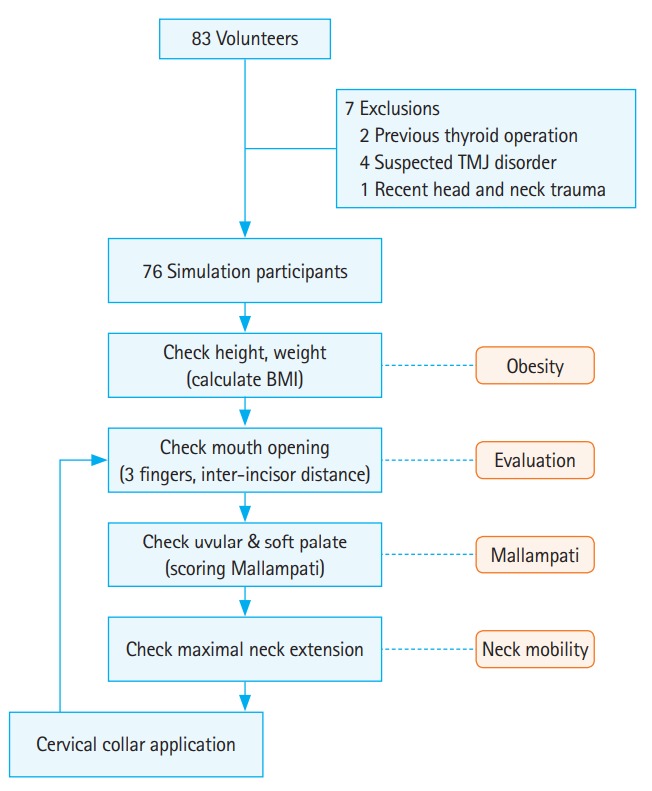
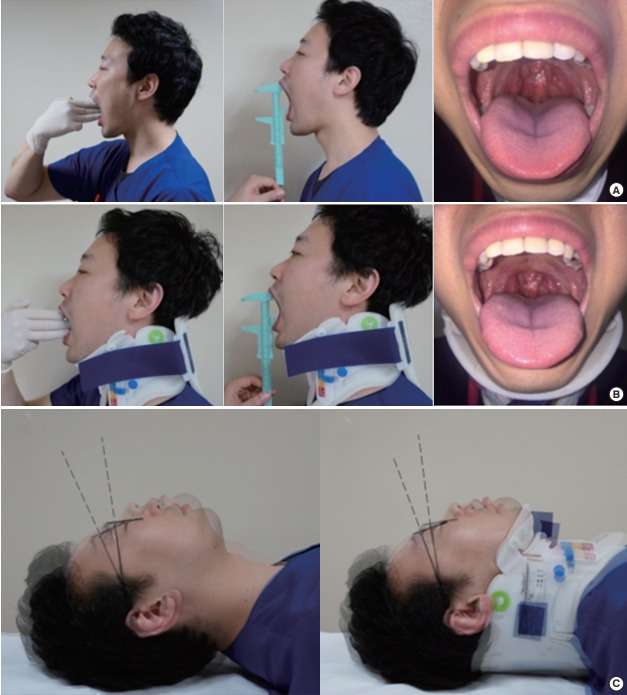
This simulation study was performed in 76 healthy volunteers. We measured the mouth opening, modified Mallampati classification, and neck extension before and after cervical collar application.
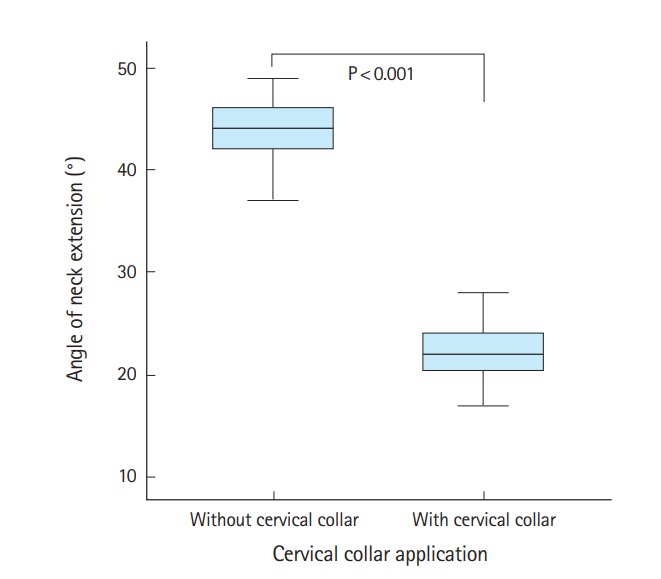
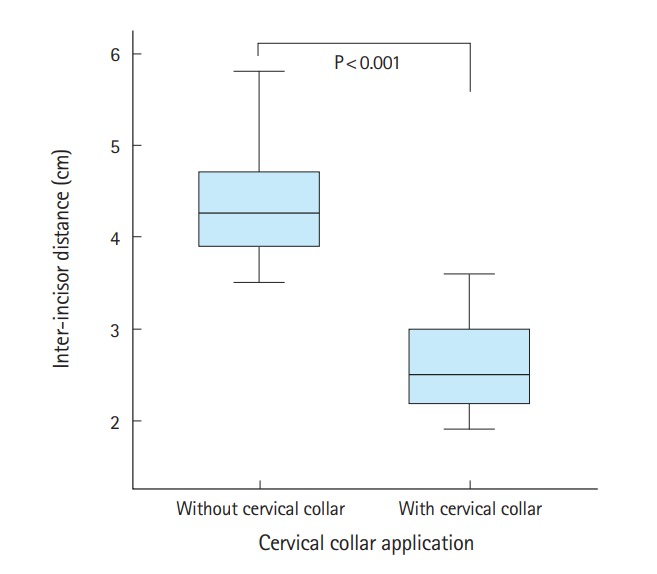
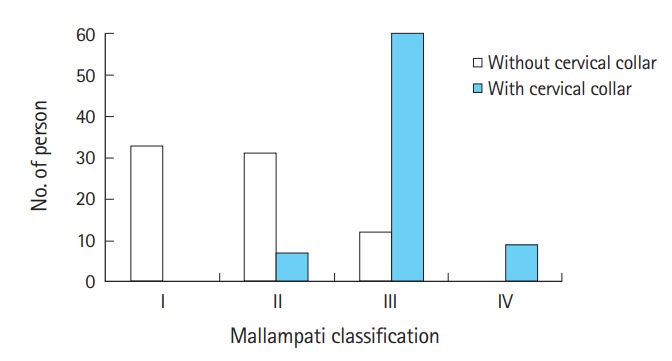
The mean inter-incisor distance significantly decreased from 4.3 to 2.6 cm (P<0.001). Fifty-seven participants classified as I and II were newly classified as III and IV according to the modified Mallampati classification after cervical collar application (16% to 91%). The angles of neck extension significantly decreased from 44° to 22° after cervical collar application (P<0.001). Before cervical collar application, our simulations predicted that 14 of 76 participants (18%) would have a difficult airway, whereas after cervical collar application, 76 of 76 (100%) were predicted to have a difficult airway.
All values for the LEMON criteria (mouth opening, modified Mallampati classification, and neck extension) worsened significantly after cervical collar application. Additionally, a difficult airway was predicted in all participants after cervical collar application.
对于因头颈部损伤而佩戴颈托的患者,气管插管操作极其困难。因此,我们分析了在佩戴颈托前后使用外部观察、评估3-3-2、马兰帕蒂评分、气道梗阻和颈部活动度(LEMON)标准的实际测量结果,以研究困难气道的原因。
本模拟研究在76名健康志愿者中进行。我们测量了佩戴颈托前后的开口度、改良马兰帕蒂分级和颈部伸展度。
平均门齿间距从4.3厘米显著降至2.6厘米(P<0.001)。根据改良马兰帕蒂分级,57名最初分类为I级和II级的参与者在佩戴颈托后重新分类为III级和IV级(从16%升至91%)。佩戴颈托后,颈部伸展角度从44°显著降至22°(P<0.001)。在佩戴颈托前,我们的模拟预测76名参与者中有14名(18%)会出现困难气道,而在佩戴颈托后,预测76名参与者全部(100%)会出现困难气道。
佩戴颈托后,LEMON标准的所有指标(开口度、改良马兰帕蒂分级和颈部伸展度)均显著恶化。此外,预测佩戴颈托后所有参与者都会出现困难气道。