Chen Zhongzhong, Lei Yunping, Cao Xuanye, Zheng Yufang, Wang Fang, Bao Yihua, Peng Rui, Finnell Richard H, Zhang Ting, Wang Hongyan
Obstetrics and Gynecology Hospital, State Key Laboratory of Genetic Engineering at School of Life Sciences, Institute of Reproduction and Development, Fudan University, Shanghai, 200011, China.
Key Laboratory of Reproduction Regulation of NPFPC, Collaborative Innovation Center of Genetics and Development, Fudan University, Shanghai, 200032, China.
BMC Med Genomics. 2018 Apr 4;11(1):38. doi: 10.1186/s12920-018-0355-9.
Mouse homozygous mutants in Wnt/planar cell polarity (PCP) pathway genes have been shown to cause neural tube defects (NTDs) through the disruption of normal morphogenetic processes critical to neural tube closure (NTC). Knockout mice that are heterozygotes of single PCP genes likely fail to produce NTD phenotypes, yet damaging variants detected in human NTDs are almost always heterozygous, suggesting that other deleterious interacting variants are likely to be present. Nonetheless, the Wnt/PCP pathway remains a genetic hotspot. Addressing these issues is essential for understanding the genetic etiology of human NTDs.
We performed targeted next-generation sequencing (NGS) on 30 NTD-predisposing Wnt/PCP pathway genes in 184 Chinese NTD cases. We subsequently replicated our findings for the CELSR1 gene in an independent cohort of 292 Caucasian NTD samples from the USA. Functional validations were confirmed using in vitro assays.
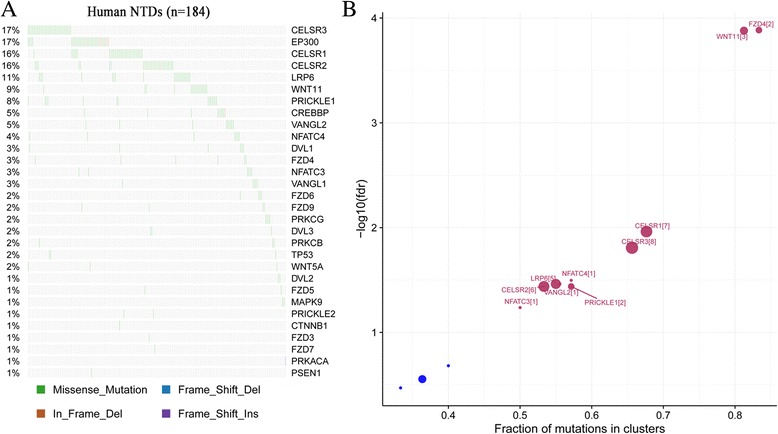
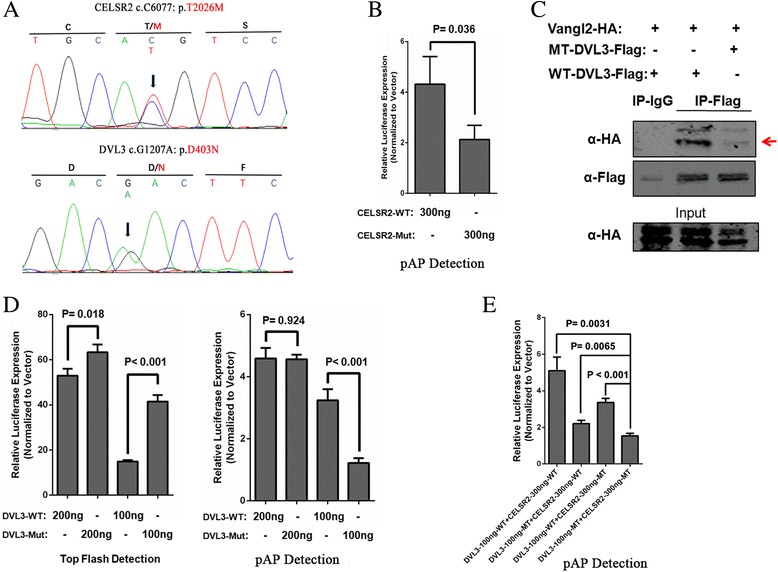
CELSR1, CELSR2 and CELSR3 genes were significantly clustered with rare driver coding mutations (q-value< 0.05) demonstrated by OncodriveCLUST. During the validation stage, the number of rare loss of function (LoF) variants in CELSR1 was significantly enriched in NTDs compared with the LoF counts in the ExAC database (p < 0.001). Functional studies indicated compound heterozygote variants of CELSR2 p.Thr2026Met and DVL3 p.Asp403Asn result in down regulation of PCP signals.
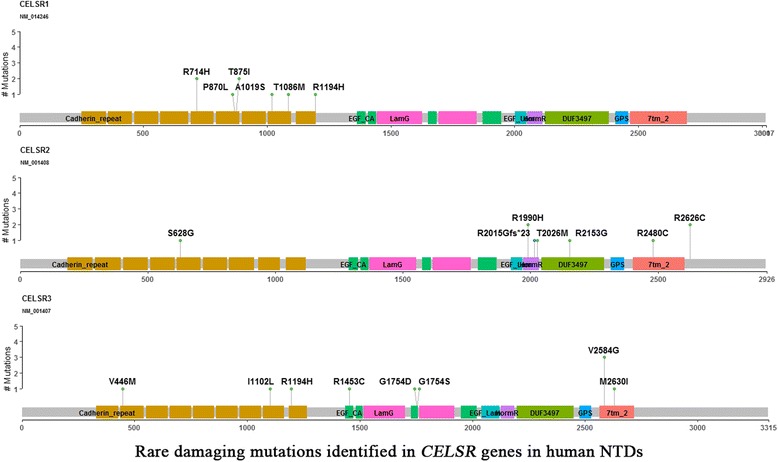
These data indicate rare damaging variants of the CELSR genes, identified in ~ 14% of NTD cases, are expected to be driver genes in the Wnt/PCP pathway. Compound damaging variants of CELSR genes and other Wnt/PCP genes, which were observed in 3.3% of the studied NTD cohort, are also expected to amplify these effects at the pathway level.
Wnt/平面细胞极性(PCP)通路基因的小鼠纯合突变体已被证明会通过破坏对神经管闭合(NTC)至关重要的正常形态发生过程而导致神经管缺陷(NTDs)。单个PCP基因的杂合子敲除小鼠可能不会产生NTD表型,但在人类NTDs中检测到的有害变异几乎总是杂合的,这表明可能存在其他有害的相互作用变异。尽管如此,Wnt/PCP通路仍然是一个遗传热点。解决这些问题对于理解人类NTDs的遗传病因至关重要。
我们对184例中国NTD病例中30个易导致NTD的Wnt/PCP通路基因进行了靶向二代测序(NGS)。随后,我们在美国的一个由292个白种人NTD样本组成的独立队列中对CELSR1基因的研究结果进行了重复验证。使用体外试验进行功能验证。
OncodriveCLUST显示,CELSR1、CELSR2和CELSR3基因与罕见的驱动编码突变显著聚集(q值<0.05)。在验证阶段,与ExAC数据库中的功能丧失(LoF)计数相比,CELSR1中罕见的功能丧失变异数量在NTDs中显著富集(p<0.001)。功能研究表明,CELSR2 p.Thr2026Met和DVL3 p.Asp403Asn的复合杂合子变异导致PCP信号下调。
这些数据表明,在约14%的NTD病例中鉴定出的CELSR基因的罕见有害变异有望成为Wnt/PCP通路中的驱动基因。在3.3%的研究NTD队列中观察到的CELSR基因和其他Wnt/PCP基因的复合有害变异,也有望在通路水平上放大这些效应。