Department of Pediatrics and Adolescent Medicine, Division of Pediatric Neurology, University Medical Center Göttingen, 37075, Göttingen, Germany.
School of Medicine, University Medical Center Göttingen, 37075, Göttingen, Germany.
Sci Rep. 2018 Apr 4;8(1):5594. doi: 10.1038/s41598-018-23908-z.
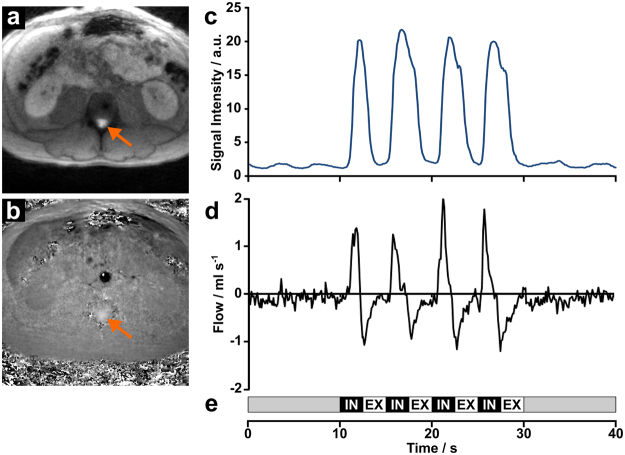
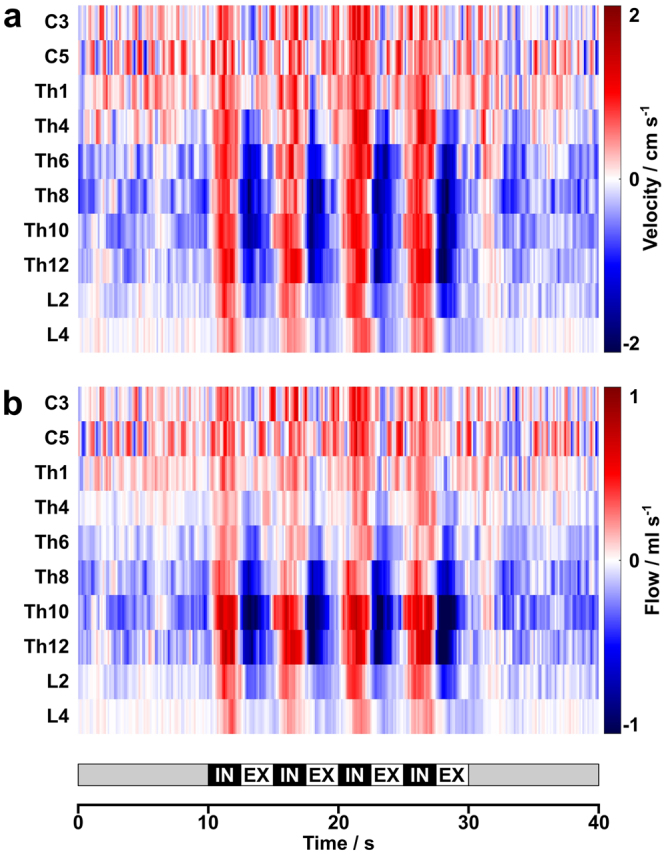
The dynamics of human CSF in brain and upper spinal canal are regulated by inspiration and connected to the venous system through associated pressure changes. Upward CSF flow into the head during inspiration counterbalances venous flow out of the brain. Here, we investigated CSF motion along the spinal canal by real-time phase-contrast flow MRI at high spatial and temporal resolution. Results reveal a watershed of spinal CSF dynamics which divides flow behavior at about the level of the heart. While forced inspiration prompts upward surge of CSF flow volumes in the entire spinal canal, ensuing expiration leads to pronounced downward CSF flow, but only in the lower canal. The resulting pattern of net flow volumes during forced respiration yields upward CSF motion in the upper and downward flow in the lower spinal canal. These observations most likely reflect closely coupled CSF and venous systems as both large caval veins and their anastomosing vertebral plexus react to respiration-induced pressure changes.
人类脑脊液在脑部和上椎管中的动力学受呼吸调节,并通过相关的压力变化与静脉系统相连。吸气时脑脊液向上流入头部,抵消了大脑的静脉流出。在这里,我们通过高时空分辨率的实时相位对比流动 MRI 研究了沿椎管的 CSF 运动。结果显示,脊髓 CSF 动力学存在分水岭,将大约在心脏水平的流动行为分开。虽然强制吸气会促使整个椎管中的 CSF 流量向上激增,但随后的呼气会导致明显的向下 CSF 流动,但仅在较低的椎管中。强制呼吸期间的净流量模式导致 CSF 在上部向上运动,而在下部向下运动。这些观察结果很可能反映了紧密耦合的 CSF 和静脉系统,因为大腔静脉及其吻合的椎丛都对呼吸引起的压力变化作出反应。