Department of Physics, University of Liverpool, Liverpool, UK.
Department of Physics and Astronomy, Aarhus University, Aarhus, Denmark.
Nature. 2018 May;557(7703):71-75. doi: 10.1038/s41586-018-0017-2. Epub 2018 Apr 4.
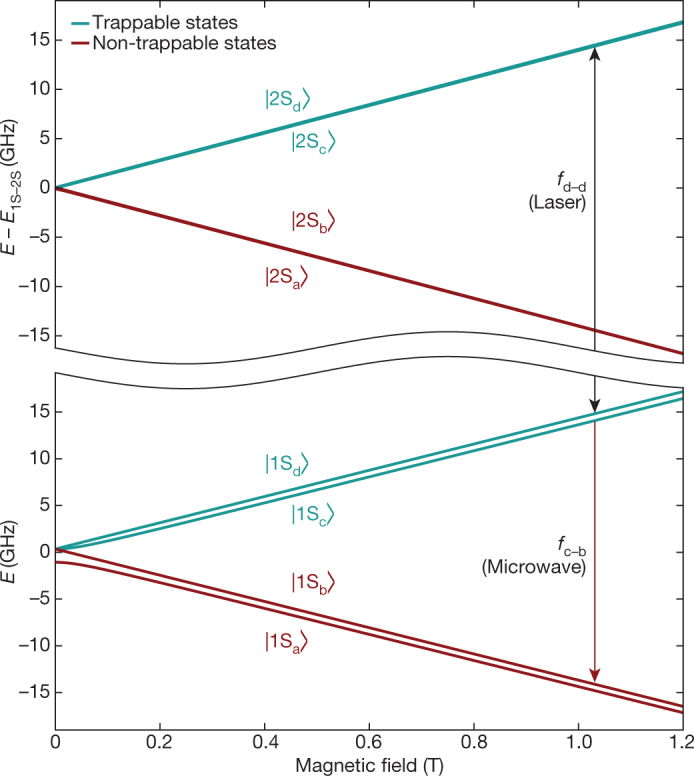
In 1928, Dirac published an equation that combined quantum mechanics and special relativity. Negative-energy solutions to this equation, rather than being unphysical as initially thought, represented a class of hitherto unobserved and unimagined particles-antimatter. The existence of particles of antimatter was confirmed with the discovery of the positron (or anti-electron) by Anderson in 1932, but it is still unknown why matter, rather than antimatter, survived after the Big Bang. As a result, experimental studies of antimatter, including tests of fundamental symmetries such as charge-parity and charge-parity-time, and searches for evidence of primordial antimatter, such as antihelium nuclei, have high priority in contemporary physics research. The fundamental role of the hydrogen atom in the evolution of the Universe and in the historical development of our understanding of quantum physics makes its antimatter counterpart-the antihydrogen atom-of particular interest. Current standard-model physics requires that hydrogen and antihydrogen have the same energy levels and spectral lines. The laser-driven 1S-2S transition was recently observed in antihydrogen. Here we characterize one of the hyperfine components of this transition using magnetically trapped atoms of antihydrogen and compare it to model calculations for hydrogen in our apparatus. We find that the shape of the spectral line agrees very well with that expected for hydrogen and that the resonance frequency agrees with that in hydrogen to about 5 kilohertz out of 2.5 × 10 hertz. This is consistent with charge-parity-time invariance at a relative precision of 2 × 10-two orders of magnitude more precise than the previous determination -corresponding to an absolute energy sensitivity of 2 × 10 GeV.
1928 年,狄拉克发表了一个将量子力学和狭义相对论结合起来的方程。这个方程的负能解,最初被认为是不真实的,但后来被证明代表了一类以前未被观察到和想象到的粒子——反物质。反物质粒子的存在是在 1932 年安德森发现正电子(或反电子)后得到证实的,但目前仍不清楚为什么在大爆炸后,物质而不是反物质幸存下来。因此,反物质的实验研究,包括对基本对称性(如电荷宇称和电荷宇称时间)的测试,以及对原始反物质(如反氦核)的证据的搜索,在当代物理研究中具有很高的优先级。氢原子在宇宙演化和我们对量子物理理解的历史发展中的基本作用,使得其反物质对应物——反氢原子——特别有趣。当前的标准模型物理要求氢和反氢具有相同的能级和谱线。最近观察到了激光驱动的 1S-2S 跃迁。在这里,我们使用磁囚禁的反氢原子来描述这个跃迁的一个超精细分量,并将其与我们仪器中氢的模型计算进行比较。我们发现,谱线的形状与预期的氢非常吻合,而且共振频率与氢的共振频率相差约 2.5×10 赫兹的 5 千赫兹。这与电荷宇称时间不变性相一致,相对精度为 2×10^-2,比以前的测定精度高两个数量级——对应于 2×10 GeV 的绝对能量灵敏度。