Shanh Farshid Ghorbani, Rahimnejad Samira, Bahrami Abdulrahman, Farhadian Maryam
Excellence Center of Occupational Health, Occupational Health and Safety Research Center, Hamadan, Iran.
Department of Biostatistics, School of Public Health, Hamadan University of Medical Sciences, Hamadan, Iran.
Indian J Occup Environ Med. 2017 Sep-Dec;21(3):121-127. doi: 10.4103/ijoem.IJOEM_86_17.
Long-term exposure to volatile organic compounds (VOCs) affects the occupancies health in petrochemical complex.
The aim of this study is to apply the lifetime cancer risk (LCR) and hazard quotient (HQ) in occupational exposure to estimate the risk of VOCs in petrochemical complexes.
A cross-sectional study was conducted in the petrochemical complex of Iran for a period of 1 year.
Sorbent tubes were used to obtain air samples from 169 workers at different petrochemical complexes in southern Iran. The compounds analyzed with gas chromatography equipped with a flame ionization detector (FID).
The data were analyzed by SPSS version 16. Comparison between the mean of pollutants concentration in personal samples was performed by one-way analysis of variance (ANOVA) test.
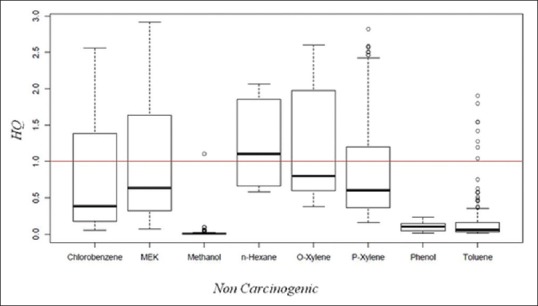
For all groups of workers, the results showed that exposure to carcinogenic compounds leads to LCR risks higher than 1 × 10. The mean of LCR for benzene is more than 10, and 53.3% of workers' exposed has a definite risk; the mean of LCR for workers exposed to ethyl benzene, epichlorohydrin, styrene, and trichloroethylene was between 10 and 10 and workers' exposure to these compounds was a probability risk for cancer. The mean of HQ was less than 1 for workers exposed to toluene, p-xylene, chlorobenzene, phenol, and methanol.
The risk assessment with LCR showed that carcinogenic compounds are the main threat to workers' health and precautions should be taken to control workers' risk.
长期接触挥发性有机化合物(VOCs)会影响石化企业员工的健康。
本研究旨在应用终生癌症风险(LCR)和危害商数(HQ)评估职业接触石化企业中VOCs的风险。
在伊朗的石化企业进行了为期1年的横断面研究。
使用吸附管从伊朗南部不同石化企业的169名工人中采集空气样本。采用配备火焰离子化检测器(FID)的气相色谱仪分析这些化合物。
数据采用SPSS 16版进行分析。通过单因素方差分析(ANOVA)检验对个人样本中污染物浓度的均值进行比较。
对所有工人群体而言,结果表明接触致癌化合物会导致LCR风险高于1×10⁻⁶。苯的LCR均值超过10⁻⁶,53.3%的接触工人存在明确风险;接触乙苯、环氧氯丙烷、苯乙烯和三氯乙烯的工人LCR均值在10⁻⁶至10⁻⁴之间,接触这些化合物的工人存在患癌概率风险。接触甲苯、对二甲苯、氯苯、苯酚和甲醇的工人HQ均值小于1。
LCR风险评估表明致癌化合物是对工人健康的主要威胁,应采取预防措施控制工人风险。