Shafiee Gita, Ostovar Afshin, Heshmat Ramin, Keshtkar Abbas Ali, Sharifi Farshad, Shadman Zhaleh, Nabipour Iraj, Soltani Akbar, Larijani Bagher
Chronic Diseases Research Center, Endocrinology and Metabolism Population Sciences Institute, Tehran University of Medical Sciences, Tehran, Iran.
The Persian Gulf Tropical Medicine Research Center, Bushehr University of Medical Sciences, Bushehr, Iran.
Int J Prev Med. 2018 Mar 9;9:25. doi: 10.4103/ijpvm.IJPVM_295_17. eCollection 2018.
Sacopenia is a common problem in elderly with the adverse outcomes. The objective of this study was to estimate the peak appendicular skeletal muscle mass (ASM) and age of its attainment by sex among the Iranian population.
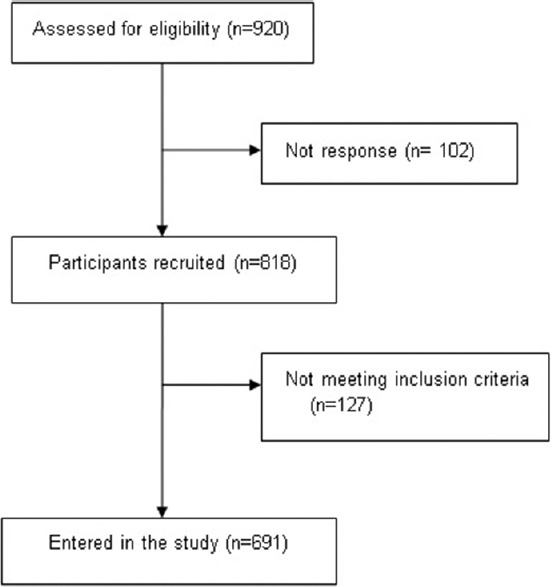
A total of 691 men and women aged 18-94 years participated in this cross-sectional, population-based study in Bushehr, Iran. ASM was measured by dual X-ray absorptiometry. Cutoff points for men and women were established considering two standard deviations (SDs) below the mean values of the skeletal muscle index (SMI) for young reference groups. The relationship between ASM and age was described by the second-degree regression models. Two SDs below the mean SMIs of reference groups were as cutoff values of low muscle mass in Iranian population.
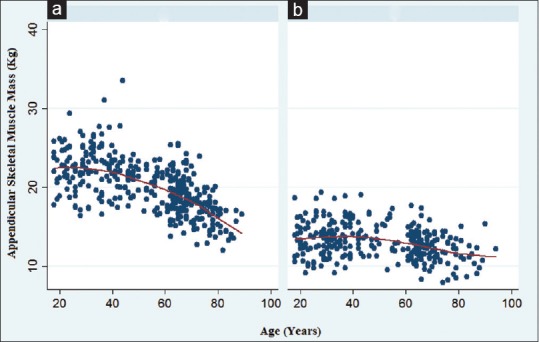
The peak ASM values were 21.35 ± 0.12 Kg and 13.68 ± 0.10 Kg, and the age at peak ASM were 26 (24-28) years and 34 (33-35) years for men and women, respectively. Mean and SD of SMI in those ages were 7.01 ± 0.02 Kg/m and 5.44 ± 0.02 Kg/m among men and women, respectively. Calculated cutoff values of low muscle mass among the Iranian population were 7.0 Kg/m and 5.4 Kg/m among men and women, respectively.
Iranian reference values of SMI for both genders were similar to Asia Working Group for Sarcopenia recommendation and lower than the United States and European values. Further studies from different nations and the Middle East countries are needed to obtain reference values for populations, enabling the researchers for comparison and also more valid reports on sarcopenia prevalence.
肌肉减少症是老年人中常见的问题,会导致不良后果。本研究的目的是估计伊朗人群中按性别划分的四肢骨骼肌质量(ASM)峰值及其达到峰值的年龄。
共有691名年龄在18 - 94岁的男性和女性参与了在伊朗布什尔进行的这项基于人群的横断面研究。通过双能X线吸收法测量ASM。根据年轻参照组骨骼肌指数(SMI)平均值以下两个标准差(SD)来确定男性和女性的临界值。用二次回归模型描述ASM与年龄之间的关系。以参照组平均SMI以下两个标准差作为伊朗人群低肌肉量的临界值。
男性ASM峰值为21.35±0.12千克,女性为13.68±0.10千克;男性和女性达到ASM峰值的年龄分别为26(24 - 28)岁和34(33 - 35)岁。在这些年龄时,男性和女性的SMI平均值及标准差分别为7.01±0.02千克/米和5.44±0.02千克/米。伊朗人群中计算出的低肌肉量临界值男性和女性分别为7.0千克/米和5.4千克/米。
伊朗两性的SMI参考值与亚洲肌肉减少症工作组的建议相似,低于美国和欧洲的数值。需要来自不同国家和中东国家的进一步研究来获取人群参考值,以便研究人员进行比较,并能更准确地报告肌肉减少症的患病率。