Kim Yeon-Pyo, Joh Ju-Youn, Kim Sun, Hwang Hwan-Sik, Shin Il-Seon
Department of Psychiatry, Chonnam National University Hwasun Hospital, 322, Seoyang-ro, Hwasun-eup, Hwasun-gun, 519-809 Chonnam, Korea.
BMC Geriatr. 2014 Dec 23;14:144. doi: 10.1186/1471-2318-14-144.
This study was conducted to determine the prevalence of a low appendicular skeletal muscle index (ASMI) using three cut-off points (mean ASMI-2SD of a gender-specific young reference group (aged 18-39 years), mean ASMI-1SD of a gender-specific young reference group, and the lower 20 percentile value of a gender-specific older group (aged ≥ 65 years)) in Korean older people and the relationship between ASMI and subjective health-related quality of life.
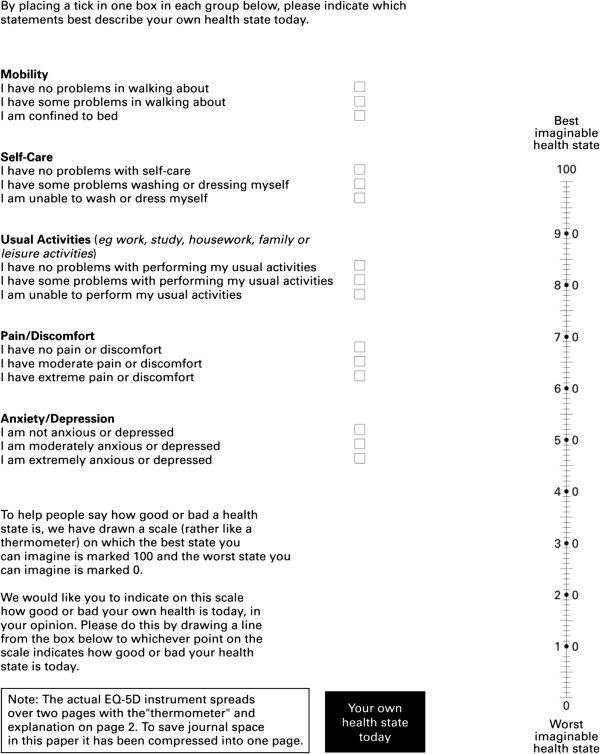
This study utilized data acquired during the Korean National Health and Nutrition Examination Survey (KNHANES) from 2008-2011. Dual-energy X-ray absorptiometry body compositional data was obtained from a subsample of 6538 subjects (men 2804, women 3734) aged 18-39 and 4413 subjects (men 1872, women 2541) aged 65 years and older. The three definitions of low appendicular skeletal muscle and the EQ-5D-3 L-Korean descriptive system were applied to Korean older people.
For the ASMI cutoff points used, in men, the three cutoff points were ASMI 2SD (6.09 kg/m2), ASMI 20 (6.48 kg/m2), and ASMI 1SD (6.95 kg/m2). In women, ASMI 2SD (4.38 kg/m2) was the lowest, followed by ASMI 1SD (4.96 kg/m2) and ASMI 20 (5.33 kg/m2). Proportions of older subjects with a low ASMI using the three cutoff points were 9.7% (ASMI 2SD) and 40.9% (ASMI 1SD) in men, and 0.7% (ASMI 2SD) and 7.4% (ASMI 1SD) in women. By multivariate ordinal logistic regression analysis, men with a low ASMI had significantly high odd ratios for the three domains of mobility (p < 0.001), self-care (p = 0.005), and usual activities (p = 0.004) among the five domains of the EQ-5D and EQ-5D index (p = 0.010).
The ASMI 2SD cut-off points for older Koreans, 6.09 kg/m2 for men and 4.38 kg/m2 for women, resulted in low prevalences of a low ASM, that is, 9.7% for men and 0.7% for women, and showed low clinical usefulness due to very low determined prevalence in women. Hence, we suggest that the cut-off point of the lowest 20% of Korean older people (men: 6.48 kg/m2, women; 5.33 kg/m2) be used for older Koreans.
本研究旨在确定韩国老年人中使用三个切点(特定性别年轻参考组(18 - 39岁)的平均四肢骨骼肌指数(ASMI)减去2个标准差、特定性别年轻参考组的平均ASMI减去1个标准差以及特定性别老年组(年龄≥65岁)的第20百分位数下限值)定义的低四肢骨骼肌指数(ASMI)的患病率,以及ASMI与主观健康相关生活质量之间的关系。
本研究利用了2008 - 2011年韩国国家健康与营养检查调查(KNHANES)期间获取的数据。双能X线吸收法身体成分数据来自6538名18 - 39岁受试者(男性2804名,女性3734名)和4413名65岁及以上受试者(男性1872名,女性2541名)的子样本。将低四肢骨骼肌的三种定义和EQ - 5D - 3L - 韩国描述系统应用于韩国老年人。
对于所使用的ASMI切点,男性的三个切点分别为ASMI 2SD(6.09kg/m²)、ASMI 20(6.48kg/m²)和ASMI 1SD(6.95kg/m²)。女性中,ASMI 2SD(4.38kg/m²)最低,其次是ASMI 1SD(4.96kg/m²)和ASMI 20(5.33kg/m²)。使用这三个切点定义的低ASMI老年受试者比例,男性中分别为9.7%(ASMI 2SD)和40.9%(ASMI 1SD),女性中分别为0.7%(ASMI 2SD)和7.4%(ASMI 1SD)。通过多变量有序逻辑回归分析,ASMI低的男性在EQ - 5D的五个领域中的活动能力(p<0.001)、自我护理(p = 0.005)和日常活动(p = 0.004)这三个领域以及EQ - 5D指数(p = 0.010)方面具有显著较高的比值比。
韩国老年人的ASMI 2SD切点,男性为6.09kg/m²,女性为4.38kg/m²,导致低ASMI的患病率较低,即男性为9.7%,女性为0.7%,且由于女性中确定的患病率极低,临床实用性较低。因此,我们建议将韩国老年人中最低的20%的切点(男性:6.48kg/m²,女性:5.33kg/m²)用于韩国老年人。