Department of General Surgery, The Second Affiliated Hospital of Nanchang University, Nanchang, Jiangxi 330000, P.R. China.
Jiangxi Province Key Laboratory of Molecular Medicine, The Second Affiliated Hospital of Nanchang University, Nanchang, Jiangxi 330000, P.R. China.
Int J Oncol. 2018 Jun;52(6):1912-1922. doi: 10.3892/ijo.2018.4348. Epub 2018 Mar 29.
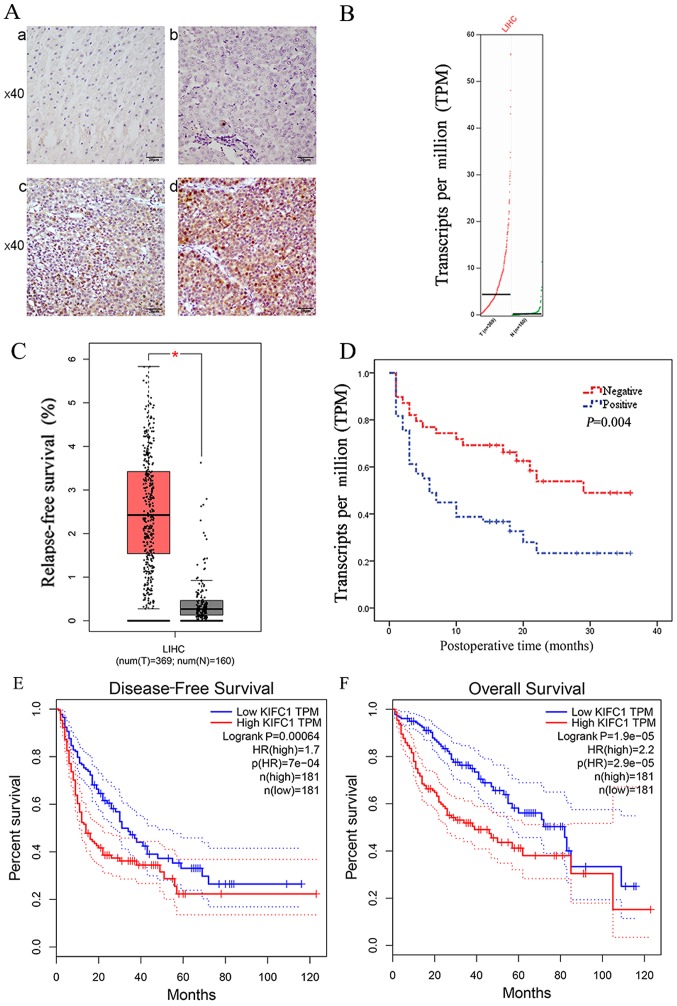
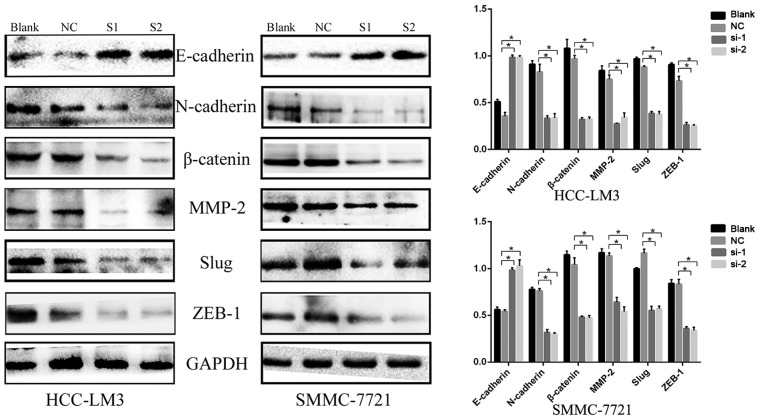
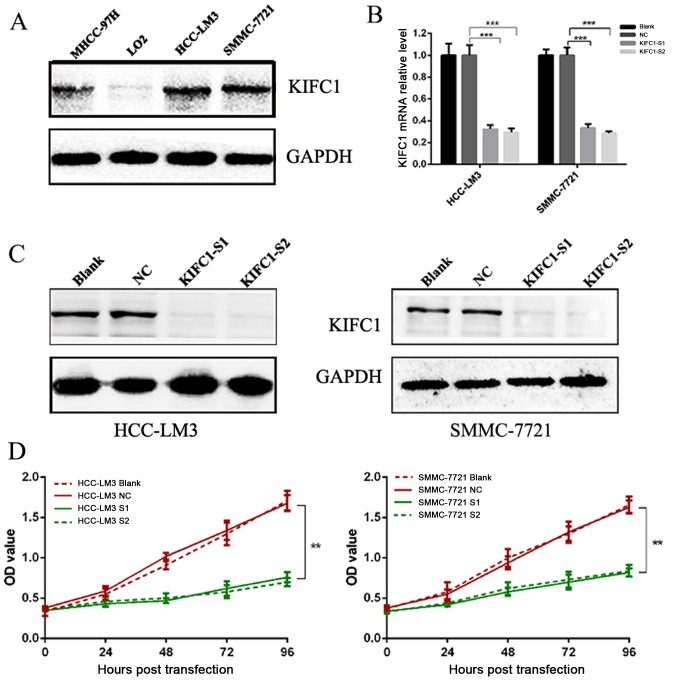
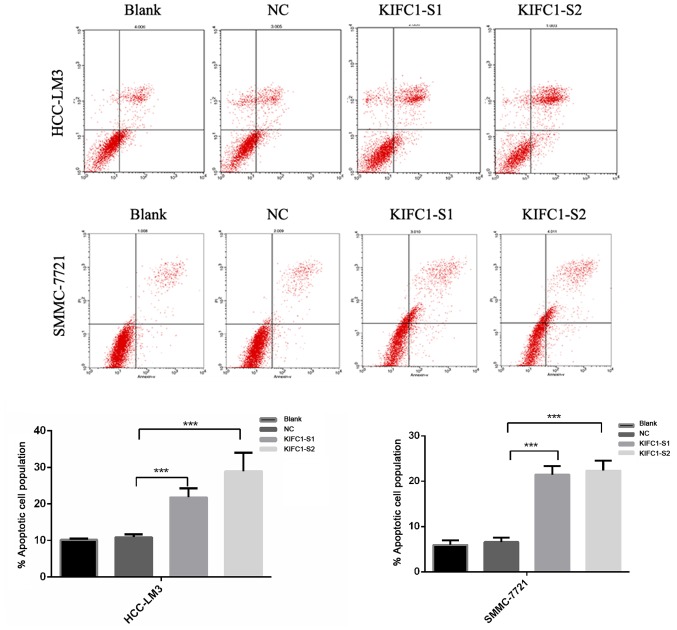
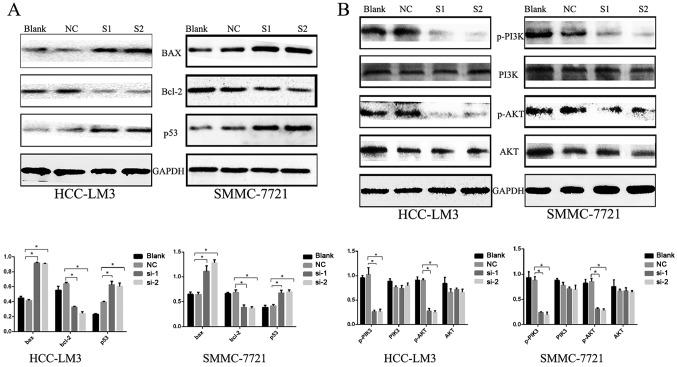
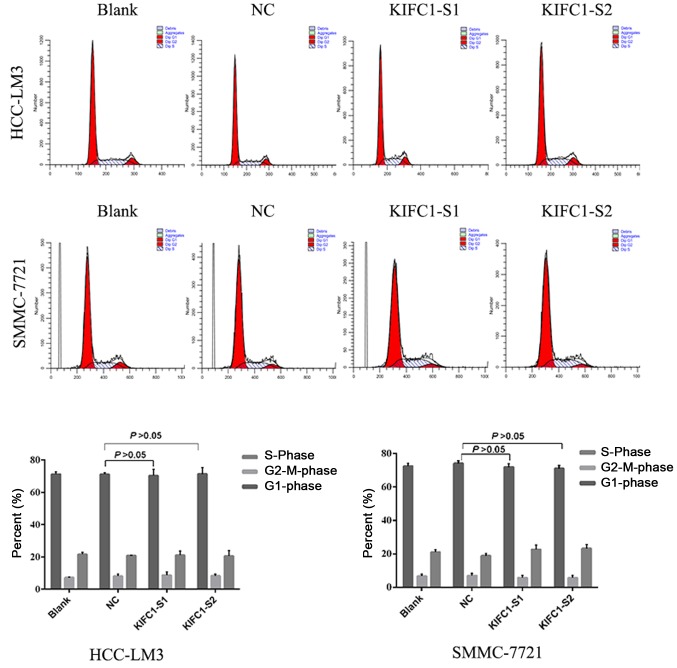
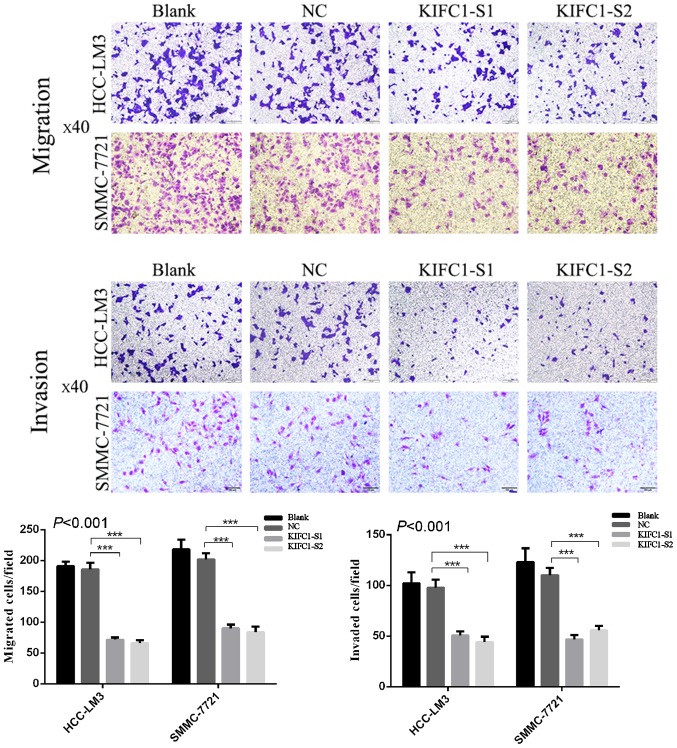
Kinesin family member C1 (KIFC1, also known as HSET) is a minus end-directed motor protein, which is critical in centrosome clustering. The present study investigated the expression of KIFC1 in paired hepatocellular carcinoma (HCC) tissues and adjacent non-cancerous tissues from 91 patients by immunohistochemical analysis; clinical data were concomitantly collected. KIFC1 was expressed at high levels in HCC tissues, compared with that in peritumoral tissues (54.9 vs. 14.3%; P<0.01), and its expression correlated with tumor emboli, metastasis, recurrence and time of recurrence. Kaplan-Meier analysis showed that the expression of KIFC1 was significantly associated with tumor-free survival rates. In addition, multivariate analyses revealed that the overexpression of KIFC1was an independent predictive marker in patients with HCC. Consistently, data derived from GEPIA was in agreement with the results. In vitro, KIFC1 knockdown effectively decreased HCC cell viability, and induced apoptosis and cell death. KIFC1 knockdown also significantly suppressed tumor cell migration and invasion in vitro. Mechanistically, the apoptosis-related protein, B-cell lymphoma-2 (Bcl-2), was downregulated in KIFC1 small interfering RNA-treated groups, whereas thee levels of Bcl-2-associated X protein and p53 were upregulated. In addition, the expression levels of phosphorylated phosphoinositide 3-kinase and phosphorylated AKT were decreased significantly when KIFC1 was silenced. The epithelial-mesenchymal transition-related proteins, N-cadherin, matrix metalloproteinase-2 (MMP-2), β-catenin, Slug, and Zinc finger E-box-binding homeobox 1, were downregulated, whereas the expression of E-cadherin was upregulated. The overexpression of KIFC1 was correlated closely with the progression of HCC and poor prognosis, and suggested that the expression levels of KIFC1 are a potential prognostic biomarker and therapeutic target in HCC.
驱动蛋白家族成员 C1(KIFC1,也称为 HSET)是一种向minus 端定向的运动蛋白,在中心体聚类中起关键作用。本研究通过免疫组织化学分析检测了 91 例配对肝癌(HCC)组织和相邻非癌组织中 KIFC1 的表达情况;同时收集了临床资料。与癌旁组织(54.9% vs. 14.3%;P<0.01)相比,KIFC1 在 HCC 组织中高表达,其表达与肿瘤栓子、转移、复发和复发时间有关。Kaplan-Meier 分析表明,KIFC1 的表达与无复发生存率显著相关。此外,多变量分析显示,KIFC1 的过表达是 HCC 患者的独立预测标志物。GEPIA 数据也与结果一致。在体外,KIFC1 敲低有效降低了 HCC 细胞活力,并诱导细胞凋亡和死亡。KIFC1 敲低还显著抑制了 HCC 细胞在体外的迁移和侵袭。机制上,B 细胞淋巴瘤-2(Bcl-2)凋亡相关蛋白在 KIFC1 小干扰 RNA 处理组中下调,而 Bcl-2 相关 X 蛋白和 p53 的水平上调。此外,当 KIFC1 沉默时,磷酸化磷脂酰肌醇 3-激酶和磷酸化 AKT 的表达水平显著降低。上皮-间充质转化相关蛋白 N-钙黏蛋白、基质金属蛋白酶-2(MMP-2)、β-连环蛋白、Slug 和锌指 E-盒结合同源框 1 下调,而 E-钙黏蛋白表达上调。KIFC1 的过表达与 HCC 的进展和不良预后密切相关,提示 KIFC1 的表达水平可能是 HCC 的一个潜在预后生物标志物和治疗靶点。