Jiao Binbin, Lai Shicong, Xu Xin, Zhang Meng, Diao Tongxiang, Zhang Guan
Peking University China-Japan Friendship School of Clinical Medicine Department of Urology, China-Japan Friendship Hospital, Chaoyang Peking University Fifth School of Clinical Medicine Department of Urology, Beijing Hospital, Dongcheng, Beijing, China.
Medicine (Baltimore). 2018 Apr;97(14):e0283. doi: 10.1097/MD.0000000000010283.
To assess the current evidence of effectiveness and safety of single-incision mini-slings (MiniArc) versus transobturator midurethral slings in the management of female stress urinary incontinence (SUI).
A systematic search was performed from the electronic databases including PubMed, EMBASE, and Cochrane Library by November 2017. Using RevMan5.3 statistical software, the primary outcomes including subject and objective cure rates at 6 to 24 months follow-up were evaluated. Meanwhile, analysis was also performed for comparing the secondary outcomes such as peri- and postoperative complications, operative data, and quality of life.
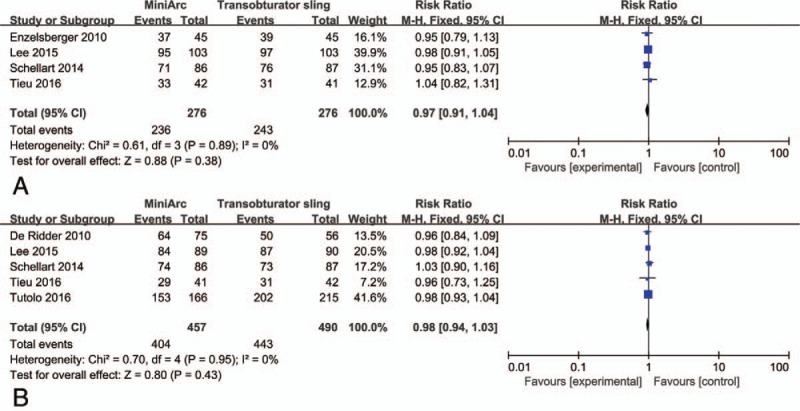
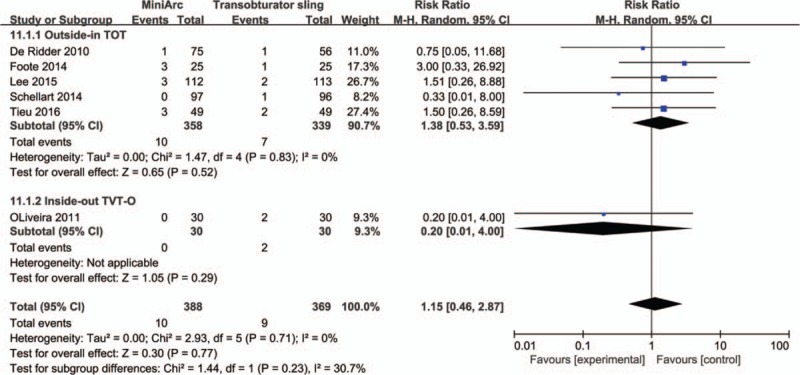
Six randomized controlled trials (RCTs) and 6 retrospective cohort studies involving 1794 patients with SUI were analyzed based on the inclusion criteria. On the basis of our analysis, MiniArc was proven to have a noninferior clinical efficacy compared with transobturator midurethral slings with respect to the objective cure rate (risk ratio [RR] = 0.98, 95% confidence interval [CI] 0.94-1.03, P = .43) and subjective cure rate (RR = 0.97, 95% CI 0.91-1. 04, P = .38). In addition, pooled analysis showed that MiniArc had significantly lower postoperative pain scores (mean difference [MD] = -1.70, 95% CI -3.17 to -0.23, P = .02) and less postoperative groin pain (RR = 0.42, 95% CI 0.18-0.98, P = .04). Moreover, the MiniArc group also had a significantly shorter operation time (MD = -6.12, 95% CI -8.61 to -3.64, P < .001), less blood loss (MD = -16.67, 95% CI -26.29 to -7.05, P < .001), shorter in-patient stay (MD = 1.30, 95% CI -1.74 to -0.86, P < .001), and less urinary retention risk (RR = 1.15, 95% CI 0.46-2.87, P = .77). However, overall evidence was insufficient to suggest a statistically significant difference in the adverse event profile for MiniArc compared with transobturator slings.
This meta-analysis indicates that MiniArc is an effective method treating SUI. When compared with transobturator slings, it not only has a similar high cure rates, but also is associated with shorter operation time, less blood loss, more favorable recovery time, lower postoperative pain scores, less postoperative groin pain, less urinary retention, and absence of a visible wound. However, the findings of this study should be further confirmed by well-designed prospective RCTs with a larger patient series.
评估单切口迷你吊带(MiniArc)与经闭孔中段尿道吊带治疗女性压力性尿失禁(SUI)的有效性和安全性的现有证据。
截至2017年11月,在包括PubMed、EMBASE和Cochrane图书馆在内的电子数据库中进行了系统检索。使用RevMan5.3统计软件,评估主要结局,包括6至24个月随访时的主观和客观治愈率。同时,还对次要结局进行了分析,如围手术期和术后并发症、手术数据和生活质量。
根据纳入标准,分析了6项随机对照试验(RCT)和6项回顾性队列研究,涉及1794例SUI患者。根据我们的分析,就客观治愈率(风险比[RR]=0.98,95%置信区间[CI]0.94 - 1.03,P=0.43)和主观治愈率(RR=0.97,95%CI 0.91 - 1.04,P=0.38)而言,MiniArc与经闭孔中段尿道吊带相比,临床疗效不劣。此外,汇总分析表明,MiniArc术后疼痛评分显著更低(平均差[MD]= - 1.70,95%CI - 3.17至 - 0.23,P=0.02),术后腹股沟疼痛更少(RR=0.42,95%CI 0.18 - 0.98,P=0.04)。此外,MiniArc组手术时间显著更短(MD= - 6.12,95%CI - 8.61至 - 3.64,P<0.001),失血量更少(MD= - 16.67,95%CI - 26.29至 - 7.05,P<0.001),住院时间更短(MD=1.30,95%CI - 1.74至 - 0.86,P<0.001),尿潴留风险更低(RR=1.15,95%CI 0.46 - 2.87,P=0.77)。然而,总体证据不足以表明MiniArc与经闭孔吊带在不良事件方面存在统计学显著差异。
这项荟萃分析表明MiniArc是治疗SUI的有效方法。与经闭孔吊带相比,它不仅治愈率相似,而且手术时间更短、失血量更少、恢复时间更有利、术后疼痛评分更低、术后腹股沟疼痛更少、尿潴留更少且无可见伤口。然而,本研究结果应通过设计良好、样本量更大的前瞻性RCT进一步证实。