Saber Afnan M, Altoukhi Doua H, Horaib Mariam F, El-Housseiny Azza A, Alamoudi Najlaa M, Sabbagh Heba J
Pediatric Dentistry Department, Faculty of Dentistry, King Abdulaziz University, P.O. Box 80209, Jeddah, 21589, Saudi Arabia.
Pediatric Dentistry Department, Faculty of Dentistry, Alexandria University, Alexandria, Egypt.
BMC Oral Health. 2018 Apr 5;18(1):59. doi: 10.1186/s12903-018-0516-4.
The aim of this study was to systematically review the literature to determine the sequelae of early extraction of compromised first permanent molars (FPMs) with regard to the skeletal and dental development of 5- to 15-year-old children. Meta-analysis was conducted when applicable.
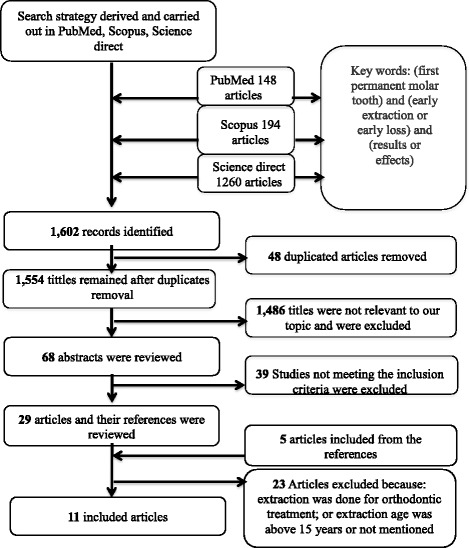
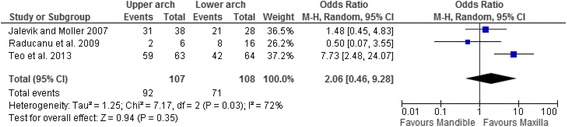
Our research protocol included a search strategy, inclusion/exclusion criteria, and a data extraction plan. The search engines used were PubMed, Scopus, and Science Direct. Study selection was performed independently by three reviewers. Articles published from 1960 to 2017 were reviewed based on inclusion and exclusion criteria. Meta-analysis was performed to compare space closure between upper and lower arches.
Eleven studies fulfilled the inclusion criteria. The consequences were decrease in post extraction space, accelerated development and eruption of second permanents molars (SPMs) and third molars, a decrease in caries and/or fillings on the proximal surfaces of adjacent teeth, lingual tipping and retrusion of incisors, and counter clockwise rotation of the occlusal plane.
There were several consequences of early extraction of FPMs, which were related to skeletal and dental development. Our systematic review suggests that comprehensive evaluation of the compromised FPMs should be performed before planning an extraction. The ideal time for FPM extraction is when the SPM is at the early bifurcation stage in order to achieve complete closure of the extraction space by the SPM. Benefits should be weighed over the risks to decrease the risk of unfavorable outcomes as much as possible. However, due to the limited evidence on the outcomes and variables that influence them, high-quality prospective studies are needed.
本研究的目的是系统回顾文献,以确定拔除5至15岁儿童患龋第一恒磨牙(FPMs)对骨骼和牙齿发育的后遗症。适用时进行荟萃分析。
我们的研究方案包括检索策略、纳入/排除标准和数据提取计划。使用的搜索引擎有PubMed、Scopus和ScienceDirect。由三位审阅者独立进行研究选择。根据纳入和排除标准对1960年至2017年发表的文章进行审查。进行荟萃分析以比较上下牙弓间的间隙关闭情况。
11项研究符合纳入标准。后果包括拔牙后间隙减小、第二恒磨牙(SPMs)和第三磨牙的发育和萌出加速、相邻牙齿邻面龋和/或充填物减少、切牙舌倾和后缩以及咬合平面逆时针旋转。
早期拔除FPMs有多种后果,与骨骼和牙齿发育相关。我们的系统评价表明,在计划拔牙前应对患龋FPMs进行全面评估。FPMs拔除的理想时机是SPM处于早期分叉阶段,以便SPM完全关闭拔牙间隙。应权衡利弊以尽可能降低不良后果的风险。然而,由于关于结果及其影响变量的证据有限,需要高质量的前瞻性研究。