Rojas Sara, Colinet Isabel, Cunha Denise, Hidalgo Tania, Salles Fabrice, Serre Christian, Guillou Nathalie, Horcajada Patricia
Institut Lavoisier, CNRS UMR 8180, UVSQ, Université Paris-Saclay, 45, Avenue Des Etats Unis, 78035 Versailles Cedex, France.
Institut Charles Gerhardt Montpellier, CNRS UMR 5253, UM, ENSCM, Place E. Bataillon, 34095 Montpellier Cedex 05, France.
ACS Omega. 2018 Mar 31;3(3):2994-3003. doi: 10.1021/acsomega.8b00185. Epub 2018 Mar 12.
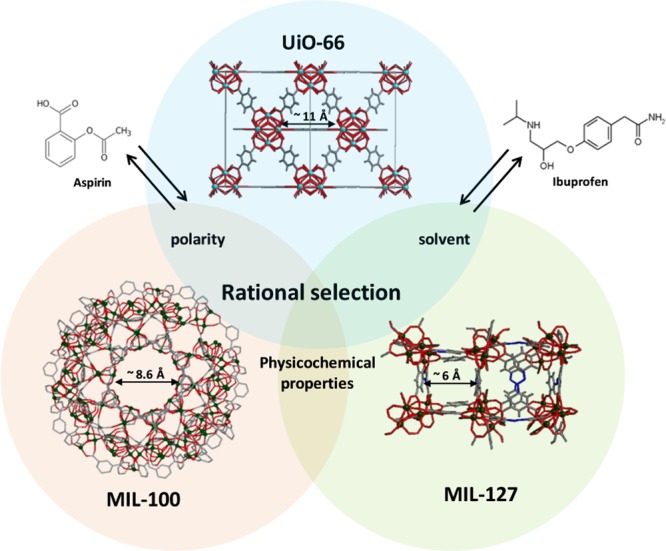
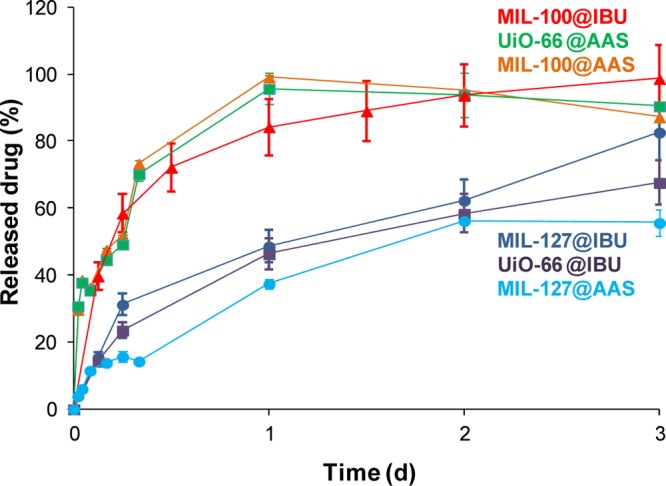
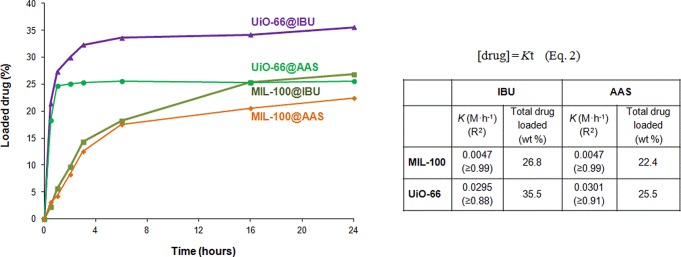
Although metal-organic frameworks (MOFs) have widely demonstrated their convenient performances as drug-delivery systems, there is still work to do to fully understand the drug incorporation/delivery processes from these materials. In this work, a combined experimental and computational investigation of the main structural and physicochemical parameters driving drug adsorption/desorption kinetics was carried out. Two model drugs (aspirin and ibuprofen) and three water-stable, biocompatible MOFs (MIL-100(Fe), UiO-66(Zr), and MIL-127(Fe)) have been selected to obtain a variety of drug-matrix couples with different structural and physicochemical characteristics. This study evidenced that the drug-loading and drug-delivery processes are mainly governed by structural parameters (accessibility of the framework and drug volume) as well as the MOF/drug hydrophobic/hydrophilic balance. As a result, the delivery of the drug under simulated cutaneous conditions (aqueous media at 37 °C) demonstrated that these systems fulfill the requirements to be used as topical drug-delivery systems, such as released payload between 1 and 7 days. These results highlight the importance of the rational selection of MOFs, evidencing the effect of geometrical and chemical parameters of both the MOF and the drug on the drug adsorption and release.
尽管金属有机框架材料(MOFs)作为药物递送系统已广泛展现出其便利的性能,但要全面了解这些材料的药物载入/递送过程仍有工作要做。在这项工作中,对驱动药物吸附/解吸动力学的主要结构和物理化学参数进行了实验与计算相结合的研究。选择了两种模型药物(阿司匹林和布洛芬)以及三种水稳定、生物相容性的MOFs(MIL-100(Fe)、UiO-66(Zr)和MIL-127(Fe)),以获得具有不同结构和物理化学特性的多种药物-基质组合。该研究表明,药物负载和药物递送过程主要受结构参数(框架的可及性和药物体积)以及MOF/药物的疏水/亲水平衡控制。结果,在模拟皮肤条件(37°C的水性介质)下的药物递送表明,这些系统满足用作局部药物递送系统的要求,例如在1至7天内释放有效载荷。这些结果突出了合理选择MOFs的重要性,证明了MOF和药物的几何和化学参数对药物吸附和释放的影响。