
金属有机框架:药物递送应用及未来前景。
Metal-organic frameworks: Drug delivery applications and future prospects.
作者信息
Mhettar Prachi, Kale Niraj, Pantwalawalkar Jidnyasa, Nangare Sopan, Jadhav Namdeo
机构信息
Department of Pharmaceutics, Bharati Vidyapeeth College of Pharmacy, Kolhapur 416013 Maharashtra State, India.
Department of Pharmaceutics, Dr. D. Y. Patil Institute of Pharmaceutical Sciences & Research, Pimpri, Pune 411018, Maharashtra State, India.
出版信息
ADMET DMPK. 2023 Nov 17;12(1):27-62. doi: 10.5599/admet.2057. eCollection 2024.
BACKGROUND AND PURPOSE
Metal-organic frameworks (MOFs) have gained incredible consideration in the biomedical field due to their flexible structural configuration, tunable pore size and tailorable surface modification. These inherent characteristics of MOFs portray numerous merits as potential drug carriers, depicting improved drug loading, site-specific drug delivery, biocompatibility, biodegradability, etc.
REVIEW APPROACH
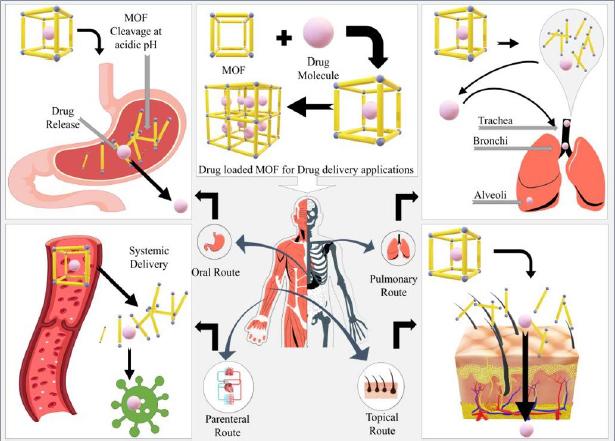
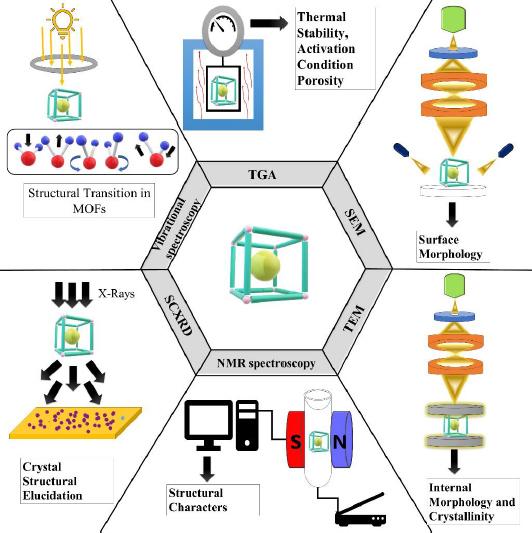
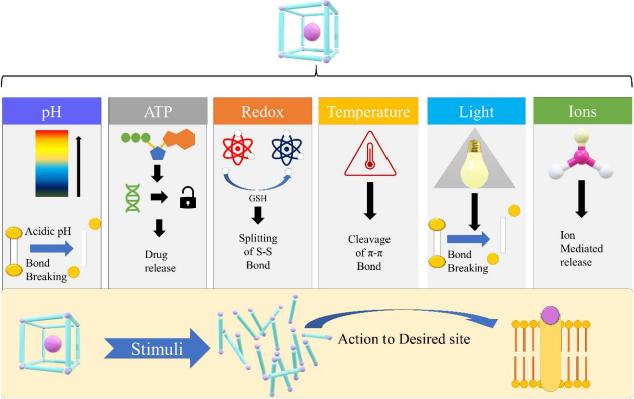
The current review article sheds light on the synthesis and use of MOFs in drug delivery applications. In the beginning, a brief overview of the key components and efficient fabrication techniques for MOF synthesis, along with its characterization methods, have been presented. The MOFs-based formulations have been critically discussed. The application of the design of experiments (DoE) approach to optimize MOFs has been elucidated. The MOFs-based formulations, especially the application of stimuli-responsive MOFs for site-specific drug delivery, have been deciphered. Along with drug release kinetic models, several administration methods for MOFs have also been enunciated. Subsequently, MOFs as future potential drug carriers have been elaborated.
KEY RESULTS AND CONCLUSION
Recently, MOFs have emerged as versatile drug delivery carriers possessing customization potential and meeting the needs of spatio-temporal drug delivery. Researchers have devised several environment-friendly approaches for MOF construction and surface modification. Owing to stimuli-responsive potential, MOFs have demonstrated their prominent therapeutic efficacy via several routes of administration. The numerous benefits of MOFs would certainly open up a new vista for its novel drug delivery applications.
背景与目的
金属有机骨架材料(MOFs)因其灵活的结构构型、可调节的孔径和可定制的表面修饰,在生物医学领域受到了极大的关注。MOFs的这些固有特性使其作为潜在的药物载体具有诸多优点,如提高药物负载量、实现位点特异性药物递送、生物相容性、生物可降解性等。
综述方法
当前这篇综述文章阐述了MOFs在药物递送应用中的合成与应用。首先,简要概述了MOF合成的关键成分和有效制备技术,以及其表征方法。对基于MOFs的制剂进行了批判性讨论。阐明了实验设计(DoE)方法在优化MOFs方面的应用。解读了基于MOFs的制剂,特别是刺激响应性MOFs在位点特异性药物递送中的应用。除了药物释放动力学模型外,还阐述了几种MOFs的给药方法。随后,详细说明了MOFs作为未来潜在药物载体的情况。
关键结果与结论
最近,MOFs已成为具有定制潜力且满足时空药物递送需求的多功能药物递送载体。研究人员设计了几种环境友好的MOF构建和表面修饰方法。由于具有刺激响应潜力,MOFs已通过多种给药途径展现出显著的治疗效果。MOFs的众多优点必将为其新型药物递送应用开辟新的前景。
 Zotero 插件