Wellcome Centre for Integrative Neuroimaging, University of Oxford, Oxford, United Kingdom.
Department of Experimental Psychology, University of Oxford, Oxford, United Kingdom.
Hum Brain Mapp. 2018 Aug;39(8):3109-3126. doi: 10.1002/hbm.24063. Epub 2018 Apr 6.
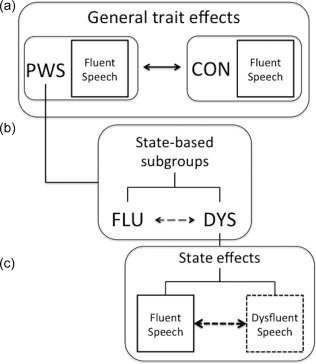
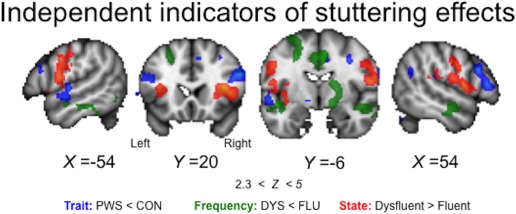
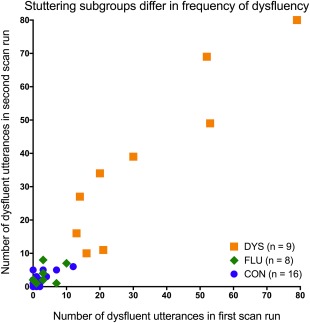
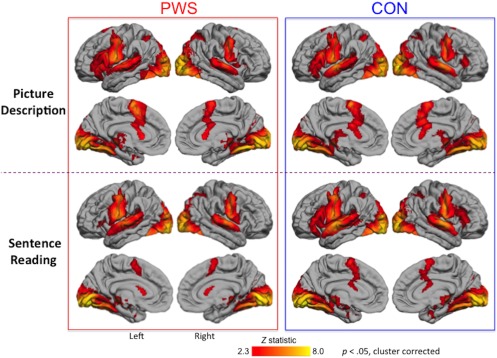
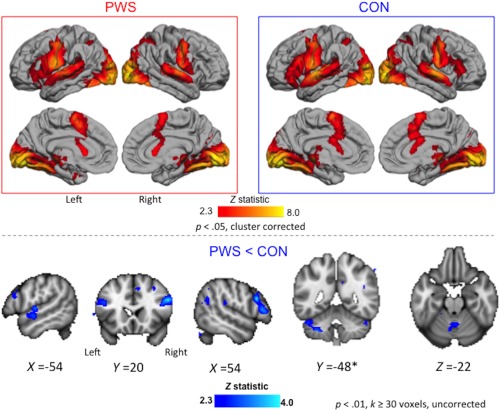
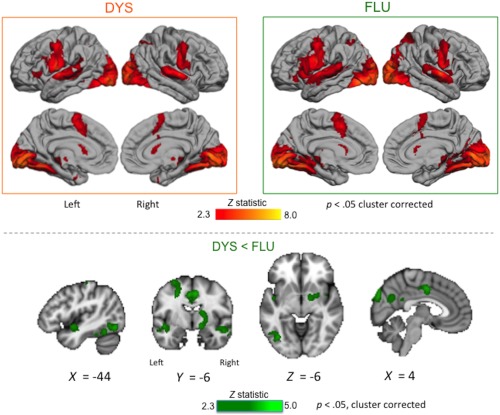
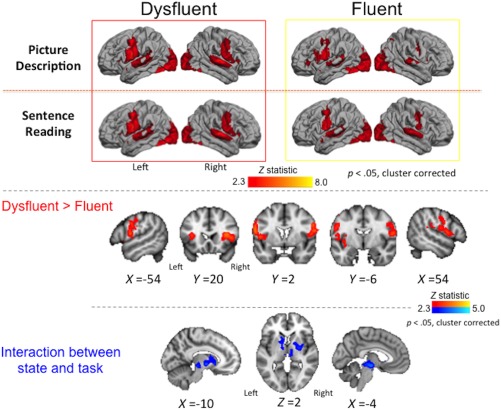
Stuttering is a disorder in which the smooth flow of speech is interrupted. People who stutter show structural and functional abnormalities in the speech and motor system. It is unclear whether functional differences reflect general traits of the disorder or are specifically related to the dysfluent speech state. We used a hierarchical approach to separate state and trait effects within stuttering. We collected sparse-sampled functional MRI during two overt speech tasks (sentence reading and picture description) in 17 people who stutter and 16 fluent controls. Separate analyses identified indicators of: (1) general traits of people who stutter; (2) frequency of dysfluent speech states in subgroups of people who stutter; and (3) the differences between fluent and dysfluent states in people who stutter. We found that reduced activation of left auditory cortex, inferior frontal cortex bilaterally, and medial cerebellum were general traits that distinguished fluent speech in people who stutter from that of controls. The stuttering subgroup with higher frequency of dysfluent states during scanning (n = 9) had reduced activation in the right subcortical grey matter, left temporo-occipital cortex, the cingulate cortex, and medial parieto-occipital cortex relative to the subgroup who were more fluent (n = 8). Finally, during dysfluent states relative to fluent ones, there was greater activation of inferior frontal and premotor cortex extending into the frontal operculum, bilaterally. The above differences were seen across both tasks. Subcortical state effects differed according to the task. Overall, our data emphasise the independence of trait and state effects in stuttering.
口吃是一种言语流畅性障碍,其特征是言语的流畅性被打断。口吃患者的言语和运动系统表现出结构和功能异常。目前尚不清楚功能差异是否反映了疾病的一般特征,还是与不流畅的言语状态有特定的关系。我们采用分层方法,对口吃者的状态和特质效应进行了分离。我们在 17 名口吃者和 16 名流利者中采集了两次口语任务(句子阅读和图片描述)时稀疏采样的功能磁共振成像数据。单独的分析确定了以下指标:(1)口吃者的一般特征;(2)口吃者亚组中不流畅言语状态的频率;(3)口吃者中流畅状态和不流畅状态之间的差异。我们发现,左侧听觉皮层、双侧额下回和内侧小脑的激活减少是区分口吃者和对照组流畅言语的一般特征。在扫描过程中具有更高不流畅状态频率的口吃亚组(n=9)相对于更流畅的亚组(n=8),右侧皮质下灰质、左侧颞顶叶皮层、扣带回和内侧顶枕叶皮层的激活减少。最后,与流畅状态相比,不流畅状态时,双侧额下回和运动前区皮层的激活增加,并延伸至额前回。以上差异在两个任务中均存在。皮质下状态效应因任务而异。总体而言,我们的数据强调了口吃特质和状态效应的独立性。