Department of Biophysics, Ruhr-University Bochum, Bochum, Germany.
Division of Clinical Epidemiology and Aging Research, German Cancer Research Center (DKFZ), Heidelberg, Germany.
EMBO Mol Med. 2018 May;10(5). doi: 10.15252/emmm.201708763.
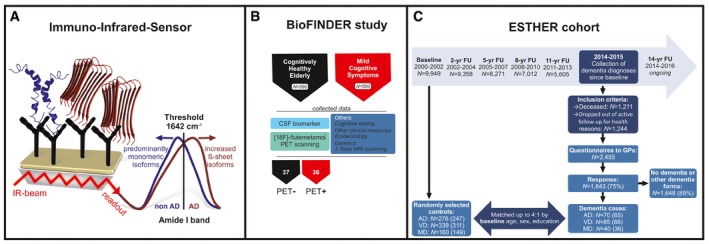
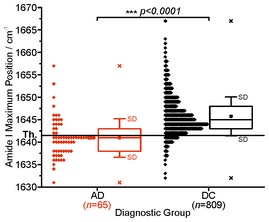
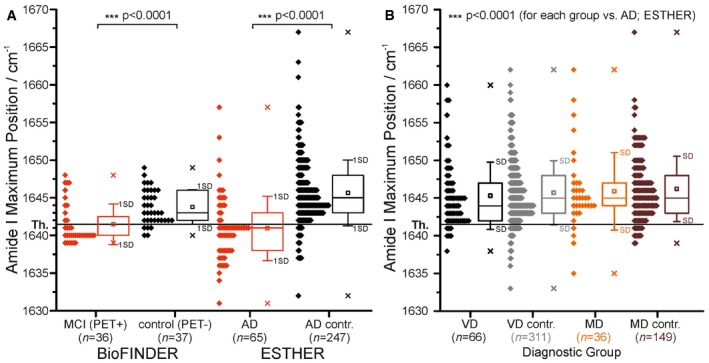
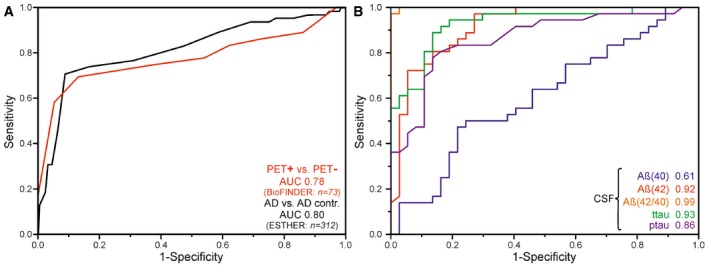
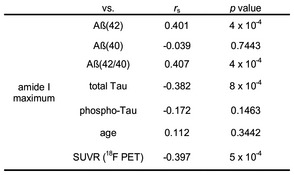
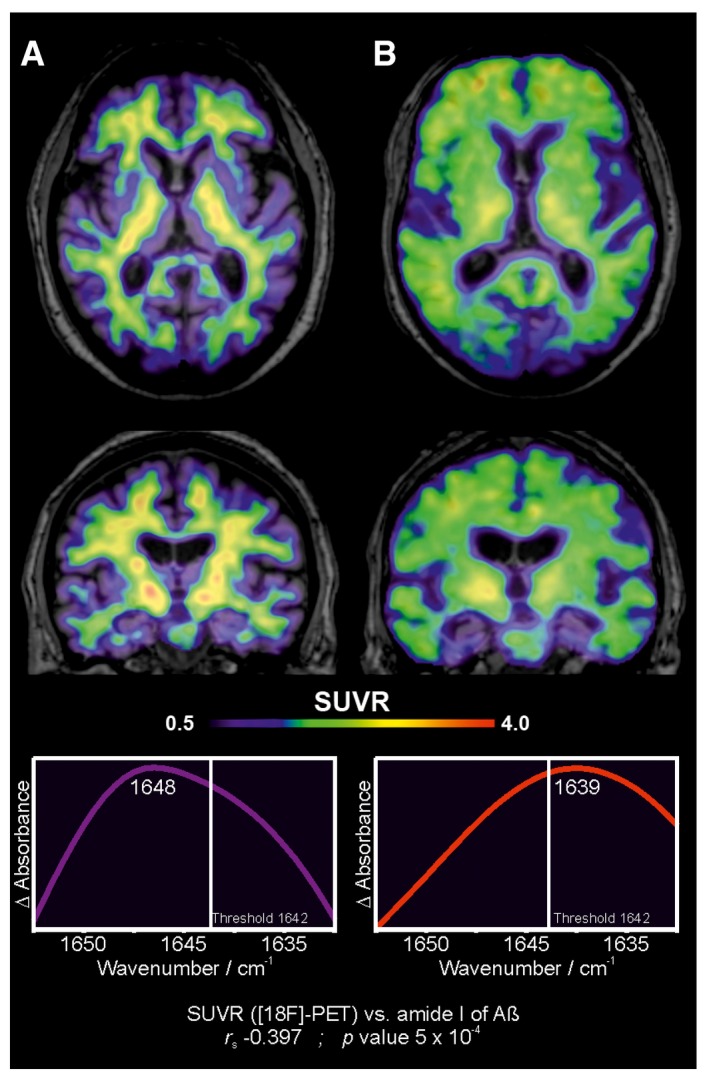
Alzheimer's disease (AD) is currently incurable, but there is general agreement that a minimally invasive blood biomarker for screening in preclinical stages would be crucial for future therapy. Diagnostic tools for detection of AD are either invasive like cerebrospinal fluid (CSF) biomarkers or expensive such as positron emission tomography (PET) scanning. Here, we determine the secondary structure change of amyloid-β (Aβ) in human blood. This change used as blood amyloid biomarker indicates prodromal AD and correlates with CSF AD biomarkers and amyloid PET imaging in the cross-sectional BioFINDER cohort. In a further population-based longitudinal cohort (ESTHER), the blood biomarker detected AD several years before clinical diagnosis in baseline samples with a positive likelihood ratio of 7.9; that is, those who were diagnosed with AD over the years were 7.9 times more likely to test positive. This assay may open avenues for blood screening of early AD stages as a funnel for further more invasive and expensive tests.
阿尔茨海默病(AD)目前无法治愈,但人们普遍认为,在临床前阶段进行微创血液生物标志物筛查对于未来的治疗至关重要。AD 的诊断工具要么像脑脊液(CSF)生物标志物那样具有侵入性,要么像正电子发射断层扫描(PET)那样昂贵。在这里,我们确定了人类血液中淀粉样蛋白-β(Aβ)的二级结构变化。这种变化用作血液淀粉样蛋白生物标志物可指示前驱 AD,并与横断面 BioFINDER 队列中的 CSF AD 生物标志物和淀粉样蛋白 PET 成像相关。在进一步的基于人群的纵向队列(ESTHER)中,血液生物标志物在基线样本中检测到 AD,比临床诊断提前数年,阳性似然比为 7.9;也就是说,那些在多年后被诊断为 AD 的人更有可能检测呈阳性。该检测方法可能为早期 AD 阶段的血液筛查开辟途径,作为进一步侵入性和昂贵测试的漏斗。