Department of Internal Medicine, Section on Nephrology, Wake Forest School of Medicine, Winston-Salem, NC, USA.
Department of Radiology, Wake Forest School of Medicine, Winston-Salem, NC, USA.
J Diabetes Complications. 2018 Jun;32(6):558-564. doi: 10.1016/j.jdiacomp.2018.03.004. Epub 2018 Mar 19.
Recent studies revealed a correlation between skeletal muscle mass index and density with longevity; these studies largely evaluated appendicular skeletal muscles in older Caucasians. This retrospective cohort study assessed the association between axial skeletal muscles size and density with survival in African Americans with type 2 diabetes mellitus.
Psoas and paraspinous muscle mass index (cross sectional area/height) and radiographic density (in Hounsfield Units) were measured using computed tomography in African American-Diabetes Heart Study participants, 314 women and 256 men, with median (25th, 75th quartile) age 55.0(48.0, 62.0) and 57.0(50.0, 64.0) years, respectively. Covariates in fully-adjusted model included age, sex, BMI, smoking, hormone replacement therapy (women), cardiovascular disease, hypertension, coronary artery calcified plaque mass, carotid artery calcified plaque mass, and African ancestry proportion.
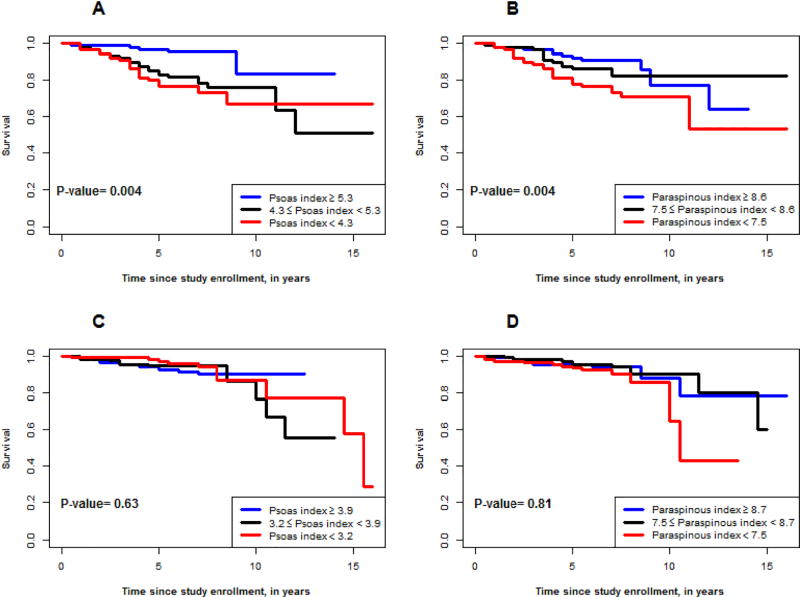
After median of 7.1(5.9, 8.2) years follow-up, 30(9.6%) of women and 49(19.1%) of men were deceased. In fully-adjusted models, psoas muscle mass index and paraspinous muscle mass index were inversely associated with mortality in men (psoas muscle mass index, hazard ratio [HR] = 0.61, P = 0.004; paraspinous muscle mass index, HR = 0.64, P = 0.004), but not in women. Psoas and paraspinous muscle densities did not associate with all-cause mortality. A penalized Cox regression that involved all covariates and predictors associated with mortality showed that only paraspinous muscle mass index remained a significant predictor of mortality (HR = 0.65, P = 0.02).
Independent from established risk factors for mortality, higher psoas and paraspinous muscle index associate with reduced all-cause mortality in middle-aged African American men with type 2 diabetes mellitus.
最近的研究表明,骨骼肌质量指数和密度与寿命之间存在相关性;这些研究主要评估了老年白种人四肢骨骼肌。本回顾性队列研究评估了 2 型糖尿病非裔美国人的轴性骨骼肌大小和密度与生存的关系。
在非洲裔美国人糖尿病心脏研究参与者中,使用计算机断层扫描测量了腰大肌和椎旁肌肉质量指数(横截面积/身高)和放射密度(以亨氏单位表示),共 314 名女性和 256 名男性,中位年龄(25 百分位数、75 百分位数)分别为 55.0(48.0、62.0)和 57.0(50.0、64.0)岁。完全调整模型中的协变量包括年龄、性别、BMI、吸烟、激素替代疗法(女性)、心血管疾病、高血压、冠状动脉钙化斑块质量、颈动脉钙化斑块质量和非洲裔祖先比例。
中位随访 7.1(5.9、8.2)年后,30 名女性(9.6%)和 49 名男性(19.1%)死亡。在完全调整的模型中,腰大肌质量指数和椎旁肌肉质量指数与男性死亡率呈负相关(腰大肌质量指数,风险比[HR] = 0.61,P = 0.004;椎旁肌肉质量指数,HR = 0.64,P = 0.004),但在女性中无相关性。腰大肌和椎旁肌肉密度与全因死亡率无关。一项涉及所有与死亡率相关的协变量和预测因子的惩罚 Cox 回归显示,只有椎旁肌肉质量指数仍然是死亡率的显著预测因子(HR = 0.65,P = 0.02)。
独立于死亡率的既定危险因素,较高的腰大肌和椎旁肌肉指数与 2 型糖尿病非裔美国中年男性的全因死亡率降低相关。