Cantero-Braojos Miguel Ángel, Cabrera-León Andrés, López-González María Angeles, Saúl Luís Angel
MenSana, Psicología y Salud, Granada, España.
Escuela Andaluza de Salud Pública, Instituto de Investigación Biosanitaria ibs.GRANADA, Hospitales Universitarios de Granada/Universidad de Granada, Granada, España; Centro de Investigación Biomédica en Red de Salud Pública y Epidemiología (CIBERESP), Madrid, España.
Aten Primaria. 2019 Mar;51(3):162-171. doi: 10.1016/j.aprim.2017.07.006. Epub 2018 Apr 5.
To assess the effectiveness, on people with chronic pain, of an intervention (Time In) designed to reduce pain and to improve psychological symptoms.
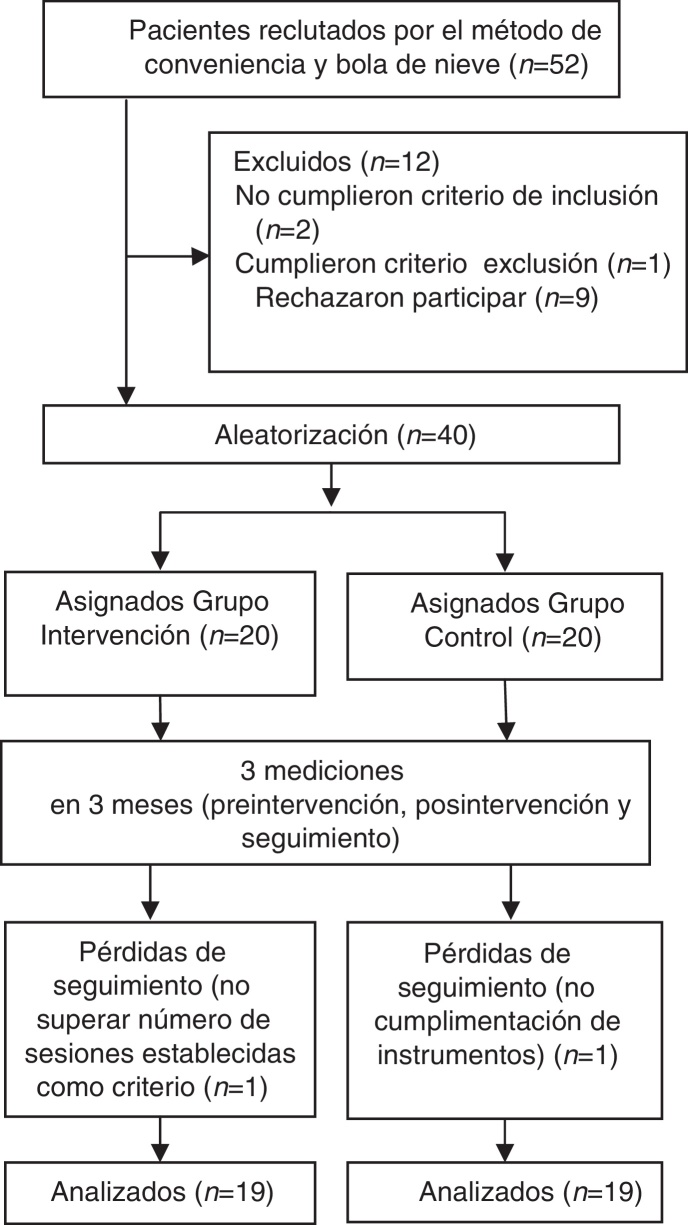
A randomized clinical trial with a control group, taking three measurements over three months.
Granada, Spain.
A sample of 40 women aged 18 or older with a history (over 6 months) of chronic pain. The recruitment was in the Fibromyalgia Association of Granada, Spain (AGRAFIM).
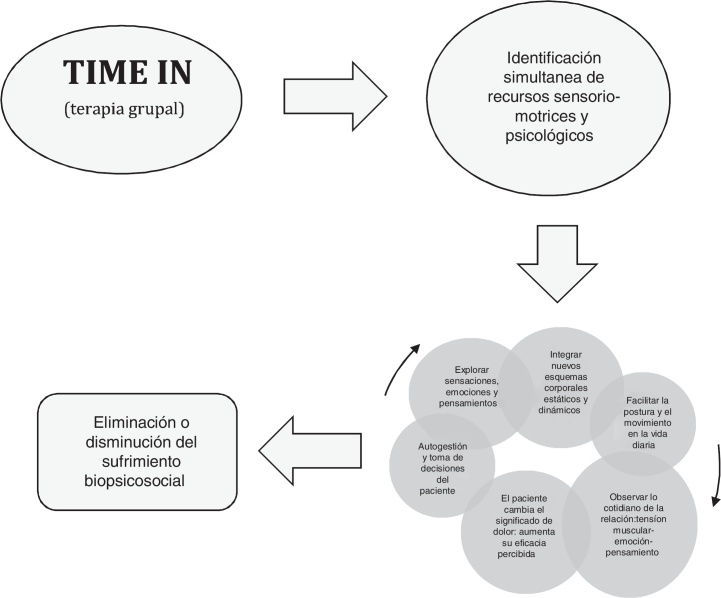
Time In is a sensorimotor intervention that combines biomechanical physiotherapeutic procedures and psychological strategies. A weekly session of 3h was planned and the total of the program was developed during five weeks.
Independent variables: sociodemographic information, clinical history and Time In intervention. Dependent variables: Brief Pain Inventory (BPI-S), Short-Form Health Survey (SF-12), Symptom Check List-90-R (SCL-90-R) and Clinical Outcome in Routine Evaluation (CORE-OM).
Significant differences were observed between control group and intervention group of most of the scales used in postintervention and follow up measurements. Thus, significantly lower mean scores were obtained in intensity, interference and areas of pain, quality of life, psychological symptoms and behavioural change. Similar results were observed on d Cohen scores. They were 'very important' on intensity of pain (d=-1.01, d=-0.97) and interference of pain (d=-0.85, d=-0.74), with an improvement percentage from 21% to 30%.
Time In intervention reduces pain and improves psychological symptoms in patients with fibromyalgia; this results in a better quality of life.
评估一种旨在减轻疼痛并改善心理症状的干预措施(“时间投入”)对慢性疼痛患者的有效性。
一项设有对照组的随机临床试验,在三个月内进行三次测量。
西班牙格拉纳达。
40名18岁及以上有慢性疼痛病史(超过6个月)的女性样本。招募工作在西班牙格拉纳达纤维肌痛协会(AGRAFIM)进行。
“时间投入”是一种感觉运动干预措施,结合了生物力学物理治疗程序和心理策略。计划每周进行一次3小时的课程,整个项目在五周内开展。
自变量:社会人口学信息、临床病史和“时间投入”干预措施。因变量:简明疼痛量表(BPI-S)、简短健康调查问卷(SF-12)、症状自评量表90修订版(SCL-90-R)和常规评估临床结果量表(CORE-OM)。
在干预后和随访测量中,干预组和对照组在大多数使用的量表上存在显著差异。因此,在疼痛强度、干扰和疼痛区域、生活质量、心理症状和行为改变方面获得了显著更低的平均得分。在科恩d值分数上也观察到了类似结果。在疼痛强度(d=-1.01,d=-0.97)和疼痛干扰(d=-0.85,d=-0.74)方面,这些差异“非常显著”,改善百分比从21%到30%不等。
“时间投入”干预措施可减轻纤维肌痛患者的疼痛并改善心理症状;这会带来更好的生活质量。