Bhatnagar Vidhu, Jinjil Kavitha, Dwivedi Deepak, Verma Rohit, Tandon Urvashi
Department of Anesthesiology and Critical Care, INHS Asvini, Mumbai, Maharashtra, India.
Department of Undersea Medicine, INHS Asvini, Mumbai, Maharashtra, India.
J Emerg Trauma Shock. 2018 Jan-Mar;11(1):31-37. doi: 10.4103/JETS.JETS_58_17.
The cardiopulmonary resuscitation (CPR) in prone position has been dealt with in 2010 American Heart Association (AHA) guidelines but have not been reviewed in 2015 guidelines. The guidelines for patients presenting with cardiac arrest under general anesthesia in lateral decubitus position and regarding resuscitation in confined spaces like airplanes are also not available in AHA guidelines. This article is an attempt to highlight the techniques adopted for resuscitation in these unusual situations.
This study aims to find out the methodology and efficacy in nonconventional CPR approaches such as CPR in prone, CPR in lateral position, and CPR in confined spaces.
We conducted a literature search using MeSH search strings such as CPR + Prone position, CPR + lateral Position, and CPR + confined spaces.
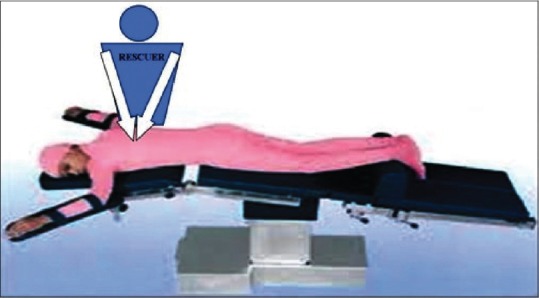
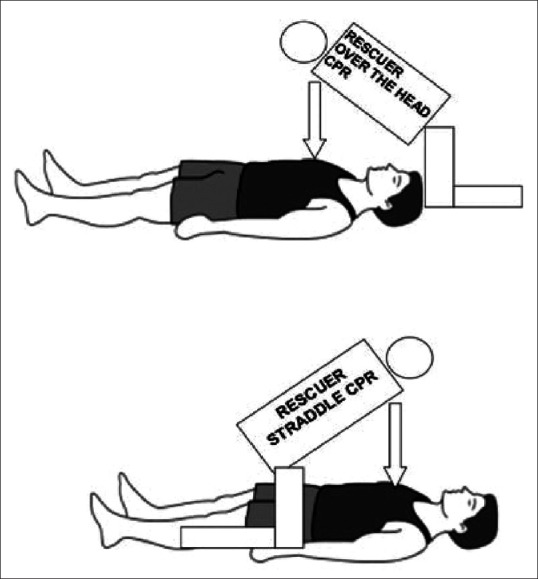
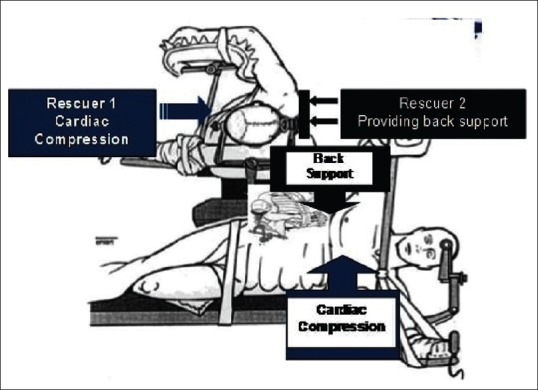
No randomized controlled trials are available. The literature search gives a handful of case reports, some simulation- and manikin-based studies but none can qualify for class I evidence. The successful outcome of CPR performed in prone position has shown compressions delivered on the thoracic spine with the same rate and force as they were delivered during supine position. A hard surface is required under the patient to provide uniform force and sternal counter pressure. Two rescuer technique for providing successful chest compression in lateral position has been documented in the few case reports published. Over the head CPR and straddle (STR), CPR has been utilized for CPR in confined spaces. Ventilation in operating rooms was taken care by an advanced airway .
A large number of studies of high quality are required to be conducted to determine the efficacy of CPR in such positions.
俯卧位心肺复苏术(CPR)已被纳入2010年美国心脏协会(AHA)指南,但未被纳入2015年指南。AHA指南中也没有关于全身麻醉下侧卧位心脏骤停患者以及在飞机等密闭空间内进行复苏的指南。本文旨在强调在这些特殊情况下所采用的复苏技术。
本研究旨在找出非常规CPR方法的操作方法和效果,如俯卧位CPR、侧卧位CPR和密闭空间内CPR。
我们使用医学主题词(MeSH)检索词进行文献检索,如CPR + 俯卧位、CPR + 侧卧位和CPR + 密闭空间。
尚无随机对照试验。文献检索得到了一些病例报告、一些基于模拟和人体模型的研究,但均不符合I类证据标准。俯卧位CPR的成功结果表明,在胸椎上进行的按压速率和力度与仰卧位时相同。患者下方需要一个坚硬表面以提供均匀的力量和胸骨反压。少数已发表的病例报告记录了在侧卧位进行成功胸外按压的双人技术。在密闭空间内进行CPR时采用了头顶CPR和跨骑式(STR)CPR。手术室中的通气由高级气道处理。
需要进行大量高质量研究以确定在这些体位下CPR的效果。