Kim Hong Jun, Oh Sang Cheul
Division of Oncology/Hematology, Department of Internal Medicine, Korea University Guro Hospital, Korea University College of Medicine, Seoul, Korea.
J Gastric Cancer. 2018 Mar;18(1):1-19. doi: 10.5230/jgc.2018.18.e3. Epub 2018 Mar 14.
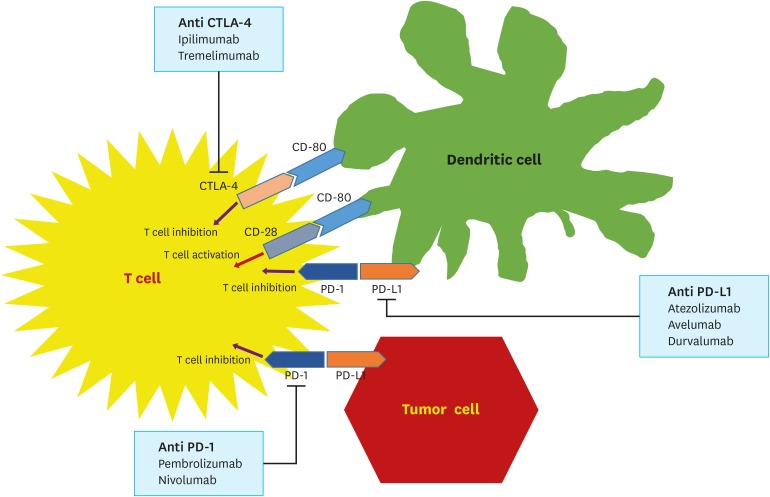
Gastric cancer (GC) is the second leading cause of cancer mortality and the fourth most commonly diagnosed malignant diseases. While continued efforts have been focused on GC treatment, the introduction of trastuzumab marked the beginning of a new era of target-specific treatments. Considering the diversity of mutations in GC, satisfactory results obtained from various target-specific therapies were expected, yet most of them were unsuccessful in controlled clinical trials. There are several possible reasons underlying the failures, including the absence of patient selection depending on validated predictive biomarkers, the inappropriate combination of drugs, and tumor heterogeneity. In contrast to targeted agents, immuno-oncologic agents are designed to regulate and boost immunity, are not target-specific, and may overcome tumor heterogeneity. With the successful establishment of predictive biomarkers, including Epstein-Barr virus pattern, microsatellite instability status, and programmed death-ligand 1 (PD-L1) expression, as well as ideal combination regimens, a new frontier in the immuno-oncology of GC treatment is on the horizon. Since the field of immuno-oncology has witnessed innovative, practice-changing successes in other cancer types, several trials on GC are ongoing. Among immuno-oncologic therapies, immune checkpoint inhibitors are the mainstay of clinical trials performed on GC. In this article, we review target-specific agents currently used in clinics or are undergoing clinical trials, and highlight the future clinical application of immuno-oncologic agents in inoperable GC.
胃癌(GC)是癌症死亡的第二大主要原因,也是第四大最常被诊断出的恶性疾病。尽管一直在持续努力进行胃癌治疗,但曲妥珠单抗的引入标志着靶向特异性治疗新时代的开始。考虑到胃癌中突变的多样性,人们期望从各种靶向特异性疗法中获得令人满意的结果,但其中大多数在对照临床试验中均未成功。失败背后有几个可能的原因,包括缺乏基于经过验证的预测生物标志物的患者选择、药物组合不当以及肿瘤异质性。与靶向药物不同,免疫肿瘤药物旨在调节和增强免疫力,并非靶向特异性的,并且可能克服肿瘤异质性。随着包括爱泼斯坦 - 巴尔病毒模式、微卫星不稳定性状态和程序性死亡配体1(PD-L1)表达等预测生物标志物的成功确立,以及理想的联合治疗方案的出现,胃癌免疫肿瘤治疗的新前沿即将到来。由于免疫肿瘤学领域在其他癌症类型中取得了创新的、改变实践的成功,目前有几项关于胃癌的试验正在进行。在免疫肿瘤治疗中,免疫检查点抑制剂是针对胃癌进行的临床试验的主要支柱。在本文中,我们回顾了目前在临床中使用或正在进行临床试验的靶向特异性药物,并强调了免疫肿瘤药物在不可切除胃癌中的未来临床应用。