Liu F X, Flatt S W, Nichols J F, Pakiz B, Barkai H S, Wing D R, Heath D D, Rock C L
Department of Family and Preventive Medicine, School of Medicine, University of California, San Diego, 3855 Health Sciences Drive, La Jolla, CA, USA 92093-0901.
Exercise and Physical Activity Resource Center, University of California, San Diego, 3855 Health Sciences Drive, La Jolla, CA, USA 92093-0188.
J Obes Weight Loss Ther. 2017;7(4). doi: 10.4172/2165-7904.1000346. Epub 2017 Aug 14.
Visceral adipose tissue is more metabolically active than other fat depots and is more closely associated with obesity-related diseases, such as cardiovascular disease and type 2 diabetes, than indicators of obesity, such as body mass index. Across various strategies to promote weight loss, including energy-reduced diet and exercise, variable effects on VAT compared to loss of total body fat have been reported.
To examine the effect of a behavioral weight loss intervention using portion-controlled prepackaged entrées on VAT, we examined data and measurements from overweight/obese men and women (N=183) who were assigned to a weight loss intervention and prescribed a reduced-energy diet with either portion-controlled prepackaged entrées or self-selected meals in a randomized clinical trial. VAT was estimated with dual-energy X-ray absorptiometry at baseline and study end (12 weeks).
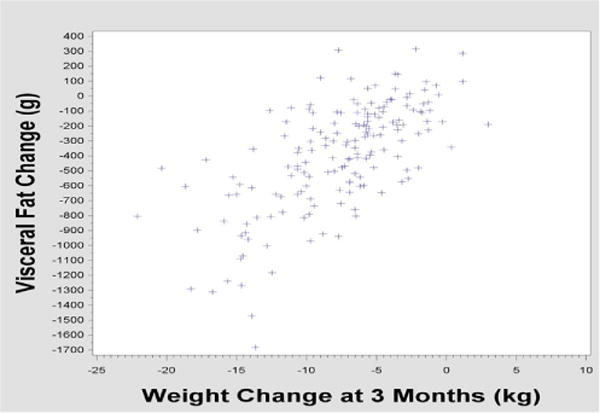
VAT loss was greater for the prepackaged entrees group (p=0.02), with an average loss of 29% compared to an average loss of 19% among participants consuming self-selected meals. VAT (mean [SEM]) was 1651 (71) g and 1546 (157) g at baseline and 1234 (59) g and 1278 (118) g at study end in the prepackaged entrees and self-selected meal groups, respectively. Greater VAT loss was associated with higher baseline weight and VAT, and greater weight loss, but not associated with age or physical activity.
Prescribing portion-controlled prepackaged entrees in a behavioral weight loss intervention promotes a reduction in VAT, which should promote improved metabolic profile and reduced cardiovascular disease risk.
内脏脂肪组织比其他脂肪储存部位具有更高的代谢活性,并且与肥胖相关疾病(如心血管疾病和2型糖尿病)的关联比肥胖指标(如体重指数)更为密切。在各种促进体重减轻的策略中,包括减少能量饮食和运动,与全身脂肪减少相比,对内脏脂肪组织的影响各不相同。
为了研究使用定量预包装主餐进行行为减肥干预对内脏脂肪组织的影响,我们检查了超重/肥胖男性和女性(N = 183)的数据和测量结果,这些参与者被分配到减肥干预组,并在一项随机临床试验中被规定采用低能量饮食,饮食内容为定量预包装主餐或自选餐。在基线和研究结束时(12周)使用双能X线吸收法估计内脏脂肪组织。
预包装主餐组的内脏脂肪组织减少更多(p = 0.02),平均减少29%,而食用自选餐的参与者平均减少19%。预包装主餐组和自选餐组在基线时内脏脂肪组织(均值[标准误])分别为1651(71)g和1546(157)g,在研究结束时分别为1234(59)g和1278(118)g。更大的内脏脂肪组织减少与更高的基线体重和内脏脂肪组织、更多的体重减轻相关,但与年龄或身体活动无关。
在行为减肥干预中规定定量预包装主餐可促进内脏脂肪组织减少,这应有助于改善代谢状况并降低心血管疾病风险。