Department of Obstetrics and Gynecology, Beijing Chaoyang Hospital, Capital Medical University, Beijing, China.
Center for Biomechanics and Bioengineering, Key Laboratory of Microgravity (National Microgravity Laboratory) and Beijing Key Laboratory of Engineered Construction and Mechanobiology, Institute of Mechanics, Chinese Academy of Sciences, Beijing, China.
PLoS One. 2018 Apr 9;13(4):e0193456. doi: 10.1371/journal.pone.0193456. eCollection 2018.
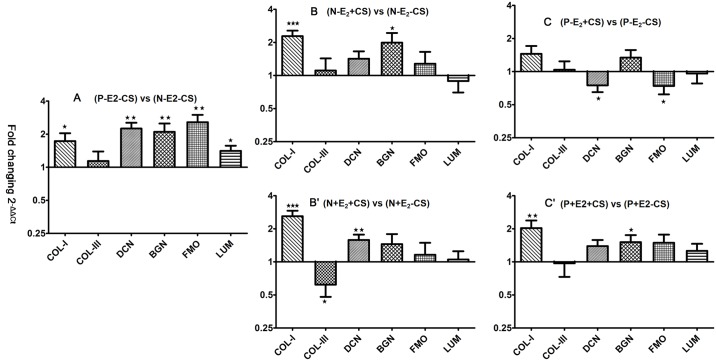
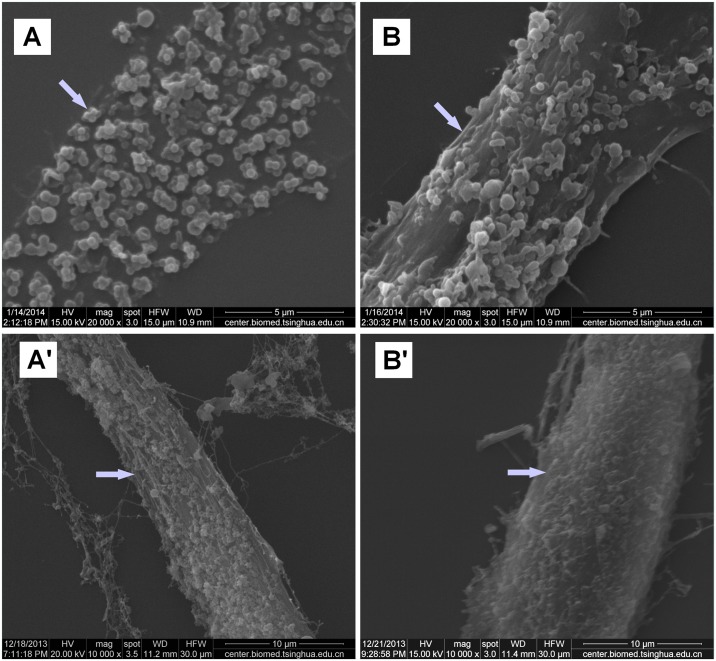
To determine the effect of mechanical stretching load and the efficacy of postmenopausal estrogen therapy (ET) on pelvic organ prolapse (POP), vaginal fibroblasts isolated from postmenopausal women with or without POP were subjected to 0.1-Hz uniaxial cyclic mechanical stretching (CS) with 10% elongation and 10-8 M 17-β-estradiol (E2) treatment. We investigated the morphological characteristics of extracellular polymers using scanning electron microscopy (SEM) and monitored the mRNA expression of type I collagen (COL I) and type III collagen (COL III) as well as the small leucine-rich proteoglycan (SLRP) family members decorin (DCN), biglycan (BGN), fibromodulin (FMO), and lumican (LUM), using real-time quantitative polymerase chain reaction (RT-PCR). Using SEM, certain viscoelastic polymers were found to be randomly distributed among fibroblasts, which for normal fibroblasts formed clusters of plum flower-like patterns under static-culture conditions and resembled stretched strips when stretched in culture, whereas polymers among POP fibroblasts resembled stretched strips under static-cultured conditions and presented broken networks when stretched in culture. RT-PCR revealed that COL I, DCN, BGN, FMO, and LUM mRNA expression was significantly higher in POP than in normal fibroblasts under static-culture condition. Following CS, COL I and BGN mRNA expression was significantly up-regulated in normal fibroblasts, and DCN and FMO mRNA expression was down-regulated in POP fibroblasts. Following concomitant CS and E2 treatment, significantly elevated COL I and DCN mRNA expression was observed in normal fibroblasts, and significantly elevated COL I and BGN mRNA expression was observed in POP fibroblasts. COL III mRNA expression was not significantly different between the POP and normal group, and CS did not significantly affect expression in either group, though COL III was down-regulated in normal fibroblasts concomitantly treated with E2 and CS. We conclude that the morphological distribution of extracellular polymers in POP fibroblasts exhibited higher sensitivity and lower tolerance to stretching loads than do normal fibroblasts. These mechanical properties were further reflected in the transcription of COL I. Defects in the compensatory function of BGN for DCN and LUM for FMO exist in POP fibroblasts, which further affect the structure and function of COL I in response to stretching load, ultimately resulting in abnormal reconstruction of pelvic supportive connective tissues and the occurrence of POP. ET can maintain stretching-induced elevations in COL I and DCN transcription in healthy women and improve stretching-induced COL I, DCN, BGN, and FMO transcriptional changes in POP women to prevent and improve POP. Only down-regulated COL III transcription was observed upon concomitant CS and E2 treatment in normal fibroblasts, which suggests that the tensile strength, not the elasticity, of the supportive connective tissues is damaged in POP and that the higher tensile strength induced by ET in healthy fibroblasts prevents POP. These findings confirm the role of higher sensitivity and lower tolerance to mechanical stretching in the pathogenesis of POP and further provide evidence supporting the use of ET to prevent and inhibit POP in postmenopausal women.
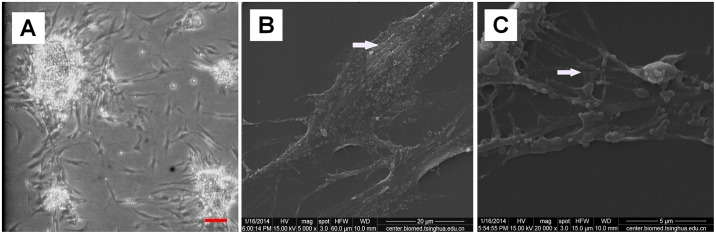
为了确定机械拉伸负荷和绝经后雌激素治疗(ET)对盆腔器官脱垂(POP)的疗效,我们对来自患有或不患有 POP 的绝经后妇女的阴道成纤维细胞进行了 0.1-Hz 单轴循环机械拉伸(CS),拉伸幅度为 10%,并使用 10-8 M 17-β-雌二醇(E2)处理。我们使用扫描电子显微镜(SEM)观察细胞外聚合物的形态特征,并使用实时定量聚合酶链反应(RT-PCR)监测 I 型胶原(COL I)和 III 型胶原(COL III)以及小富含亮氨酸的蛋白聚糖(SLRP)家族成员decorin(DCN)、biglycan(BGN)、fibromodulin(FMO)和lumican(LUM)的 mRNA 表达。使用 SEM,发现某些粘弹性聚合物在成纤维细胞之间随机分布,正常成纤维细胞在静态培养条件下形成梅花状簇,在培养中拉伸时类似于拉伸条,而 POP 成纤维细胞之间的聚合物在静态培养条件下类似于拉伸条,在培养中拉伸时呈现断裂网络。RT-PCR 显示,在静态培养条件下,POP 中的 COL I、DCN、BGN、FMO 和 LUM mRNA 表达明显高于正常成纤维细胞。CS 后,正常成纤维细胞中 COL I 和 BGN 的 mRNA 表达明显上调,POP 成纤维细胞中 DCN 和 FMO 的 mRNA 表达下调。同时进行 CS 和 E2 处理后,正常成纤维细胞中 COL I 和 DCN 的 mRNA 表达明显上调,POP 成纤维细胞中 COL I 和 BGN 的 mRNA 表达明显上调。COL III mRNA 表达在 POP 和正常组之间没有显著差异,CS 对两组的表达均无显著影响,但 E2 和 CS 同时处理后,正常成纤维细胞中的 COL III 表达下调。我们得出结论,POP 成纤维细胞中细胞外聚合物的形态分布对拉伸负荷的敏感性更高,耐受性更低。这些力学特性进一步反映在 COL I 的转录上。POP 成纤维细胞中 BGN 对 DCN 和 LUM 对 FMO 的代偿功能缺陷进一步影响 COL I 对拉伸负荷的反应,最终导致盆腔支持性结缔组织的异常重建和 POP 的发生。ET 可维持健康女性因拉伸引起的 COL I 和 DCN 转录升高,并改善 POP 女性因拉伸引起的 COL I、DCN、BGN 和 FMO 转录变化,从而预防和改善 POP。仅在正常成纤维细胞中观察到同时进行 CS 和 E2 处理时 COL III 的转录下调,这表明 POP 中支持性结缔组织的拉伸强度而不是弹性受损,而 ET 在健康成纤维细胞中诱导的较高拉伸强度可预防 POP。这些发现证实了对机械拉伸更高的敏感性和更低的耐受性在 POP 发病机制中的作用,并进一步提供了支持 ET 用于预防和抑制绝经后妇女 POP 的证据。