College of Pharmacy, Jinan University, Guangzhou 510632, PR China; Guangdong Provincial Key Laboratory of Pharmacodynamic Constituents of TCM and New Drugs Research, College of Pharmacy, Jinan University, Guangzhou 510632, PR China; Integrated Chinese and Western Medicine Postdoctoral research station, Jinan University, Guangzhou 510632, PR China.
College of Pharmacy, Jinan University, Guangzhou 510632, PR China; Guangdong Provincial Key Laboratory of Pharmacodynamic Constituents of TCM and New Drugs Research, College of Pharmacy, Jinan University, Guangzhou 510632, PR China.
J Pharm Biomed Anal. 2018 Jun 5;155:157-168. doi: 10.1016/j.jpba.2018.03.047. Epub 2018 Mar 26.
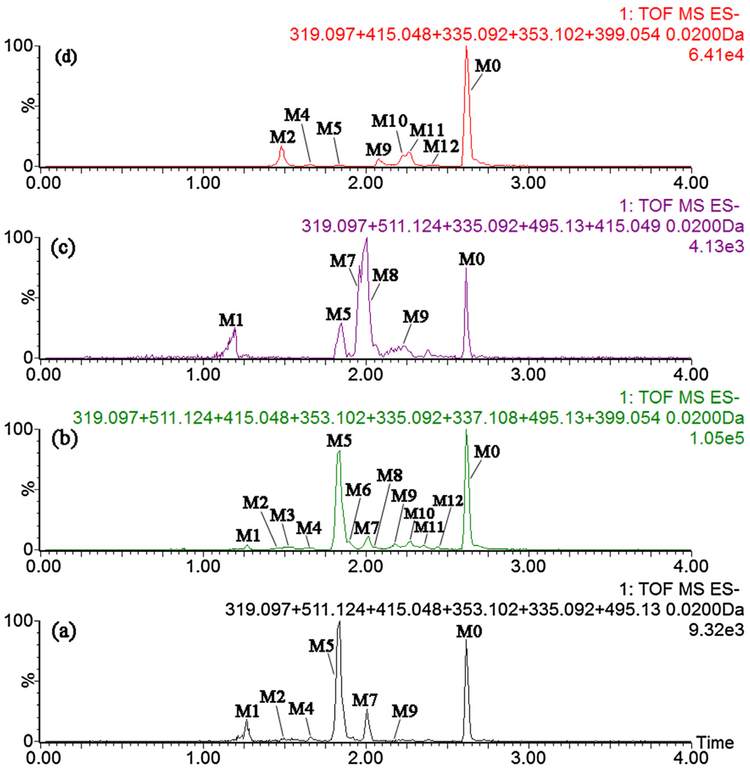
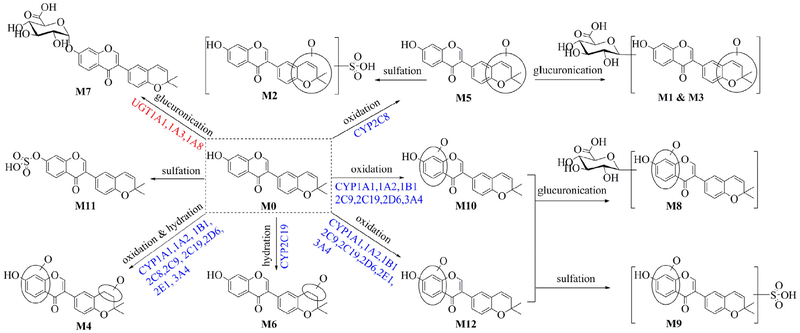
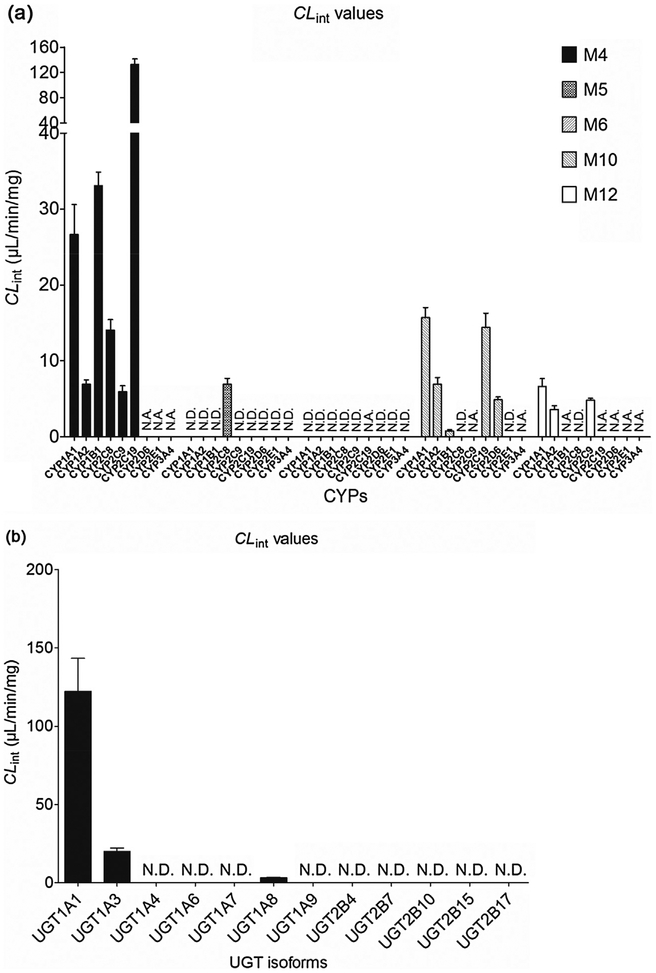
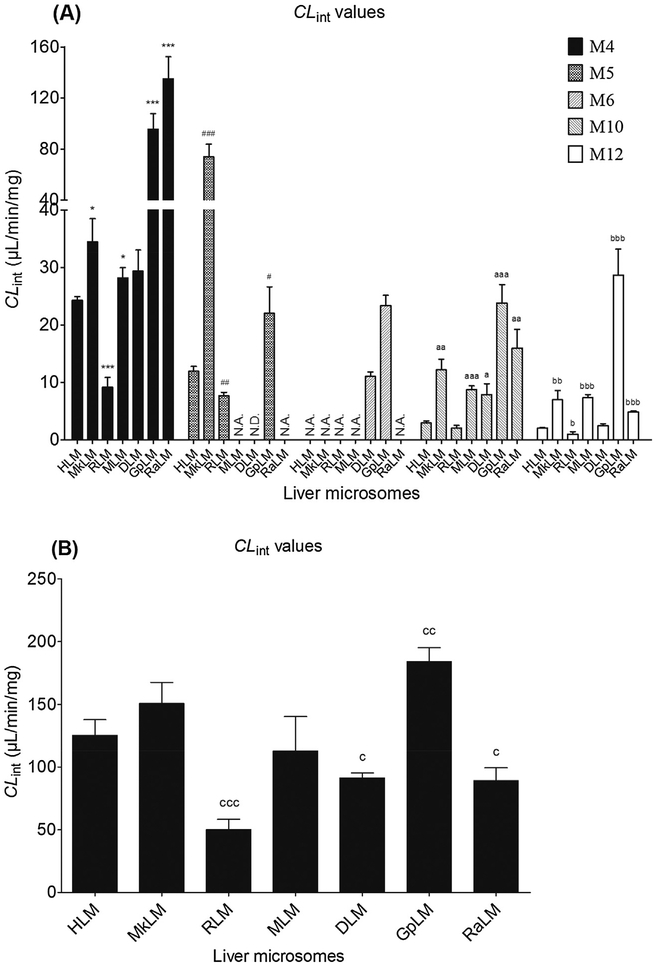
Corylin, an phenolic compound from Psoralea corylifolia, has been reported with various pharmacological properties but has poor bioavailability due to massive metabolism. In this study, twelve metabolites of corylin mainly involving in oxidation, hydration, glucuronidation and sulfation were detected in mice. Furthermore, the oxidation and hydration of corylin (M4) in human liver microsomes (HLM) and human intestine microsomes (HIM) were both efficient with high CL (intrinsic clearance) values of 24.29 and 42.85 μL/min/mg, respectively. CYP1A1, 1B1 and 2C19 contributed most for M4 with the CL values of 26.63, 33.09 and 132.41 μL/min/mg, respectively. Besides, M4 was strongly correlated with phenacetin-N-deacetylation (r = 0.885, p = 0.0001) and tolbutamide-4-oxidation (r = 0.727, p = 0.001) in twelve individual HLMs, respectively. In addition, corylin was efficiently glucuronidated (M7) in HLM (125.33 μL/min/mg) and in HIM (108.74 μL/min/mg). UGT1A1 contributed the most for M7 with the CL value of 122.32 μL/min/mg. Meanwhile, M7 was significantly correlated with β-estradiol-3-O-glucuronidation (r = 0.742, p = 0.006) in twelve individual HLMs. Moreover, the metabolism of corylin showed marked species differences. Taken together, corylin was subjected to massive first-pass metabolism in liver and intestine, while CYP1A1, 1B1, 2C19 and UGT1A1 were the main contributors. Finally, the proposed metabolic pathway of corylin involed CYP and UGT isoforms were summarized, which could help to understand the metabolic fate of corylin in vivo.
松果菊苷是一种来源于毛果巴戟天的酚类化合物,具有多种药理学特性,但由于代谢量大,生物利用度差。本研究在小鼠体内检测到松果菊苷的 12 种主要代谢物,涉及氧化、水合、葡萄糖醛酸化和硫酸化。此外,松果菊苷(M4)在人肝微粒体(HLM)和人肠微粒体(HIM)中的氧化和水合反应均非常有效,其内在清除率(CL,intrinsic clearance)值分别为 24.29 和 42.85 μL/min/mg。CYP1A1、1B1 和 2C19 对 M4 的 CL 值贡献最大,分别为 26.63、33.09 和 132.41 μL/min/mg。此外,M4 与 12 个人 HLMs 中的非那西汀-N-去乙酰化(r=0.885,p=0.0001)和甲苯磺丁脲-4-氧化(r=0.727,p=0.001)呈强相关性。此外,松果菊苷在 HLM(125.33 μL/min/mg)和 HIM(108.74 μL/min/mg)中可被高效葡萄糖醛酸化(M7)。UGT1A1 对 M7 的 CL 值贡献最大,为 122.32 μL/min/mg。同时,M7 与 12 个 HLMs 中的雌二醇-3-O-葡萄糖醛酸化呈显著相关性(r=0.742,p=0.006)。此外,松果菊苷的代谢在种属间存在明显差异。总之,松果菊苷在肝脏和肠道中经历了大量的首过代谢,而 CYP1A1、1B1、2C19 和 UGT1A1 是主要的代谢酶。最后,总结了松果菊苷涉及 CYP 和 UGT 同工酶的代谢途径,有助于了解其在体内的代谢命运。