Karim Muhammad Tariq, Inam Sumera, Ashraf Tariq, Shah Nadia, Adil Syed Omair, Shafique Kashif
Research Evaluation Unit, College of Physicians and Surgeons Pakistan, Karachi, Pakistan.
J Prev Med Public Health. 2018 Mar;51(2):71-82. doi: 10.3961/jpmph.17.189.
Areca nut is widely consumed in many parts of the world, especially in South and Southeast Asia, where cardiovascular disease (CVD) is also a huge burden. Among the forms of CVD, acute coronary syndrome (ACS) is a major cause of mortality and morbidity. Research has shown areca nut chewing to be associated with diabetes, hypertension, oropharyngeal and esophageal cancers, and CVD, but little is known about mortality and re-hospitalization secondary to ACS among areca nut users and non-users.
A prospective cohort was studied to quantify the effect of areca nut chewing on patients with newly diagnosed ACS by categorizing the study population into exposed and non-exposed groups according to baseline chewing status. Cox proportional hazards models were used to examine the associations of areca nut chewing with the risk of re-hospitalization and 30-day mortality secondary to ACS.
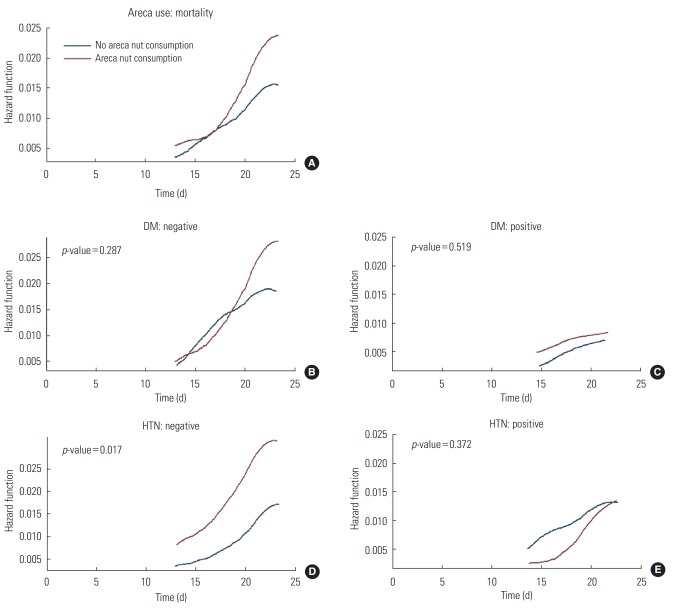
Of the 384 ACS patients, 49.5% (n=190) were areca users. During 1-month of follow-up, 20.3% (n=78) deaths and 25.1% (n=96) re-hospitalizations occurred. A higher risk of re-hospitalization was found (adjusted hazard ratio [aHR], 2.05; 95% confidence interval [CI], 1.29 to 3.27; p=0.002) in areca users than in non-users. Moreover, patients with severe disease were at a significantly higher risk of 30-day mortality (aHR, 2.77; 95% CI, 1.67 to 4.59; p<0.001) and re-hospitalization (aHR, 2.72; 95% CI, 1.73 to 4.26; p<0.001).
The 30-day re-hospitalization rate among ACS patients was found to be significantly higher in areca users and individuals with severe disease. These findings suggest that screening for a history of areca nut chewing may help to identify patients at a high risk for re-hospitalization due to secondary events.
槟榔在世界许多地区被广泛食用,尤其是在南亚和东南亚,而这些地区心血管疾病(CVD)也是一个巨大的负担。在心血管疾病的各种形式中,急性冠状动脉综合征(ACS)是死亡和发病的主要原因。研究表明,嚼槟榔与糖尿病、高血压、口咽癌和食管癌以及心血管疾病有关,但对于嚼槟榔者和不嚼槟榔者中因急性冠状动脉综合征导致的死亡率和再次住院情况知之甚少。
对一个前瞻性队列进行研究,根据基线咀嚼状态将研究人群分为暴露组和非暴露组,以量化嚼槟榔对新诊断为急性冠状动脉综合征患者的影响。采用Cox比例风险模型来检验嚼槟榔与急性冠状动脉综合征继发的再次住院风险和30天死亡率之间的关联。
在384例急性冠状动脉综合征患者中,49.5%(n = 190)为嚼槟榔者。在1个月的随访期间,发生了20.3%(n = 78)的死亡和25.1%(n = 96)的再次住院情况。发现嚼槟榔者的再次住院风险更高(调整后风险比[aHR],2.05;95%置信区间[CI],1.29至3.27;p = 0.002),高于不嚼槟榔者。此外,重症患者的30天死亡率(aHR,2.77;95%CI,1.67至4.59;p < 0.001)和再次住院风险(aHR,2.72;95%CI,1.73至4.26;p < 0.001)显著更高。
发现急性冠状动脉综合征患者中,嚼槟榔者和重症患者的30天再次住院率显著更高。这些发现表明,筛查嚼槟榔史可能有助于识别因继发事件而有高再次住院风险的患者。