Al-Sharabi Ali Kaid, Shuga-Aldin Hussien, Ghandour Ibrahim, Al-Hebshi Nezar Noor
Department of Periodontology, Oral Pathology, Oral Medicine and Radiology, Faculty of Dentistry, University of Sana'a, Sana'a, Yemen.
Int J Dent. 2013;2013:317640. doi: 10.1155/2013/317640. Epub 2013 Feb 21.
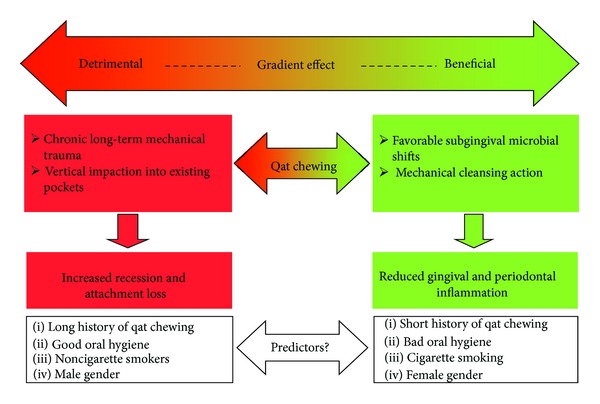
This study assessed the effect of qat chewing on periodontal health, independent of other risk factors. Four hundred qat chewers and 100 nonchewers (20-50 years) were included. Demographic data and detailed information about chewing and smoking were obtained. Periodontal status was assessed using Community Periodontal Index (CPI) and clinical attachment loss (CAL). The qat chewers were older, included more males and smokers, and had worse oral hygiene but higher education levels; the majority were heavy chewers (mean duration of 14.45 years and frequency of 6.10 days/week). Regression analysis identified age, oral hygiene, education level, and cigarette smoking as independent predictors of periodontal destruction. Adjusted for these, qat chewing showed marginally significant association only with CAL (OR = 4.7; P = 0.049). The chewing sides showed significantly higher scores than the nonchewing sides; however, equal scores on both sides or lower scores on the chewing sides (possibly no or beneficial effect) were still observed in 50% of the chewers. Heavy qat chewing is shown here as an independent risk factor for attachment loss. However, the possibility that the habit may have beneficial effects in a subset of the chewers cannot be excluded. A holistic model that resolves the existing contradiction is presented.
本研究评估了咀嚼巧茶对牙周健康的影响,排除了其他风险因素。研究纳入了400名巧茶咀嚼者和100名非咀嚼者(年龄在20至50岁之间)。收集了人口统计学数据以及关于咀嚼和吸烟的详细信息。使用社区牙周指数(CPI)和临床附着丧失(CAL)评估牙周状况。巧茶咀嚼者年龄较大,男性和吸烟者更多,口腔卫生较差但教育水平较高;大多数为重度咀嚼者(平均咀嚼时长14.45年,频率为每周6.10天)。回归分析确定年龄、口腔卫生、教育水平和吸烟是牙周破坏的独立预测因素。校正这些因素后,咀嚼巧茶仅与CAL显示出边缘显著关联(OR = 4.7;P = 0.049)。咀嚼侧的得分显著高于非咀嚼侧;然而,仍有50%的咀嚼者两侧得分相同或咀嚼侧得分更低(可能无影响或有有益影响)。重度咀嚼巧茶在此被证明是附着丧失的一个独立风险因素。然而,不能排除这种习惯在一部分咀嚼者中可能具有有益影响的可能性。本文提出了一个解决现有矛盾的整体模型。