Gastroenterology Department, La Paz University Hospital, Paseo de la Castellana 261 4th floor, 28046, Madrid, Spain.
Cell Therapy Laboratory, La Paz Hospital Institute for Health Research, Madrid, Spain.
Stem Cell Res Ther. 2018 Apr 10;9(1):95. doi: 10.1186/s13287-018-0837-x.
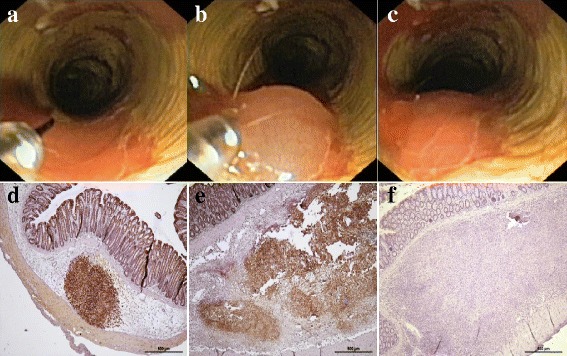
Mesenchymal stem cells have potential applications in inflammatory bowel disease due to their immunomodulatory properties. Our aim was to evaluate the feasibility, safety and efficacy of endoscopic administration of adipose-derived mesenchymal stem cells (ASCs) in a colitis model in rats.
Colitis was induced in rats by rectal trinitrobenzenesulfonic acid (TNBS). After 24 h ASCs (10 cells) or saline vehicle were endoscopically injected into the distal colon. Rats were followed for 11 days. Daily weight, endoscopic score at days 1 and 11, macroscopic appearance at necropsy, colon length and mRNA expression of Foxp3 and IL-10 in mesenteric lymph nodes (MLN) were analyzed.
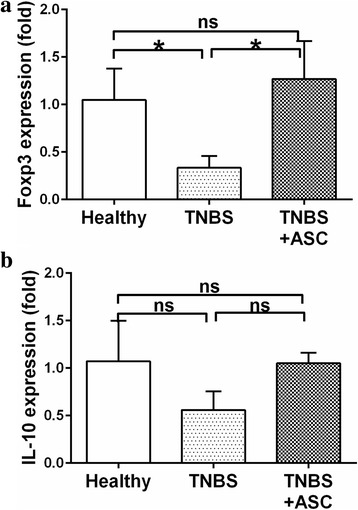
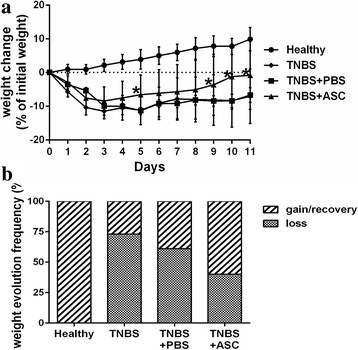
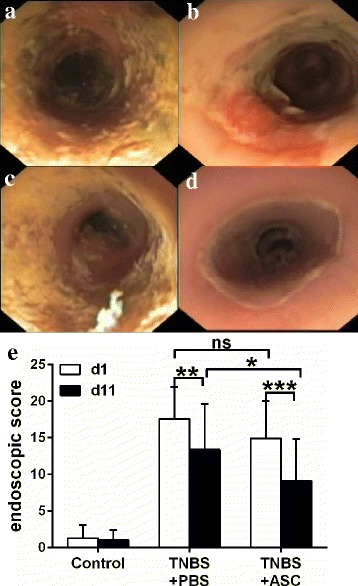
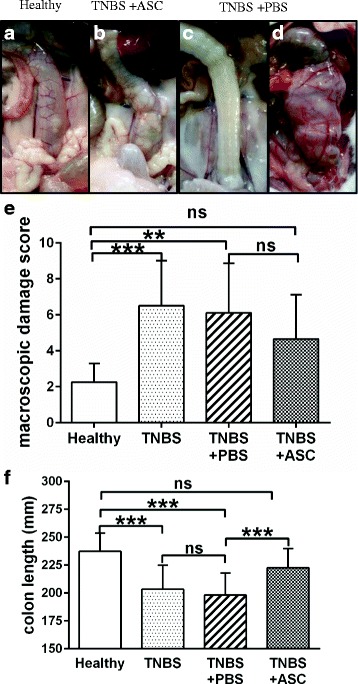
Endoscopic injection was successful in all the animals. No significant adverse events or mortality due to the procedure occurred. Weight evolution was significantly better in the ASC group, recovering initial weight by day 11 (- 0.8% ± 10.1%, mean ± SD), whereas the vehicle group remained in weight loss (- 6.7% ± 9.2%, p = 0.024). The endoscopic score improved in the ASC group by 47.1% ± 5.3% vs. 21.8% ± 6.6% in the vehicle group (p < 0.01). Stenosis was less frequent in the ASC group (4.8% vs. 41.2%, p < 0.01). Colon length significantly recovered in the ASC group versus the vehicle group (222.6 ± 17.3 mm vs. 193.6 ± 17.9 mm, p < 0.001). The endoscopic score significantly correlated with weight change, macroscopic necropsy score and colon length. Foxp3 and IL-10 mRNA levels in MLN recovered with ASC treatment.
ASC submucosal endoscopic injection is feasible, safe and ameliorates TNBS-induced colitis in rats, especially stenosis.
间充质干细胞具有免疫调节特性,因此在炎症性肠病中有潜在的应用。我们的目的是评估脂肪来源间充质干细胞(ASCs)在大鼠结肠炎模型中的内镜给药的可行性、安全性和疗效。
通过直肠三硝基苯磺酸(TNBS)诱导大鼠结肠炎。在 24 小时后,将 ASCs(10 个细胞)或生理盐水载体通过内镜注射到远端结肠。对大鼠进行 11 天的随访。分析每日体重、第 1 天和第 11 天的内镜评分、尸检时的大体外观、结肠长度和肠系膜淋巴结(MLN)中 Foxp3 和 IL-10 的 mRNA 表达。
所有动物的内镜注射均成功。没有因该程序而发生的严重不良事件或死亡。与对照组相比,ASC 组的体重变化明显更好,第 11 天恢复初始体重(-0.8%±10.1%,均值±标准差),而对照组仍处于体重减轻状态(-6.7%±9.2%,p=0.024)。与对照组相比,ASC 组的内镜评分改善了 47.1%±5.3%,而对照组仅改善了 21.8%±6.6%(p<0.01)。ASCs 组狭窄的发生率较低(4.8%比 41.2%,p<0.01)。与对照组相比,ASC 组的结肠长度明显恢复(222.6±17.3mm 比 193.6±17.9mm,p<0.001)。内镜评分与体重变化、大体尸检评分和结肠长度显著相关。ASC 治疗后,MLN 中的 Foxp3 和 IL-10mRNA 水平恢复。
ASCs 黏膜下内镜注射是可行的、安全的,并可改善大鼠 TNBS 诱导的结肠炎,特别是狭窄。