Division of Hematopoietic Innovative Therapies, Centro de Investigaciones Energéticas, Medioambientales y Tecnológicas (CIEMAT) and Centro de Investigación Biomédica en Red de Enfermedades Raras (CIBERER-ISCIII), Avda, Complutense, 40, 28040 Madrid, Spain.
Advanced Therapy Unit, Instituto de Investigación Sanitaria Fundación Jiménez Díaz, (IIS-FJD/UAM), Avda, Complutense, 40, 28040 Madrid, Spain.
Int J Mol Sci. 2018 Jun 23;19(7):1853. doi: 10.3390/ijms19071853.
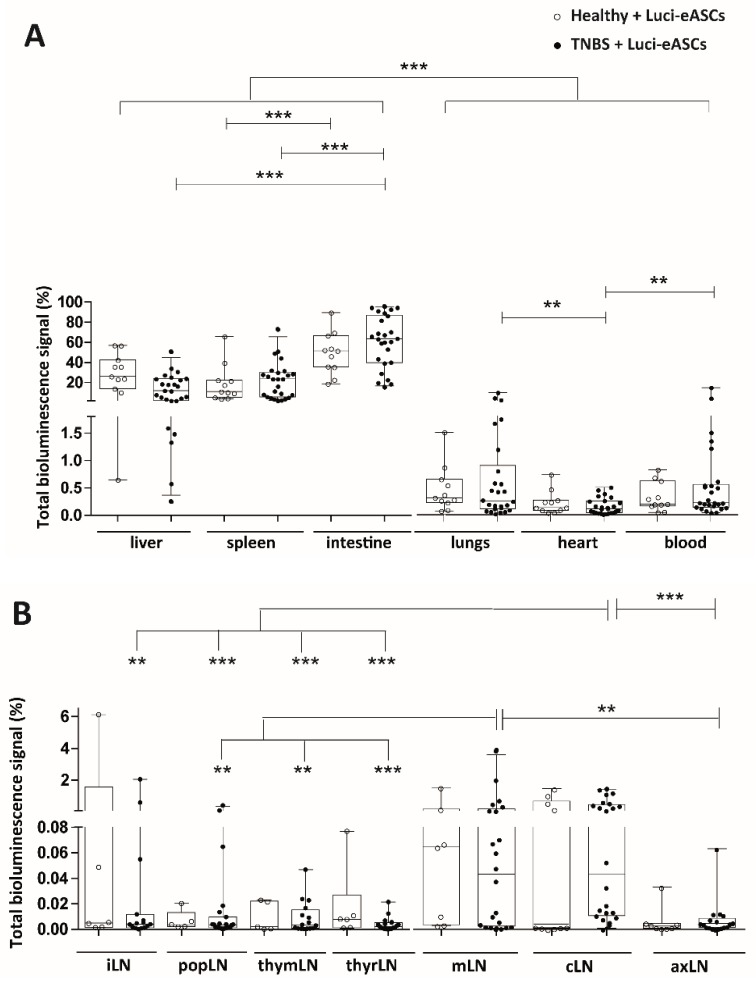
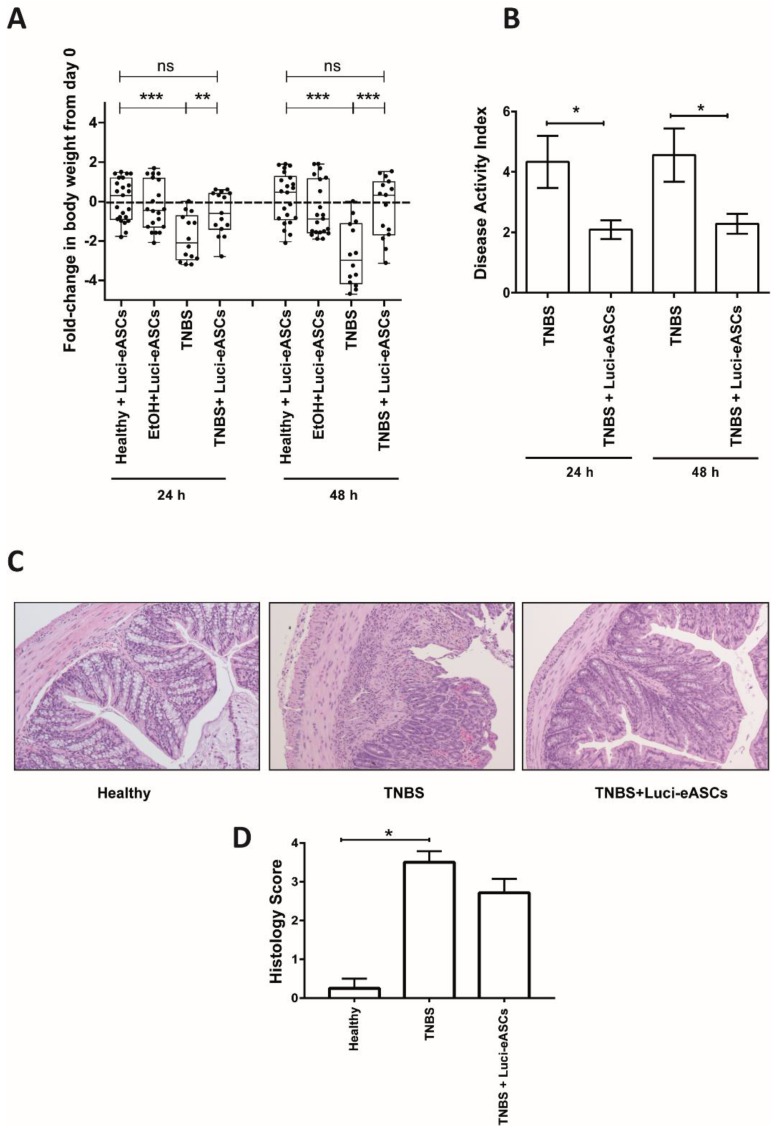
Mesenchymal stem cells (MSCs) have emerged as a promising treatment for inflammatory diseases. The immunomodulatory effect of MSCs takes place both by direct cell-to-cell contact and by means of soluble factors that leads to an increased accumulation of regulatory immune cells at the sites of inflammation. Similar efficacy of MSCs has been described regardless of the route of administration used, the inflammation conditions and the major histocompatibility complex context. These observations raise the question of whether the migration of the MSCs to the inflamed tissues is a pre-requisite to achieve their beneficial effect. To address this, we examined the biodistribution and the efficacy of intraperitoneal luciferase-expressing human expanded adipose-derived stem cells (Luci-eASCs) in a mouse model of colitis. Luci-eASC-infused mice were stratified according to their response to the Luci-eASC treatment. According to the stratification criteria, there was a tendency to increase the bioluminescence signal in the intestine at the expense of a decrease in the bioluminescence signal in the liver in the “responder” mice. These data thus suggest that the accumulation of the eASCs to the inflamed tissues is beneficial for achieving an optimal modulation of inflammation.
间充质干细胞 (MSCs) 已成为治疗炎症性疾病的一种有前途的方法。MSCs 的免疫调节作用既通过直接的细胞间接触,也通过可溶性因子来实现,这导致调节性免疫细胞在炎症部位的积累增加。无论使用何种给药途径、炎症条件和主要组织相容性复合体背景,MSCs 都具有相似的疗效。这些观察结果提出了一个问题,即 MSCs 是否向炎症组织迁移是实现其有益效果的先决条件。为了解决这个问题,我们在结肠炎小鼠模型中检查了腹腔内表达荧光素酶的人扩增脂肪来源干细胞 (Luci-eASC) 的分布和疗效。根据对 Luci-eASC 治疗的反应,对 Luci-eASC 输注的小鼠进行分层。根据分层标准,“应答者”小鼠的肠道内的生物发光信号有增加的趋势,而肝脏内的生物发光信号有减少的趋势。这些数据表明,eASC 向炎症组织的聚集有利于实现炎症的最佳调节。