Institute for Integrative Biology of the Cell, UMR9198, CNRS, Université Paris-Sud, CEA, Avenue de la Terrasse, 91198, Gif sur Yvette, France.
School of Agriculture Food and Wine, University of Adelaide, Glen Osmond, South Australia, 5064, Australia.
Sci Rep. 2018 Apr 9;8(1):5698. doi: 10.1038/s41598-018-23739-y.
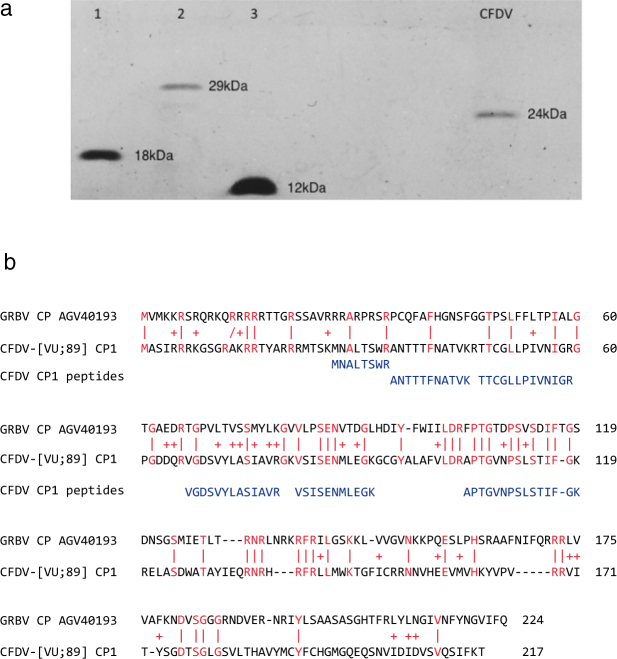
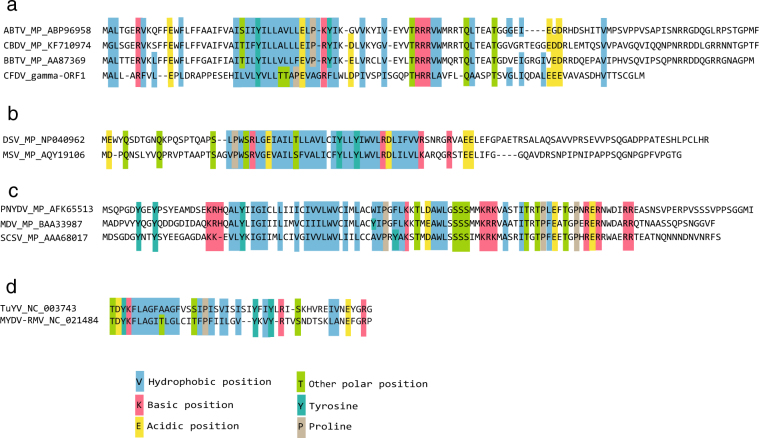
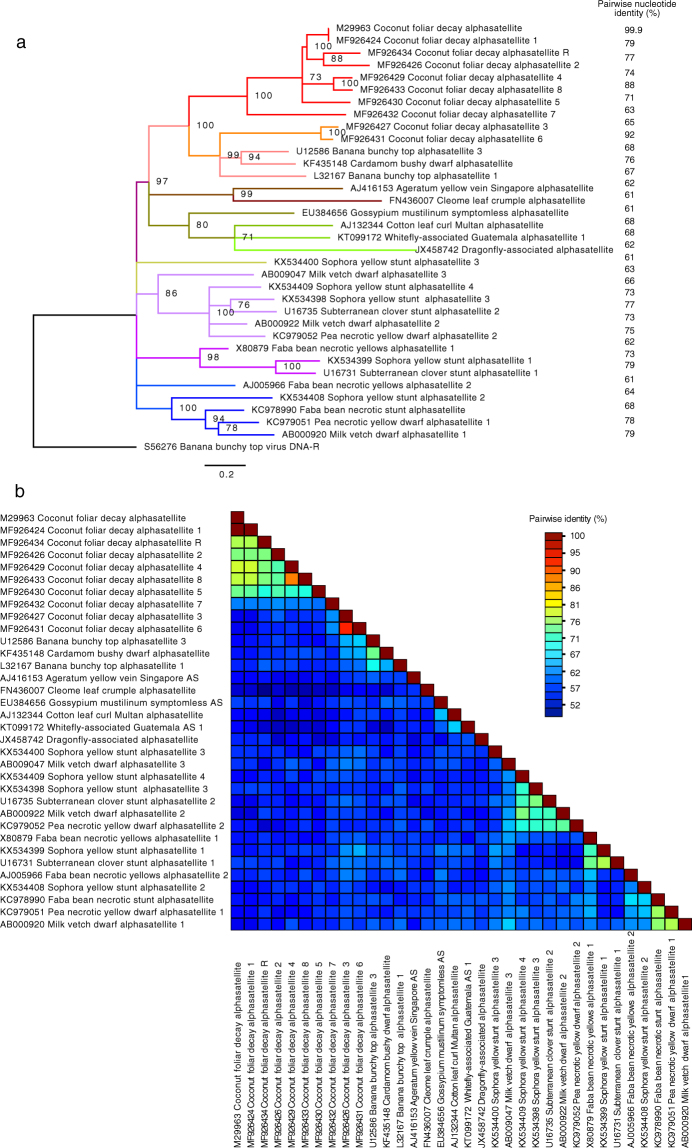
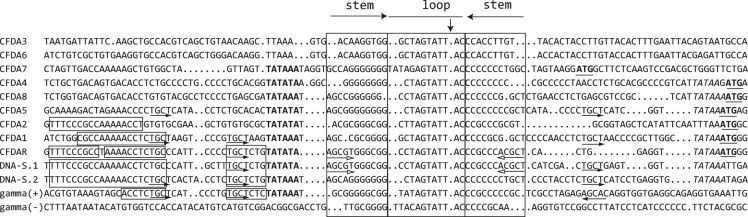
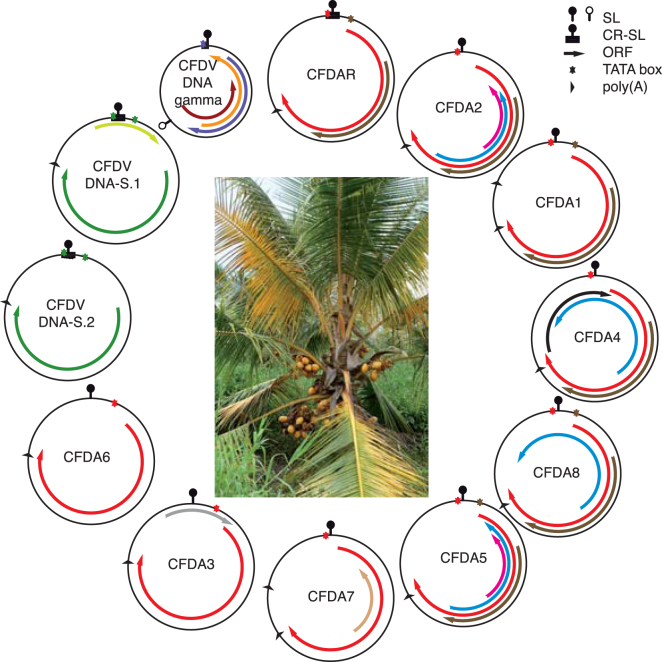
The unique ecology, pathology and undefined taxonomy of coconut foliar decay virus (CFDV), found associated with coconut foliar decay disease (CFD) in 1986, prompted analyses of old virus samples by modern methods. Rolling circle amplification and deep sequencing applied to nucleic acid extracts from virion preparations and CFD-affected palms identified twelve distinct circular DNAs, eleven of which had a size of about 1.3 kb and one of 641 nt. Mass spectrometry-based protein identification proved that a 24 kDa protein encoded by two 1.3 kb DNAs is the virus capsid protein with highest sequence similarity to that of grabloviruses (family Geminiviridae), even though CFDV particles are not geminate. The nine other 1.3 kb DNAs represent alphasatellites coding for replication initiator proteins that differ clearly from those encoded by nanovirid DNA-R. The 641 nt DNA-gamma is unique and may encode a movement protein. Three DNAs, alphasatellite CFDAR, capsid protein encoding CFDV DNA-S.1 and DNA-gamma share sequence motifs near their replication origins and were consistently present in all samples analysed. These DNAs appear to be integral components of a possibly tripartite CFDV genome, different from those of any Geminiviridae or Nanoviridae family member, implicating CFDV as representative of a new genus and family.
椰子叶片衰退病毒(CFDV)于 1986 年与椰子叶片衰退病(CFD)相关联,其独特的生态学、病理学和未定义的分类学促使人们用现代方法分析旧的病毒样本。对病毒制剂和 CFD 感染棕榈核酸提取物进行的滚环扩增和深度测序,鉴定出 12 种不同的环状 DNA,其中 11 种大小约为 1.3kb,一种为 641nt。基于质谱的蛋白质鉴定证明,由两个 1.3kb DNA 编码的 24kDa 蛋白是病毒衣壳蛋白,与双生病毒科(Geminiviridae 家族)的病毒衣壳蛋白具有最高的序列相似性,尽管 CFDV 颗粒不是双联体。其他 9 个 1.3kb DNA 代表复制起始蛋白的阿尔法卫星,与纳米病毒 DNA-R 编码的复制起始蛋白明显不同。641nt 的 DNA-γ是独特的,可能编码运动蛋白。三个 DNA,阿尔法卫星 CFDAR、衣壳蛋白编码 CFDV DNA-S.1 和 DNA-γ在它们的复制起点附近共享序列基序,并且始终存在于所有分析的样本中。这些 DNA 似乎是可能的三分体 CFDV 基因组的组成部分,与任何双生病毒科或纳米病毒科成员的基因组不同,这表明 CFDV 是一个新属和新科的代表。