University of Colorado Denver, Departments of Physical Medicine and Rehabilitation, Otolaryngology, and Psychiatry, Children's Hospital Colorado, Aurora, CO, USA.
University of Colorado Denver, Departments of Psychiatry and Pediatrics, Aurora, CO, USA.
Clin Neurophysiol. 2018 Jun;129(6):1148-1160. doi: 10.1016/j.clinph.2018.02.132. Epub 2018 Mar 16.
To examine the utility of the mismatch response (MMR) and acoustic change complex (ACC) for assessing speech discrimination in infants.
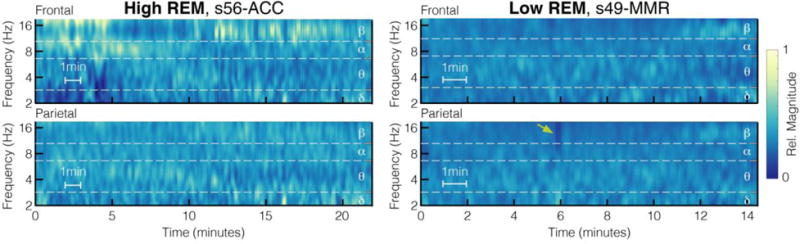
Continuous EEG was recorded during sleep from 48 (24 male, 20 female) normally hearing aged 1.77 to -4.57 months in response to two auditory discrimination tasks. ACC was recorded in response to a three-vowel sequence (/i/-/a/-/i/). MMR was recorded in response to a standard vowel, /a/, (probability 85%), and to a deviant vowel, /i/, (probability of 15%). A priori comparisons included: age, sex, and sleep state. These were conducted separately for each of the three bandpass filter settings were compared (1-18, 1-30, and 1-40 Hz).
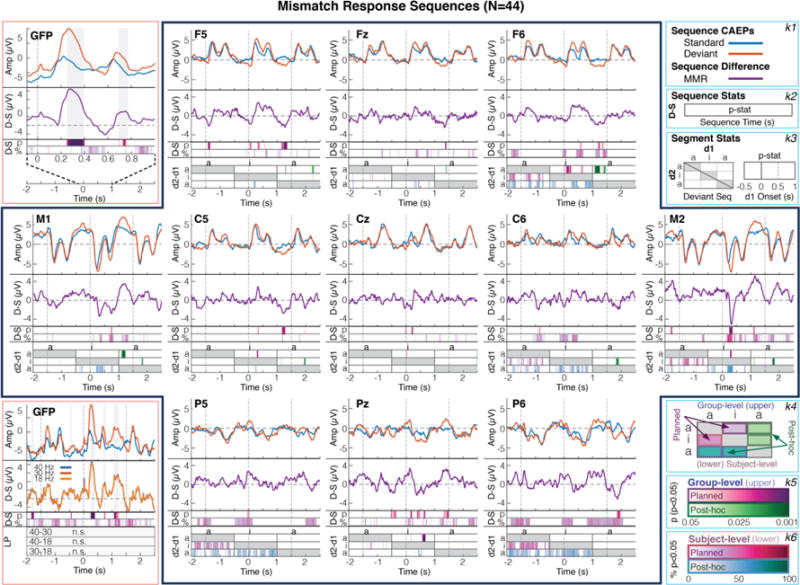
A priori tests revealed no differences in MMR or ACC for age, sex, or sleep state for any of the three filter settings. ACC and MMR responses were prominently observed in all 44 sleeping infants (data from four infants were excluded). Significant differences observed for ACC were to the onset and offset of stimuli. However, neither group nor individual differences were observed to changes in speech stimuli in the ACC. MMR revealed two prominent peaks occurring at the stimulus onset and at the stimulus offset. Permutation t-tests revealed significant differences between the standard and deviant stimuli for both the onset and offset MMR peaks (p < 0.01). The 1-18 Hz filter setting revealed significant differences for all participants in the MMR paradigm.
Both ACC and MMR responses were observed to auditory stimulation suggesting that infants perceive and process speech information even during sleep. Significant differences between the standard and deviant responses were observed in the MMR, but not ACC paradigm. These findings suggest that the MMR is sensitive to detecting auditory/speech discrimination processing.
This paper identified that MMR can be used to identify discrimination in normal hearing infants. This suggests that MMR has potential for use in infants with hearing loss to validate hearing aid fittings.
探讨失配响应(MMR)和听性变化复合(ACC)在评估婴儿言语辨别能力中的作用。
48 名(男 24 名,女 20 名)正常听力婴儿,年龄 1.77 至-4.57 个月,在睡眠期间连续记录脑电图,以响应两个听觉辨别任务。ACC 记录于三个元音序列(/i/-/a/-/i/)。MMR 记录于标准元音/a/(概率 85%)和变异元音/i/(概率 15%)。进行了预先比较:年龄、性别和睡眠状态。这些比较分别在三个带通滤波器设置(1-18、1-30 和 1-40 Hz)下进行。
预先测试显示,对于任何三种滤波器设置,年龄、性别或睡眠状态均不会导致 MMR 或 ACC 出现差异。在所有 44 名睡眠婴儿中都明显观察到了 ACC 和 MMR 的反应(排除了四名婴儿的数据)。观察到的 ACC 显著差异与刺激的开始和结束有关。然而,在 ACC 中,既没有观察到组间差异,也没有观察到言语刺激的个体差异。MMR 显示两个明显的峰出现在刺激的开始和结束时。置换 t 检验显示,在刺激开始和结束时,标准刺激和变异刺激之间的 MMR 峰值均有显著差异(p<0.01)。在 MMR 范式中,1-18 Hz 滤波器设置显示所有参与者均有显著差异。
在听觉刺激下观察到了 ACC 和 MMR 的反应,这表明婴儿即使在睡眠中也能感知和处理言语信息。在 MMR 中观察到标准和变异反应之间存在显著差异,但在 ACC 中没有观察到差异。这些发现表明,MMR 对检测听觉/言语辨别处理敏感。
本研究确定 MMR 可用于识别正常听力婴儿的辨别力。这表明 MMR 有可能用于听力损失婴儿,以验证助听器的适配情况。