Equity and Health Policy Research Group, Department of Public Health Sciences, Karolinska Institutet, SE 171 77, Stockholm, Sweden.
Stockholm County Council, Centre for Epidemiology and Community Medicine, Box 45436, 104 31, Stockholm, Sweden.
Int J Equity Health. 2018 Apr 10;17(1):42. doi: 10.1186/s12939-018-0756-6.
Health inequities among children in Sweden persist despite the country's well-developed welfare system and near universal access to the national child health care programme. A multisectoral extended home visiting intervention, based on the principles of proportionate universalism, has been carried out in a disadvantaged area since 2013. The present study investigates the content of the meetings between families and professionals during the home visits to gain a deeper understanding of how it relates to a health equity perspective on early childhood development.
Three child health care nurses documented 501 visits to the families of 98 children between 2013 and 2016. A qualitative data-driven conventional content analysis was performed on all data from the cycle of six visits per child, and a general content model was developed. Additional content analysis was carried out on the data from visits to families who experienced adverse situations or greater needs.
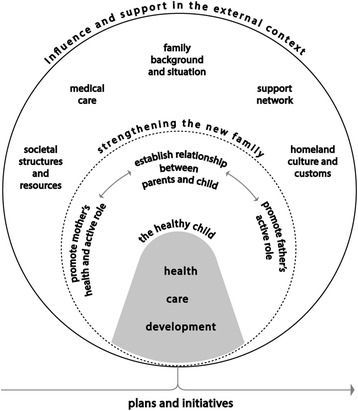
The analysis revealed that the home visits covered three main categories of content related to the health, care and development of the child; the strengthening of roles and relations within the new family unit; and the influence and support located in the broader external context around the family. The model of categories and sub-categories proved stable over all six visits. Families with extra needs received continuous attention to their additional issues during the visits, as well as the standard content described in the content model.
This study on home visiting implementation indicates that the participating families received programme content which covered all the domains of nurturing care as recommended by the WHO Commission on Social Determinants of Health and recent research. The content of the home visits can be understood to create enabling conditions for health equity effects. The intervention can be seen to represent a practical example of proportionate universalism.
尽管瑞典拥有发达的福利体系和近乎普及的国家儿童保健计划,但儿童健康不平等现象仍然存在。自 2013 年以来,在一个贫困地区开展了一项基于相称普遍主义原则的多部门扩展家访干预措施。本研究调查了家庭和专业人员在家访期间的会议内容,以更深入地了解其与儿童早期发展的健康公平视角的关系。
2013 年至 2016 年期间,三名儿童保健护士记录了 98 名儿童的 501 次家访。对每个孩子六次家访周期的所有数据进行了基于数据的定性常规内容分析,并开发了一个通用内容模型。对经历不利情况或更多需求的家庭的家访数据进行了额外的内容分析。
分析表明,家访涵盖了与儿童健康、护理和发展相关的三个主要类别;加强新家庭单位内的角色和关系;以及家庭周围更广泛的外部环境的影响和支持。类别和子类别模型在所有六次家访中都保持稳定。有额外需求的家庭在访问期间会持续关注他们的额外问题,以及内容模型中描述的标准内容。
这项关于家访实施的研究表明,参与的家庭收到了涵盖世界卫生组织社会决定因素健康委员会和最近研究推荐的所有养育关怀领域的方案内容。家访的内容可以理解为为健康公平效果创造有利条件。该干预措施可以被视为相称普遍主义的一个实际例子。